Showing posts with label Building Techniques. Show all posts

History of Architecture: The Ancient Pyramids to the Steel Buildings of Today

on 12 January 2012

History of Architecture
The Ancient Pyramids to the Steel Buildings of Today 
Guest Blog by Simon Marshall

Architecture is a practice that has been around since before recorded history and the reasons for constructing distinctive, enormous and aesthetically pleasing structures has varied. Some of the greatest architectural achievements have come to symbolize ideas and even entire nations.

Egyptian

One of the most striking forms of architecture is that of the buildings constructed by the Ancient Egyptians, especially the pyramids. Pyramid construction began around 2,700 B.C. and continued for a thousand years. The Great Pyramid at Giza is believed to have taken 23 years and required 20,000 to 30,000 laborers. A committee was responsible for the pyramid construction, which included an architect, overseer of construction and a chief engineer.
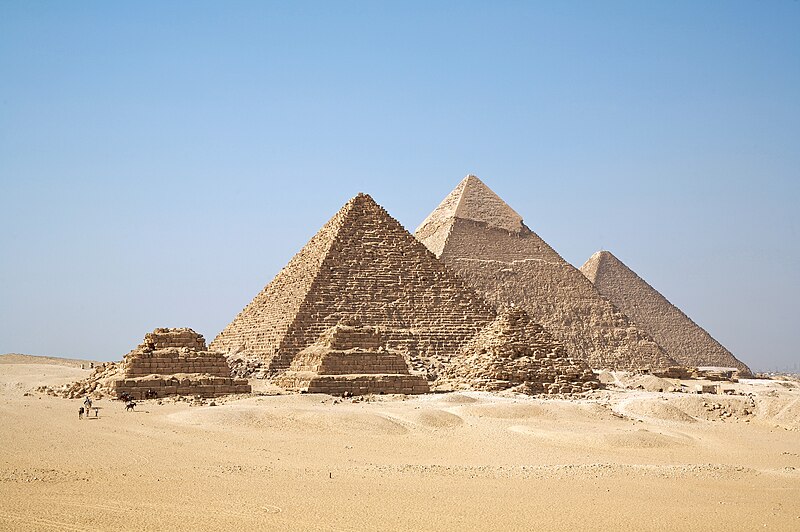
The Pyramids of Giza
Image courtesy of Ricardo Liberato, Wikipedia Commons
The pyramid cores were made from cheaper limestone, while the outer layers was made from finer limestone. The capstone was made from basalt, granite or a hard stone that was plated with a precious metal, such as silver, gold or electrum.

Copper chisels were used to quarry limestone and sandstone. Harder stones included granite and diorite. A very hard rock called dolerite was used to pulverize granite near the edge that would be extracted using about 65 men. Then, wooden pegs were jammed into the slots that opened up from the dolerite pounding and the slots were then filled with water. The pegs would then expand and split the granite, allowing it to be slid on to a boat. The slipway on which the stones were dragged was lubricated with oil so that the stones slipped more easily. The stones were dragged into position using ramps constructed from mud brick and covered with plaster chips.

One major issue that the master architect must have faced was the act of communicating precise construction plans for over 20,000 workers. However, Ole J. Bryn, an architect and associate professor, speculates that the Egyptians had developed their own building grid that allowed the architect to project the pyramid by simply understanding its dimensions.

Greek

Many Greek structures built prior to the 5th century B.C. were made using crude stones. The structures were coated with marble dust and lime. When the Greeks began using marble, they still coated the marble with the same coating.

The Parthenon
Image courtesy of Steve Swayne, Wikipedia Commons
The most well known temple is the Parthenon, which is viewed as a symbol of Ancient Greece and was built in 438 BC. It had a rectangular floor plan and had a series of steps on both sides. The most distinctive feature is that of the Doric columns. The temple consisted of two rooms, with the larger of the two containing a cult statue. The smaller room was the treasury. The Doric columns are a type of order that consists of triglyphs and metopes on the entablature. Each metope has a panel of relief sculpture. Various other relief sculptures are found throughout.

Roman

The Romans were also known for their architecture. The Colosseum was the most significant entertainment center of Ancient Rome and was used to hold gladiatorial combat, mock battles and dramas. It was completed in 80 AD and was able to seat 50,000 spectators. It has an elliptical shape and consists of three floors made of travertine stone. The fourth floor consisted of windows. Emperor Vespasian had the Colosseum constructed after the end of Nero's rule as a way to appease the people.

The Colosseum
Image courtesy of David Iliff. License: CC-BY-SA 3.0
Another significant architectural feature was the aqueduct, which continues to survive today. The aqueducts were constructed to transport water across gaps and the greatest one, found near Sierra de Guadarrama, is 2950 feet long.

Gothic

The Great Cathedrals were built during the Gothic architectural period between 1,100 and 1,450 AD. These were often structures that were much larger than what was normally possible at the time. They were constructed to symbolize a ship carrying people of God, with the roof constructed in a way that was similar to the hull of a ship.

The structure consists of a nave that is braced by lower aisles. The aisles are separated by rows of columns and serve to buttress the inner walls, which hold the roof. They were made from stone. There was also a crossing, which was the point where the transept and the nave intersected. On the outside, the crossing appeared as a dome. From the inside, occupants can see piers and arches, which supported the weight of the dome. Later Gothic cathedrals were lighter and were supported by flying buttresses.

Reims Cathedral
Image courtesy of Bodoklecksel, Wikipedia Commons
Nave of Reims Cathedral looking west. The upper Rose Window is in  Gothic architecture Rayonnant style.
Image courtesy of Vassil, Wikipedia Commons

Medieval

Castles were constructed throughout the Middle Ages. The largest castle ever constructed was the Malbork Castle in Poland, which was stolen from the Polish by the Teutonic Knights. This castle was finished in 1406, making it the largest castle in the world in terms of surface area. The building was so well-designed that much of it remained standing after World War 2, when it was used as a battling ground between the Germans and Soviets.
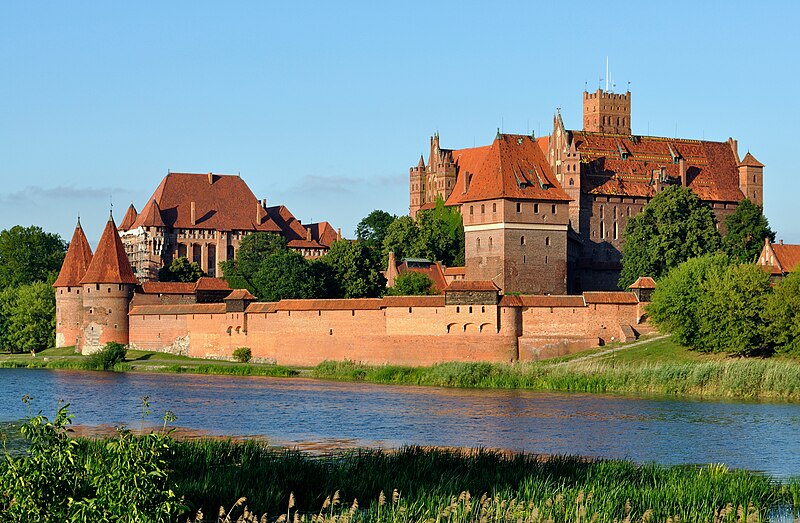
Malbork Castle
Image courtesy of DerHexer, derivative work of Carschten, Wikipedia Commons
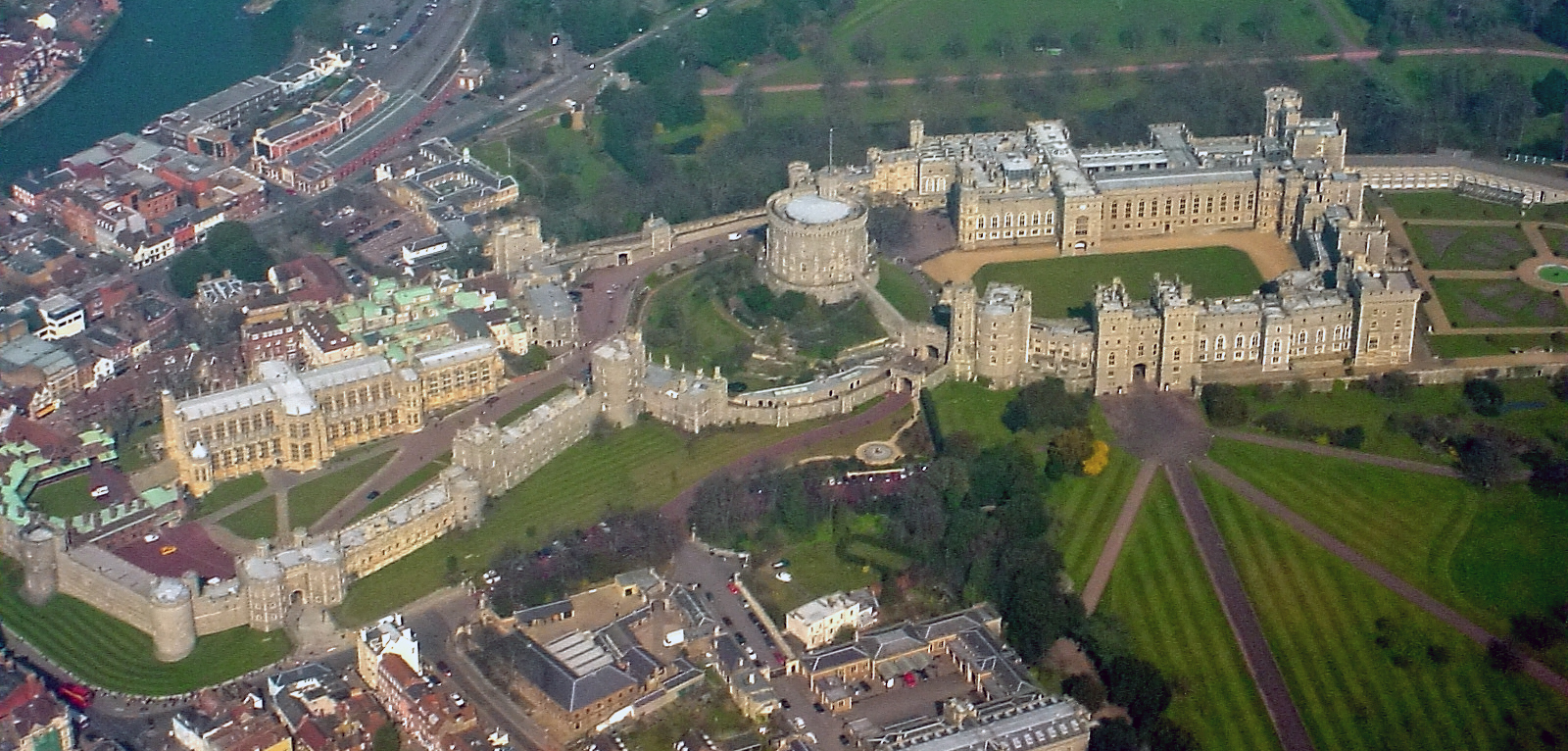
Castles did not have set standards for how they were built and were constructed based on the needs of the community. The motte-and-bailey fortress was the most common type of castle, which consisted of a circular ditch with wooden palisades at the edge of the ditch, with a wooden tower constructed on the top of a mound. The more iconic stone castles were constructed mostly by the wealthy. Originally, the castles were not meant to be lived in and were instead used as a last place to retreat when defending against invaders. Stone castles became more common in the 1100s and many castles became large enough for the entire community to live in.

Windsor Castle: motte (center) and two baileys (left and right)
Image courtesy of Mark S Jobling, derivative work of Hchc2009, Wikipedia Commons

Neoclassical

Between the 1730s and 1925s, Classical architectural ideas became popular once again, as seen in many of the buildings located in Washington DC. The classical buildings were constructed to match the Roman and Greek legal and political ideals that form the foundation of the US constitution and political system.

The White House itself was a Georgian estate that was transformed into a Neoclassical mansion when architect Benjamin Henry Latrobe added the portico in 1824. Many of the other buildings, including the US Capitol building, were created through a competition carried out between different designers, most of whom submitted designs inspired by the Renaissance. However, three of the buildings had classical inspirations, which Thomas Jefferson preferred. It was his suggestion that the Capitol look like the Roman Pantheon.

Another distinct piece of architecture is the Washington Monument, which is the world's tallest stone obelisk. Architect Robert Mills designed the monument in the 1840s and it was not finished until 1884.

COLCKWISE FROM TOP LEFT: Lincoln Memorial, Washington Monument, OAS Building,
World War II Memorial, Meridian Hill Park, U.S. Capitol, Memorial Bridge, White House
Image courtesy of Andrew G. Clem

Modern

Modern steel buildings are the tallest structures that can be constructed. The first skyscrapers were built in the 1880s when 10 to 20 story buildings were constructed. In 1855, Sir Henry Bessemer developed a process for refining and strengthening raw iron that allowed much larger buildings to be supported. Prior to the development of steel, taller buildings were constructed using solid concrete, which had to be very thick to support the weight of the structure.

The steel serves as a skeleton for the building, holding everything else up and together. While concrete is not the main supporter of the building's weight, it is still used in skyscraper construction.

Burj Khalifa
Image courtesy of Wikipedia
Most modern steel buildings are designed using computer software, since a building that would take a structural engineer months to design can be finished in one day. The architect designs the building and the structural engineer is responsible for determining what needs to be done to meet the architect's requirements. The engineer performs mathematical calculations  to  determine  where  the  framework,  beams,  columns,  girders,  trusses  and bracing go. Braces are placed in strategic areas to provide additional support for the area of a load. Joints and nodes connect structural elements together. The steel structure is built on a concrete foundation with anchor bolts that are embedded into the concrete. They are also connected to column base plates with washers and nuts. Most of the recent developments in steel buildings have resulted from a need to construct buildings that are resistant to earthquakes.

Since 2010, the world's tallest building has been Dubai's Burj Khalifa, whose chief architect was Skidmore, Owings and Merrill. The building was constructed during the global financial crisis of 2007-10 and most of the apartments in the building are currently vacant. The building's design was derived from a patterning system that comes from Islamic architecture. It is 2,723 feet tall.

This article was written by Simon Marshall, CEO of Buildingsguide.com, a leading online resource for steel and metal building information, buying guides, and in-depth research.

Civilizations Around the World: The Inca

on 11 January 2012


The Inca Empire: Rise and Fall


The Inca Empire
Image courtesy of EuroHistory Teacher, Wikipedia Commons

The Incas began as a hill tribe from Peru. Over a course of 300 years, they dominated the whole area of the Andes mountains.

By the 1500s, their empire became known as Tawantinsuyu, “The Four United Provinces” in Quencha, the language of the people of the central Andes of South America.

Their four provinces (or suyu in Quencha) include ChinchaySuyu, AntiSuyu, KuntiSuyu, QullaSuyu, and the coners of these provinces meet at the center, Cusco, the Inca capital. 


Religion and Culture
The Inca referred to themselves as “children of the Sun,” as they belived they were descendents of the sun god, Inti. Other than Inti, they worshiped many gods that relate to nature:
  • Viracocha (also Pachacamac) - Created all living beings
  • Apu Illapu - Rain God, prayed to when they need rain
  • Ayar Cachi - Hot-tempered God, causes earthquakes
  • Illapa - Goddess of lightning and thunder (also Yakumama water goddess)
  • Inti - sun god and patron deity of the holy city of Cuzco (home of the sun)
  • Kuychi - Rainbow God, connected with fertility
  • Mama Kilya - Wife of Inti, called Moon Mother
  • Mama Occlo - Wisdom to civilize the people, taught women to weave cloth, and build houses
  • Manco Cápac - known for his courage and sent to earth to become first king of the Incas, taught people how to grow plants, make weapons, work together, share resources, and worship the Gods
  • Pachamama - The Goddess of earth and wife of Viracocha, people give her offerings of coca leafs and beer and pray to her for major agricultural occasions
  • Qochamama - Goddess of the sea
  • Sachamama - Means Mother Tree, goddess in the shape of a snake with two heads
  • Yakumama - Means mother Water, represented as a snake, when she came to earth she transformed into a great river (also Illapa)
They worshiped their deities daily because they believed without doing so the gods would intervene and cause problems. The Incas also worshiped huacas - sacred places or objects. A huaca could range from being a large building or a tiny toy statue. Every family had a huaca amd would offer it daily prayers. Priests performed daily ceremonies at the temples, offering prayers to the huacas in their care.

The Inca believed in the afterlife and mummified their dead like the ancient Egyptians. Those who obeyed the Incan moral code — ama suwa, ama llulla, ama quella (do not steal, do not lie, do not be lazy) — "went to live in the Sun's warmth while others spent their eternal days in the cold earth." The mummies of dead rulers remained in their palaces and were treated as if they were still alive. They were brought offerings and were paraded through the streets on special occasions.

The Inca practiced cranial deformation. They would wrap tight cloth straps around the heads of newborns in order to alter the shape of their soft skulls into a more conical form; this cranial deformation was made to distinguish the nobility apart from the common people.

Once and every month, the Incas held a major religious festival. Festivals were held outside and included many kinds of games, songs, dancing, food, parades, and sacrifice (of animals usually). If something special was happening, like the crowning of a new emperor or a drought, the Incas would include human sacrifice as part of the festival. The biggest and most important festivity held once a year during the winter solstice of the southern hemisphere was Inti Raymi, the feast of the sun The "Inti Raymi" or "Sun Festivity". It was aimed to worship the "Apu Inti" (Sun God) in the great Cuzco Main Plaza.

Architecture
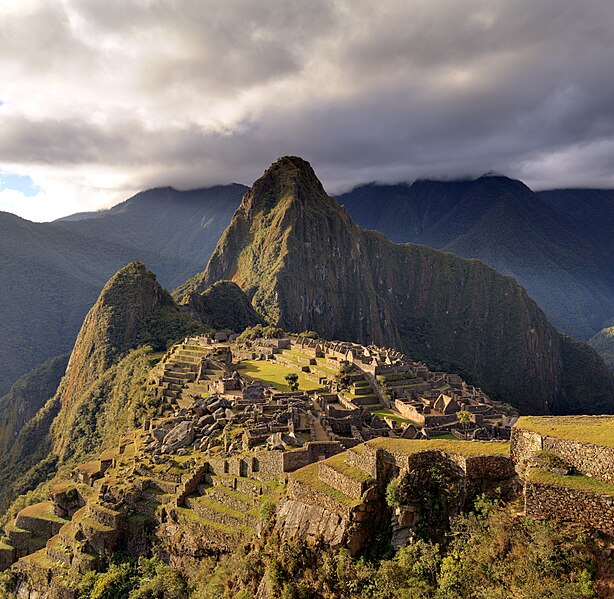
By far the best example of Inca architecture is the breath taking site of Machu Picchu:  
Machu Picchu, Image courtesy of Martin St-Amant, Wikipedia Commons
Inca buildings were constructed of white granite or limestone. The temples were constructed without any use or mortar because the stone block fit together so perfectly. The stones that were used fit together because they were sculpted by repeatedly lowering a rock onto another rock and carving away any sections on the lower rock. Another technique used was narrowing of the top than at the bottom of walls of temples and palaces. They are not perpendicular but slope slightly inward. The doors of Inca houses were usually high and trapezoidal shape. As in ancient Egypt, the bottom of the door is wider than the top.
Pictures of the exterior wall of the Inca fortress of Sacsayhuaman, showing how the huge pieces of rock fit perfectly.
Image courtesy of Christophe Meneboeuf, Wikipedia Commons 
Stone wall, Image courtesy of Rutahsa Adventures
Doorway, Image courtesy of Lonely Planet Images

Social Order and Politics
The social order of the Inca varied from area to area, but it maintained the same basic structure. On top were the Sapa Inca. Inca translates to emperor, sapa means only - so Sapa Inca means "Only Ruler". Then came the nobles, these were often the priests and relatives of past emperors or the current ones. After, there were craftsmen and architects; they were very high on the social ladder because of their skills valued by the Empire. Then came the working class, often just farmers. After this, were the slaves and peasants of the society.
Inca empire expansion
Image courtesy of Spesh531, Wikipedia Commons
When the Chancas attacked, in the early 15th century, and Cusi Yupanqui took over his father's throne, Viracocha Inca, he managed to put the empire back together under the name of Pachacuti in alliance with his son Tupac Inca. With this, Tawantinsuyu was born.
"Through threat, negotiation, or actual bloody conquest, they subjugated new provinces, determined the number of tax-paying peasants, installed a local Inca governor, and then left an administration in place that was empowered to supervise and collect taxes before armies moved on. If cooperative, the local elites were allowed to retain their privileged positions and were rewarded handsomely for their collaboration. If uncooperative, the Incas exterminated them and wiped out their supporters. Peasants were a crop, a crop that could be harvested through periodic taxation. Docile, obedient workers who created surpluses, in fact, were more valuable than any of the ...potatoes...llamas...and alpacas..." - Kim MacQuarrie, "The Last Days of the Incas," pg. 45


Gold figurines, Image courtesy of Geyman.com
Art
The Inca sculpted pottery and ceramics which featured geometric designs painted in black, red, brown, yellow, and white. Metalworkers excelled making ornaments, tools, and weapons out silver, copper, gold, and bronze. Female statues are found with Inca offerings to the gods. Because llamas were very important in the Andean region, lots of stylized llama figures were made by metalworkers. 


Wooden llama, Image courtesy of lrb.com
Metal artwork is scarce. Spanish conquistadores took it upon themselves to melt down as much gold and silver as possible to send back to Spain. 

The Mystery of Machu Picchu
On July 24, 1911, Hiram Bingham (with the help of local Indians) stumbled upon what he believed was Vilcabamba, the lost city of the Inca where the last of the independent Inca rulers waged a years-long battle against the Spanish -- but what he found was not the lost city, but a forgotten city.

Since the Inca did not develop a writing system (they used a knotting system known as the quipu), they did not leave behind any documented clues on what the purpose of the location was. Bingham had to rely on excavating to determine what Machu Picchu was. At first he had belived it was some kind of a training ground for women since most skeletal remains found was mostly female (later analysis proved it was fifty-fifty male and female). The latest accepted idea (2007) is that this marvelous city, in fact, was a royal estate of Pachacuti.
"To commemorate his conquest of the Vilcabamba Valley, Pachacuti ordered that his third royal estate be built, this one very near the Chuquichaca bridge, on a high ridge overlooking what is now called the Urubamba River. The Inacas apparently called the new site Picchu, meaning 'peak.' Since the proposed citadel and nearby satellite communities were planned from the start to form a part of a luxurious private estate, the entire complex would display some of the finest examples of Inca engineering and art. [...] The citadel of Machu Picchu was thus the third and perhaps the most important jewel in the crown of architectural monuments that Pachacuti had created, after Pisac and Ollantaytambo." - Kim MacQuarrie, "The Last Days of the Incas," pg. 441, 443
Excavation at Machu Picchu is still continuing but any further evidence regarding the purpose of the location is highly unlikely. The best clues scientist and archaeologist have is only the remains that can reveal the reasons for its construction, the activities that took place long ago on the peak along the Urubamba River.

Learn more about the Incas!
Here are our recommendations:
  

References:

Jones, David M. The Myths & Religion of the Incas. UK: Southwater, 2008.
MacQuarrie, Kim. The Last Days of the Incas. UK: Piatkus, 2007.
"National Geographic Photo Gallery--Inca Culture." National Geographic. Web. 08 Jan. 2012. 
Williams, Bill. "The Incredible Incas for Kids." The Incredible Incas for Kids. Web. 08 Jan. 2012. 


Profile-photo

About the Author


I'm Jose Pierre and I like learning about all aspects of culture, both ancient and modern. I enjoy learning how they communicated, expressed themselves, and their technology.

Share This

Never miss an article, subscribe here!

Credits & Policies

Banner created by Melanie Magdalena.

Images courtesy of: Ricardo Liberato (Pyramids of Giza), Aurbina (Moai), Maria Reiche (Nazca), Zunkir (Gobekli Tepe), Bjorn Christian Torrissen (Chichen Itza), Gareth Wiscombe (Stonehenge).

Images were released to the public and/or licensed under Creative Commons.

Editor's Note

Welcome to BermudaQuest, a free online journal primarily about Archaeology, Ancient History, and stories about different cultures from around the world.

Founded by Melanie E Magdalena, BermudaQuest and Origins (our magazine) have over a million readers! We would love to include your insight, experience, photos, and thoughts about your culture, heritage, and travels. Make sure you check out Origins, with over 4 million readers!