Showing posts with label Archaeology. Show all posts

Across the Zooniverse

on 24 April 2013

Telescope View of Sky from Big Hill, NSW. [Ryan Wick, Flickr]

Keeping an eye on citizen astronomy


Amateur astronomers in Russia made a discovery last week any professional would envy – it seems they may have identified the remnants of the ill-fated Soviet Mars 3 lander, 30 years after it lost contact with Earth.

Photos taken by the High Resolution Imaging Science Experiment (HiRISE) camera on NASA’s Mars Reconnaissance Orbiter (MRO) in 2007 show what appears to be the parachute, heat shield, and retrorocket of the Mars 3 lander.

But finding object as small as an 11-metre-wide parachute on the surface of Mars takes a lot of work, especially as the most promising photo – a section of which is below – contains 1.2 billion pixels and requires 2,500 computer screens to view the entire image at full resolution.

The possible Mars 3 lander hardware was found by a group of Russian citizen enthusiasts.
[NASA/JPL-Caltech/University of Arizona]

This is the most recent example of how citizen science is blossoming – and getting results – within the field of astronomy. There is a wealth of amateurs who pursue backyard observations as a hobby and their efforts make headlines worldwide. Some have historically contributed to science by finding comets, tracking asteroids, the Search for Extraterrestrial Intelligence (SETI) program, and monitoring stars.

The Soviet Mars 3 lander before venturing
to Mars in 1971. [Armael, Wikimedia Commons]
One of the most visible citizen-science projects in astronomy and astrophysics is the “Zooniverse” which invites members of the public to analyse data ranging from determining the shape of galaxies to trying to detect if any planets outside our solar system orbit stars.

The Galaxy Zoo


The Zooniverse project grew out of the Galaxy Zoo project which was set up to determine the shape, or morphology, of galaxies.

Galaxy shape is a useful visual indicator to professional astronomers about the state of the galaxy and the physical processes which may be going on inside it.

While there are many types of galaxy shapes, bright galaxies usually fall into one of three categories:
     • spiral
     • elliptical
     • irregular

The Sloan Digital Sky Survey, an internationally funded project to map the sky, photographed and mapped more than 930,000 galaxies over eight years.

Faced with an overwhelming amount of data to sift through, astronomers conceived of the Galaxy Zoo idea to ask the general public for help to look through all the data and classify the shapes of galaxies.

Three main galaxy shapes (from left): spiral galaxy PIA09337, elliptical galaxy NGC 1316, and irregular galaxy NGC 3738.
[NASA]
Since this requires little background knowledge, any member of the public can help so long as they have an internet connection.

Using a simple, clickable interface, users can say whether galaxies are rounded, have spiral arms, have any unusual or distinguishing features, or whether they want to discuss the objects in more detail.

This is especially important in a data-rich field like astronomy: users can sometimes be the first human being to actually look at a galaxy since most of the processing of the images they examine have been done by computers.

Getting the numbers up


For all the excellent work done by the general public, there will still be disagreement about the exact classification of galaxy shapes – and this, fundamentally, raises questions about data integrity.
[Gwydion M. Williams]

This is why the Galaxy Zoo project aims to have at least 20 people attempt to classify each galaxy.

To use the data in professional research, astronomers have to look for disagreements between members of the general public.

Taking a threshold level is one way to solve the problem. If, say, 80% of respondents say a galaxy is a particular shape, that is a reasonable way forward and is perfectly suitable for some analysis purposes.

The cost of this may be that there is a high number of “unclassified” galaxies where there is large disagreement, perhaps caused by very few individuals having looked at a galaxy.

And the results are …


There have been a healthy number of scientific publications arising from the Galaxy Zoo project team, including the relationship between galaxy colour and environment and studies of highly unusual objects such as “Hanny’s Voorwerp” – a possible light echo from quasars (the brightest objects in the known universe).
[NASA]

In my own research, we recently used data from Galaxy Zoo to explore the connection between galaxy morphology, galaxy mass, and the likelihood of hosting an Active Galactic Nucleus (AGN) in a massive cluster of galaxies – a collection of gravitationally bound galaxies and one of the most extreme “environments” in which a galaxy can live.

We used the data to explain an earlier result that red and passive spiral galaxies are, in the majority, also massive and similar in nature to most of the massive elliptically shaped cluster galaxies.

We then inferred that the life cycle of high and low mass cluster galaxies are markedly different.

But we wouldn’t have been able to make these conclusions without the citizen scientists who classified the bulk of the data for us – something for which we are extremely appreciative.

And who knows? As shown by the Russian amateur astronomers sifting through NASA’s high-resolution photos, the next big astronomy discovery could be made by you.

Profile-photo
About the Author

Kevin Pimbblet, from Monash University, is an experienced observational astronomer whose core research interests cover a number of modern topics in extra-galactic astrophysics, large-scale structure of the Universe and cosmology.
Kevin Pimbblet receives funding from the Australian Research Council.
This article was originally published at The Conversation. Read the original article.

Space Archaeology

on 23 April 2013

Space archaeology is a recent research method scientists
FlyingSinger, Flickr.com, CC BY 2.0
have begun using in order to evaluate man-made items found across the galaxy. These artifacts can range from orbital debris, satellites, and other various objects humans have placed on the Moon and Mars. Through these artifacts we keep track of and discover in space we monitor and interpret the adventures of man as we travel into the world beyond. 

The cultural resource or heritage management is in charge of evaluating the significance of space sites and artifacts according to national and inter-national preservation laws. They examine how and why these outer space artifacts and sites of our recent history should be preserved for our future generations to view. For example, they decide on whether or not the site where Neil Armstrong landed on the Moon should be preserved so that we can see the first steps man made on the moon. 


NASA Goddard Photo and Video, Flickr.com, CC BY 2.0

People like Beth O’Leary, an associate professor of Anthropology at New Mexico State University (NMSU) and co-editor of the handbook of space engineering, archaeology, and heritage, have dedicated themselves to preserve the many artifacts on the moon. One site she had dedicated herself in watching over is the flag and the footprint of Neil Armstrong left to prove he walked on the Moon. With a grant from NASA, O’Leary helped establish the Lunar Legacy Project; which aims to preserve the historical information found at Tranquility Base. She previously stated, “We need to prepare for the future because in fifty years many travelers may go to the moon, if the site is not protected, what will be left?”

Idaho National Library, Flickr.com, CC BY 2.0
There are artifacts left behind in space other than those found on the Moon and Mars, but some of them threaten the safety of Earth. Since some of these artifacts, like low orbiting satellites and stations, currently run the risk of impacting each other and other space objects; instead of them being labeled as our cultural heritage they are considered space junk. An informed decision on the risk of letting them continue to orbit or destroying them should be made while keeping their international and historical significance in mind.

Because of the global safety dilemma there is the potential of parts of space archaeological record being destroyed and possibly forgotten. The question of which artifacts are culturally important and which are not is being asked, but how exactly are we suppose to answer. As humans living in the world today we have no idea what artifacts will have relevance and which will not in the future. Making us run the risk of leaving a missing link in our record of space exploration. For example, Wall-E from the Disney movie, feeds his curiosity by examining items he comes across in the mountains of trash left by the humans. He finds a woman’s bra and begins examining it and placing it on his head as a hat and over his eyes as a blindfold, confused about what the primary purpose of his finding was. Will we be just as confused when looking at the space artifacts we left behind in the future?

Ancient Oklahoma

on 19 April 2013

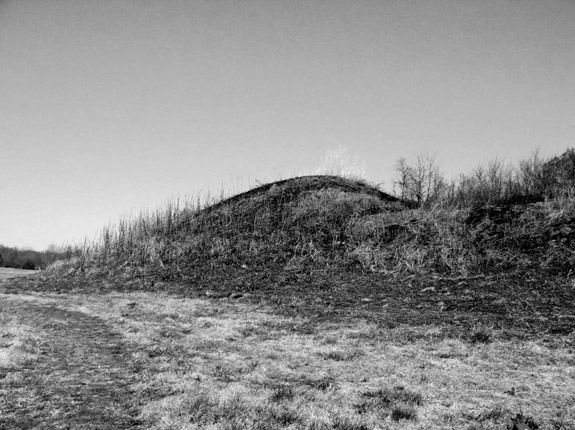
The Spiro Mounds of Oklahoma are only a few miles away from the city Spiro. The mound site consists of 12 mounds, an elite village, and a support village within 150 acres of land. Originally in prehistoric times the mounds area was home mostly to nomads, but as cultures and society began to emerge when ancient people began to become sedentary the Spiro Mounds also transformed into what they are today. By 800 BCE the Spiro Mounds became a permanent settlement that was used until 1450 BCE.

Heironymous Rowe, commons.wikimedia.org,  CC BY-SA 3.0

Heironymous Rowe, commons.wikimedia.org, CC BY-SA 3.0
During that time period, which is typically called the Mississippian period the Spiro culture flourished. Archaeological evidence shows that Spiro culture had economic, political, and religious all the way from the Great Lakes to the east coast and the Gulf of Mexico to the Gulf of California. They had an extensive religious center developed as well as a highly developed trade network. The Spiro political system was also able to exert total control over the entire South East. In its height the Spiro people shared an iconographic writing system with over 60 other tribes along with horticulture and extensive ceremonies.

No one is certain as to why the Spiro Mounds were abandoned or why the culture declined, but it was probably caused by a number of environmental, cultural, and political factors. Today the Spiro Mounds are available for the public to explore and at the Spiro Mounds Archaeological Center many artifacts including artistic and utilitarian prehistoric Native American artifacts.

To Find Out More Check Out: http://www.okhistory.org/sites/spiromounds

[From the Archive] The World's First Art Studio?

on 10 March 2013

Birth of bling: world's first art studio found in South Africa

By Peter Hiscock

Could we have found the first artist’s studio in human history? We may well have.

We all recognise the material signs of wealth. Fast cars, large yachts and sparkling bling all tell us who has more. Crowns, insignia, mayoral gowns are material signs of rank or status.

Archaeologists have long pondered when these public displays of social difference first occurred. Emerging evidence suggests the antiquity of public symbolism is surprisingly great.

Bansky's Caveman, by Stefan Kloo (Lord Jim)
[Flickr, CC BY-2.0]

Indeed, the symbolism of social difference seems to have been present from the earliest period of our species existence. The rise of Homo sapiens may even have been linked to the use of public symbols.

Recent work in southern Africa, published today in Science, is helping archaeologists clarify the early history of painting and its use in creating symbols.

Discoveries at Blombos Cave


The latest discovery comes from Blombos Cave, a large cavern located on the southern African coast, south-east of Cape Town.


Location of Blombos Cave, archaeological site
[Vincent Mourre, Wikimedia Commons, CC BY-SA 3.0]

Here a team, led by Christopher Henshilwood of the University of Bergen and Francesco d’Errico from the Université de Bordeaux, has found a 100,000 year old artist’s workshop.

Excavations of the deep sediments piled up in the cave have regularly yielded surprising finds. Archaeologists have previously recovered standardised bone tools, perhaps awls, and delicately-shaped tools of stone projectile points dated to 70,000 years ago.

Henshilwood and his colleagues suggest these tools show ancient artisans were able to plan and create a sophisticated technology.

Even more revealing is the presence of ochre, natural iron-rich rock that can be ground into powder and used as paint. Archaeologists have long suspected pieces of ochre with abraded facets in those early times might indicate paintings of some kind, on rocks, wooden artefacts or even human bodies.

Since 70,000-year-old ochre slabs have geometric engravings on their surface, it is clear early humans were artistic, but until now archaeologists could not be sure they were painters.

The world’s first studio


Now Blombos has yielded new materials that reveal the earliest artist’s workshop.

In a layer 100,000 years old, Henshilwood excavated two containers, which are probably artist’s palettes or mixing-bowls, and associated tools.

Each palette or bowl is a large abalone shell containing a residue of ochre, burnt bone and other materials that had been ground up and combined with some fluid into a vibrant red paste.


One of these containers also contained a small grinding stone and a number of bone fragments that had been used to stir the paste.

The other container was associated with fragments of ochre, in this case red ferruginous siltstone, that had been abraded to create the red powder and the grinding stones on which they had been rubbed.

Henshilwood speculates that for a short period about 100 millennia ago, the site was used primarily as a workshop for preparing and using the paint mixtures.

Why paint?


Henshilwood and his team think this early painting workshop may be an example of artistic developments associated with the emergence of Homo sapiens.

The genetic evidence, as well as ancient skeletons that have been found demonstrate humans evolved in Africa and migrated across the globe in the last 70-100,000 years.

Some recent genetic studies have even suggested our species originated in southern Africa, possibly not far from Blombos.

Did the earliest modern humans develop a knowledge of chemistry that helped them invent painting?
Or does this workshop reflect the emergence of art itself, a behaviour that was carried forth by humans in their global dispersion?

Bifacial points, engraved ochre and bone tools discovered in Blombos Cave, c. 75-80,000 years old.
[Chris Henshilwood, Wikimedia Commons, CC BY-SA 3.0]

It turns out the evolution of art may have a very long history. Ochre has been found in far older African sites, dating back more than 300,000 years, as well as in Europe and the Middle East.

<< Learn more about Ochre in Paleolithic Burials in Origins >>


It’s been associated with hominids related, or ancestral, to us, such as Homo heidelbergensis and Homo neanderthalensis. If early hominids used ochre to colour themselves or their possessions then at least a basic form of painting had been present amongst hominids for several hundred millennia.

The artist’s workshop at Blombos 100,000 years ago is not the earliest use of ochre/paint but it represents a new intensity, a new scale, of artistry that may reflect a new role for painted public symbols.

This workshop was created near the start of the last Ice Age at a time when population size and resource availability changed.

In this context, signals of identity and differentiation perhaps assisted people to negotiate territory and trading relationships with neighbouring groups.

The Blombos discovery suggests the expression of social difference through painting was an important element in the development of modern culture.

We may well have found the beginning of a tradition that gave us Leonardo da Vinci, Rembrandt, Pablo Picasso, and, of course, Banksy.

For Further Reading


Henshilwood, C. S. et al. "A 100,000-Year-Old Ochre-Processing Workshop at Blombos Cave, South Africa." Science. 14 October 2011: Vol. 334 no. 6053 pp. 219-222. DOI: 10.1126/science.1211535

Profile-photo
About the Author

Peter Hiscock is an archaeologist interested in the emergence and global dispersal of modern humans and long-term changes in their technology and social life. His research speciality is Australian prehistory and Palaeolithic technology; his research areas are France, Australia, and Africa.
Peter Hiscock receives funding from ARC. He is affiliated with the Australian National University.The Conversation
This article was originally published at The Conversation. Read the original article.

Civilizations Around the World: The Toltec

on 16 May 2012

The Toltec Civilization was one of three great empires of the Basin of Mexico, after the fall of Teotihuacan and before the rise of the Aztecs. The capital was at Tula (a.k.a. Tollan), in the Valley of Mexico, was home to 40,000 to 60,000 people, Tula controlled most of central Mexico, the Yucatan peninsula, the Gulf coast, and perhaps even Chiapas. Although the Postclassic has become virtually synonymous with Aztec rule, central Mexico was Toltec domain with their influence spread throughout central and eastern Mexico during the Toltec heyday (about AD 900-1200).

The Tula archaeological site, 40 miles north of Mexico City, is best known for its nearly 15-foot-high stone warriors, which once served as columns supporting a pyramid. Structures worth seeing include the Tlahuizcalpantecuhtli Pyramid, Coatepantli (Serpent Wall) and the Burnt Palace. There is also a small museum. One of their notable inventions was the tzompantli, a wall adorned with the heads of sacrificial victims, particularly prisoners of war.

Tula, Hidalgo [commons.wikimedia.com]

The Toltec in Mesoamerican have been used in different ways by different scholars to refer to as a population of pre-Columbian central Mexico or to the mythical ancestors mentioned in the mythical/historical narratives of the Aztecs.

It is an ongoing debate whether the Toltecs were an actual ethnic group in Mesoamerican history or if they are only an Aztec myth. Amoung scholars, it is a debate whether the Aztec narratives of Toltec history should be given credence as descriptions of actual historical events. The scholars who have maintain that continued analysis of the narratives understood the Toltecs as an actual ethnic group and see the sources as actual history, and connect the Toltec to the archaeological site of Tula, Hidalgo, the supposed Tollan of Aztec myth.

Another controversy relating to the Toltecs are reasons behind similarities in architecture and iconography between the archaeological site of Tula and the Maya site of Chichén Itzá. There is no knowledge of influence between the two sites.

Profile-photo

About the Author


I'm Jose Pierre and I like learning about all aspects of culture, both ancient and modern. I enjoy learning how they communicated, expressed themselves, and their technology.

TV Shows Promote the Looting of Archaeological Sites

on 15 March 2012

Spike TV and National Geographic Channel are glamorizing the looting of American archaeological sites. 
A lawsuit has already been filed against National Geographic after illegal digging on state land for the "Diggers: Montana Juice" episode.
Lamoka projectile points from central New York
made from quartz and flint.
PAR via Wikimedia Commons

"On 20 March, Spike TV will premiere a new show called American Digger, while a show called Diggerson the National Geographic Channel made its debut 28 February. Both shows "promote and glorify the looting and destruction of archaeological sites," Society for American Archaeology (SAA) President William F. Limp wrote in a message posted earlier this week to the SAA listserv.
'Two hundred years ago, archaeology was a treasure hunt—finding fabulous things for museum collections,' says Lekson. 'But we learned long ago that archaeological sites were really books to be read, pages of history. We can learn a great deal about pasts we would otherwise never know, by studying sites themselves and artifacts (simple or spectacular) in their original contexts at sites. When treasure hunters loot sites, ripping artifacts out of the ground, we lose any chance of understanding context—what was with what, its date, how it was used, what it can tell us about history—all so somebody can have a trinket on their mantelpiece.'
  • "Archaeologists Protest 'Glamorization' of Looting on TV" on  Science Magazine
  • "'Diggers,' 'American Digger' TV Shows Said To Promote Looting Of Archaeological Sites" on  Huffington Post


Profile-photo

About the Author


I'm Melanie, the founder of BermudaQuest and an archaeology undergraduate at the University of New Mexico. I love writing about ancient and modern cultures. My goal is to make information about our origins available to everyone [in simple English!]

Sites Around The World: Easter Island

on 13 March 2012

Easter Island is a volcanic Polynesian island in the southeastern Pacific Ocean, at the southeasternmost point of the Polynesian triangle. It is a special territory of Chile that was annexed in 1888. Easter Island is famous for its 887 extant monumental statues, called Moai, created by the early Rapanui people. The name “Easter Island” was given by the Dutch explorer Jacob Roggeveen, the island's first European visitor, who encountered the island on Easter Sunday, 1722. He named the island “Paasch-Eyland”, which is 18th century Dutch for "Easter Island”. The island's official Spanish name, Isla de Pascua, also means "Easter Island".

The Rapa Nui (or Rapanui) are the native inhabitants of Easter Island and make up 60% of the island's population, with some living also on the mainland, Chile. They mostly speak Spanish (which is the most widely spoken language on Easter Island as well as being the primary language of education and administration). The 2002 census counted 3,304 island inhabitants—almost all living in the village of Hanga Roa on the sheltered west coast. The Rapa Nui's main source of income comes from tourism, which focuses on the giant Moai sculptures.


The Moai are monolithic human statues carved from rock between the 12th and 15th century. Nearly half of them are located in Rano Raraku, a volcanic crater and the main Moai quarry, but hundreds were transported from there and set on stone platforms called ahu around the island's perimeter. The tallest Moai erected, called Paro, is almost 33 feet high and weighs 82 tons. The heaviest erected was a shorter but squatter Moai at Ahu Tongariki, weighing 86 tons; and one unfinished sculpture, if were completed, would have been approximately 69 feet tall with a weight of about 270 tons.

The Moai are commonly referred to as "Easter Island heads" even though they are whole-body statues. Most of them are buried up to their shoulders so only their heads are visible. Their disproportionate sized heads (a three-to-five ratio between the head and the body, a sculptural trait that demonstrates a cheifly head) make it appear that most Moai are just heads. Some of them  have been excavated, their bodies uncovered, and examined to reveal that they do have a body and markings that have been protected from erosion by their burial.

Characteristics of Moai statues:
  • large, broad, elongated noses
  • pronounced chins
  • heavy brows
  • rectangle-shaped ears
  • distinctive fish-hook-shaped curl of the nostrils
  • deep eye slits
  • less eroded Moai have designs carved on their backs and posteriors.
    [The Moai carved from tuff hardly show carvings since tuff is easily eroded. The best place to see the designs are on the few Moai carved from basalt or ones that are buried.]
  • some of the moai were painted
    [Hoa Hakananai'a was decorated with maroon and white paint, now housed in the British Museum in London.]
  • Material: 834 carved from tuff, 13 carved from basalt, 22 from trachyte,17 from fragile red scoria


Profile-photo

About the Author


I'm Jose Pierre and I like learning about all aspects of culture, both ancient and modern. I enjoy learning how they communicated, expressed themselves, and their technology.

Sites Around the World: Skara Brae

on 08 March 2012

Skara Brae home
Of the coast of Scotland in the Orkney Isles are the well-preserved remains of the Neolithic village Skara Brae. The organized housing complexes contain what can only be described as “fitted furniture.” These closely built [nearly identical] homes of the Neolithic farming community have a dresser, central hearth (fireplace), box beds, and a tank that may have been for fishing bait. These homes also had stone doors (a possible symbol for privacy and security). Based on the lack of evidence of weapons, this was a very peaceful and secure community.

From left to right: House 9 (visible hearth), House 8 (stone walls), House 1 (furniture remains) 

Skara Brae is the best preserved Neolithic village in Northern Europe. “In 1850 a violent storm ravaged the Bay of Skaill in the Orkney Isles to the north-east of mainland Scotland, revealing the Neolithic village of Skara Brae buried beneath the sand dunes. It is the best preserved Neolithic village in northern Europe and it offers us a unique window into the lives of the farmers who lived there between 3,200 and 2,500 BC. Skara Brae's remarkable survival through the ages is thanks to the design of the original builders who buried the stone-slab walls up to roof level in clay soil and waste material in order to provide insulation and protection from the elements” (BBC). This type of tightly knit and communal village life is unusual for early farming communities; there seems to have been little room for “non-conformists.”

Heart of Neolithic Orkney World Heritage Site


Skara Brae is part of the Heart of Neolithic Orkney World Heritage Site, which also includes:

  • A large chambered tomb, Maes Howe;
  • Two ceremonial stone circles, the Stones of Stenness and the Ring of Brodgar;
  • Together with several unexcavated burial, ceremonial, and settlement sites.
These Orkney monuments are the only records we have of the indigenous cultural tradition, which flourished 500-1,000 years and disappeared around 2,000 BCE. UNESCO states in “The Heart of Neolithic Orkney, “They are testimony to the cultural achievements of the Neolithic peoples of northern Europe, during the period 3000-2000 BC.”

Visiting Skara Brae


Those who wish to visit Skara Brae can tour the original homes as well as a reconstructed version that shows visitors what Neolithic life was like; plus in the Visitor Center, you can explore the site’s history with touchscreen presentations, fact-finding quizzes for children and adults, and see artifacts discovered during the 1970s excavations.

For Further Reading:


Image Credits: Wknight94 via Wikimedia Commons (CC)

Profile-photo

About the Author

I'm Melanie, the founder of BermudaQuest and an archaeology undergraduate at the University of New Mexico. I love writing about ancient and modern cultures. My goal is to make information about our origins available to everyone [in simple English!]

Sites Around the World: Jericho

on 06 March 2012

Jericho
Greatcommission.com
In the Old Testament, we have an account of the Israelites defeating the city of Jericho when they came into the Promised Land after wandering in the wilderness for 40 years. According to the biblical account, after the Israelites marched around the city once a day for six days, on the seventh day they encircled the city seven times. On the seventh time around, the priests blew the trumpets, the people shouted and the walls fell flat.

Charles Warren rediscovered these walls in 1868. Jericho, also known as present day Tell es-Sultan, is considered one of the oldest continuously inhabited cities in the world, with evidence of settlement dating back to 9000 BCE.

During the Natufian phase (10,800-8,500 BCE), sedentary hunter-gatherers lived in large semi-subterranean oval stone structures. By the Pre-Pottery Neolithic A phase (8,500-7,300 BCE) roofed, oval semi-subterranean dwellings appear as a village. During this time, the first tower was built along with a defensive perimeter wall. Inhabitants began engaging in long distance trade and growing domesticated crops. Plastered human skulls appear in rectangular houses with red- and white-painted floors during the Pre-Pottery Neolithic B phase (7,300-6,000 BCE). “Plastered skulls are a known trait from PPNB sites, such as Kfar HaHoresh, Beidha, Çatalhöyük and Beisamoun, and similar eerie statuary at 'Ain Ghazal” (Kris Hirst). 

Tell es-Sultan
Wikipedia Commons
By the Early Neolithic (6.000-5,000 BCE), Jericho was mostly abandoned. Throughout the Middle and Late Neolithic (5,000-3,100 BCE), there was very minimal occupation. Extra defensive walls and towers were added during the Early and Middle Bronze Age (3,100-1,800 BCE). In the Late Bronze Age (1,800-1,400 BC), Jericho is destroyed.
“The citizens of Jericho were well prepared for a siege. A copious spring which provided water for ancient, as well as modern, Jericho lay inside the city walls. At the time of the attack, the harvest had just been taken in (Joshua 3:15), so the citizens had an abundant supply of food. This has been borne out by many large jars full of grain found in the Canaanite homes by John Garstang in his excavation in the 1930s and also by Kenyon. With a plentiful food supply and ample water, the inhabitants of Jericho could have held out for perhaps several years.

After the seventh trip around the city on the seventh day, Scripture tells us that the wall ‘fell down flat’ (Joshua 6:20). The Hebrew here carries the suggestion that it “fell beneath itself.”5 Is there evidence for such an event at Jericho? It turns out that there is ample evidence that the mudbrick city wall collapsed and was deposited at the base of the stone retaining wall at the time the city met its end.

After the city walls fell, how did the Israelites surmount the four to five meter (12–15 foot) high retaining wall at the base of the tell? Excavations have shown that the bricks from the collapsed walls formed a ramp against the retaining wall so that the Israelites could merely climb up over the top. The Bible is very precise in its description of how the Israelites entered the city: ‘the people went up into the city, every man straight before him [i.e., straight up and over],’ (Joshua 6:20). The Israelites had to go up, and that is what archaeology has revealed. They had to go from ground level at the base of the tell to the top of the rampart in order to enter the city.” – Bryant Wood
After this, Jericho lost its power as a political center and was ruled by Babylonians, the Persian, Roman, Byzantine and Ottoman Empire, and others up until present day. 

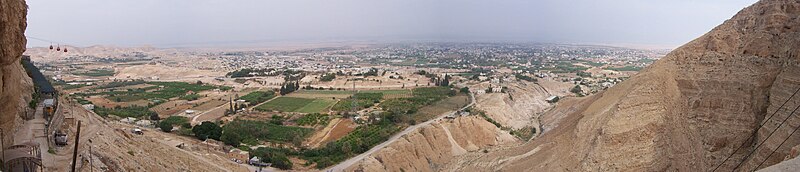
Panorama of Jericho
Wikipedia Commons


Profile-photo
About the Author


I'm Melanie, the founder of BermudaQuest and an archaeology undergraduate at the University of New Mexico. I love writing about ancient and modern cultures. My goal is to make information about our origins available to everyone [in simple English!]

13 Baktuns Later, Is this the End or the Eve of a New Beginning?

on 01 March 2012

9th Annual Tulane 
Maya Symposium
(February 24 - 26, 2012)

This year’s Maya Symposium incorporated a wide variety of specialties (such as epigraphy, archaeology, and art history) in order to explore the great cities and states of the Maya civilization. The speaker series consisted of talks about different baktuns.

The event began with Anthony Aveni, keynote speaker, on Friday, February 24, 2012, at the New Orleans Museum of Art. Since we attended the 2011 UT Maya Meetings, his Maya Apocalypse Soon? presentation was simply a refresher: no, the world is not ending in 2012!

The following day, February 25, 2012, was the series of speakers with their presentations of the baktuns. David Stuart introduced the concept of foundational time: the timeframe during which Maya history is anchored (this term can be used to avoid claiming whether something is mythology or history). The Maya had a habit of telescoping and collapsing in their written records: their history travels into the deep mythological past, incorporates the historical “present”, and jumps into the deep future.

Maya history begins during the 7th cycle. Patricia McAnany presented when material signatures originated. She also pointed out that all Maya rulers most likely did not employ the Long Count yet. Solar tracking, centralizing ancestors, scalable cyclical architecture, and creation narratives in cave portals characterize the exuberant 7th cycle. The preclassic was made possible by collective action – the people were united. It would seem that organized leadership became a necessity for creating and maintaining monumental structures. Rulers appear and fall.

With the collapse of El Mirador, Tikal rises as a super power. Kathryn Reese-Taylor discussed a possible Teotihuacan invasion of Maya territory during the 8th cycle. By the 9th cycle, as Marc Zender noted, Mesoamerica was full of texts; most of which are inaccessible, highly specific, and terse. The Maya style is multivocal, impersonal, and self-referential in nature. And just as texts became more prominent, transitions and transformations began yet again. Prudence Rice discussed where the Itza could have possibly come from and how their migration changed the Maya lifestyle during the 10th cycle.

The Itza may have influenced Mayapan, the last Maya capital in Mexico, according to Susan Milbrath during her presentation of Cycle 11. It is a clear an ideological battle took place: religious foreign cults were growing, the Cocom and Puuc did not get along, and Aztec influence was greater than ever. During Cycle 12 (presented by Laura Caso), cacao and vanilla united the remaining free Maya during the Spanish conquest. It was not until 1697 that the Spanish invaded the last independent Maya settlement.

The Maya did not disappear though. Judith Maxwell did an incredible job of presenting the last 400 years of Maya history. Despite the Spanish conquest, caste wars, persecution, genocide, and more, the Maya are relearning “how to be Maya.” They still have Maya dances, they are being taught how to read glyphs, and education is now available in Mayan. In 1985, the constitution of Guatemala finally stated that “the Maya have the right to exist.” During this last baktun of the Long Count, the Maya are now in the eve of a new Maya dawn.

“Let us celebrate a new beginning; the future depends on us, not the stars.”

If you would like to read summaries about each individual talk, leave a comment below and we will get to work!


Profile-photo

About the Author


I'm Melanie, the founder of BermudaQuest and an archaeology undergraduate at the University of New Mexico. I love writing about ancient and modern cultures. My goal is to make information about our origins available to everyone [in simple English!]

Rachel Preston Prinz: "Archaeo-Architecture"

on

Last December, while browsing about the Web, I stumbled into a TEDx talk about sustainable architecture. I immediately fell in love with the speaker's work. I immediately went to Twitter - I just had to share the most innovative and creative talk with BermudaQuest followers. What I did not expect was a reply:

 Thanks so much for tweeting my TED talk! ♥

Today, I would like to share this wonderful interview. Rachel Preston Prinz is a passionate advocate of historic preservation. She strives to applying lessons learned in preservation and archaeology to modern bio-regional design. Her work has included forensic architecture, archaeological architecture, the preservation and adaptive reuse of historic structures, re/design for handicapped accessibility, as well as the design of bio-climatic residences and commercial structures for non-profits.

Tell me about yourself. What's your background as it relates to sustainable architecture? What is Archinia?
I got into sustainable design through an unusual route: when working on my Master's thesis in Architectural Design, I was afforded the opportunity to study in Italy - to get up close and personal with the subject of my thesis - the late sixteenth century Andrea Palladio, and in particular his Villa Emo at Fanzolo. After spending nearly a month studying the site, I realized that Palladio had introduced some incredible bio-regional design aspects to his buildings, making them not only well-designed as far as their response to their time and place - that being the Mannerist period of playful reinterpretations of Renaissance idealism and a deep respect for all things ordained by the heavens (his villas use mythical imagery to connect to the particular powers of certain gods and goddesses) - but the houses were also appropriate as a response to their specific physical environment. The houses were naturally heated, cooled and lit, water naturally went where it needed to be, and was swept away from where it didn't. The landscape and the architecture were inexorably intertwined, working together. I realized that what might appear as merely "structure" had a place. It stuck with me, and I began to search for that "sense of place" in everything else I would study or design.

Archinia is half "architecture" and half "Nia". I am technically a Nia white-belt instructor, though I don't teach. Nia is part dance, part yoga, and part martial arts. Nia is a mindfulness-based dance practice, where your only aim is to finding your own edges, so you can take your body places you weren't even sure it could go. Architecture and dance are intimates - moving through space requires a specific kind of attention - and I want to awaken that awareness in my design work.
Her firm, Archinia, is an architectural cooperative, employing the services of an array of professionals normally not considered part of "traditional architecture." Archinia's inclusive approach allows her to develop pioneering interdisciplinary research in: "revisiting historic precedents to get past style and into the design's substance; the development and design of eco-communities; and preserving context in historic structures, trails, roads, and monuments."

How did New Mexico archaeology inspire your work? Are there any sites in particular that you feel should be more well known?
I've always had a passion for archaeology. But for years I actually believed that you had to have a degree to participate in it. So I never pursued it. When I got to New Mexico three years ago, I was taking time to "reboot" my design paradigm. So, I started volunteering on various archaeological projects. Before I realized it, some of the archaeologists I was working with recognized that it was handy to have an architect around. Especially one trained in vernacular design. I could automatically see patterns where others had to look, and often missed. I came to love archaeo-astronomy and studying how astronomy influenced design. Then, when at Chaco Canyon one weekend, I realized that all these sites I was studying had some things in common. They were built with materials found within a very small radius from the site. The sites were oriented towards the sun for maximum solar gain. They were hand-built by the people of that place, and their culture was reflected in the details. Before long, I realized other places in NM confirmed these observations, responding to their environments and cultures in different ways in a variety of historic periods, but answering the same problems. I realized that archaeology told us how to build correctly for our place - and it worked when the power or gas went out - which was relevant as many thousands of us in NM suffered through staying up all night tending a fireplace, if we were lucky enough to have one, for 5 days with no gas for heat in the coldest part of winter
The most magical NM Archaeological sites to me are the petroglyphs at Mesa Prieta, everything at Chaco, Taos Pueblo, and the cave complexes at Tsankawai and Bandalier. The NM carved cave complexes are a special thrill... not only are the sites positioned strategically for access to water and therefore some degree of health, agriculture and protection, they are also oriented to the sun to take advantage of solar heat in the winter. Facing a cave opening south or southwest invites the late day sun in to warm your "bedchamber" before you tuck in to your blanket. It's ingenious and SO simple.
What projects is Archinia working on currently and what projects have been successful in the past?
We have the incredible good fortune of having a diverse workload that incorporates our interdiciplinary approach. We are working on archaeological projects including developing National Register nominations of National Historic Trails; historic preservation projects including developing ways of preserving context and landscape in historic sites, including current projects the Sanctuario de Chimayo and the Santa Fe National Cemetery; and we are helping in the design and implementation of vernacular homes and eco-communities right here at home as well as in far-away places including Arizona, Costa Rica, Canada and Russia.
How can the public help promote sustainable architecture?
Wow, that's a tough question! It is so easy to get greenwashed in design. I think that the biggest thing people can do to promote sustainability is to commit to it: Participate in your community's planning process. Buy local food. Encourage community gardens. Don't poison your own water supply (aquifers) with non-organic pesticides and fertilizers. Work within 10 miles of your home. Don't drive if you can walk or ride a bike - and look around when you do to absorb what makes your own place great, so you can help protect it. Be a good neighbor. Share. Help other people you may not agree with all the time to achieve their dreams, and if you can, encourage them to do it in a more sustainable way. We can all make a difference if we just try.

If you would like to hear more from Rachel Preston Prinz, 
we highly recommend her TEDx Talk!


Profile-photo
About the Author


I'm Melanie, the founder of BermudaQuest and an archaeology undergraduate at the University of New Mexico. I love writing about ancient and modern cultures. My goal is to make information about our origins available to everyone [in simple English!]

Experimental Archaeology Project at Tiwanaku

on 28 February 2012

Experimental archaeology is used to determine how something was done or made. Experiments are designed to determine the archaeological correlates of ancient behavior. Prehistoric techniques died with their practitioners, so archaeologists rediscover them.

In Tiwanaku, Paul Harmon was puzzled about the Tiwanaku pyramids. How were they made if there was a lack of nearby quarries? The red sandstone quarries were 10 kilometers away; an incredible distance considering that one of the stones alone weighted over 130 tons. Most elaborate carvings and monoliths were made of green andesite stone, and the only source of this stone is on the Copacabana peninsula, across Lake Titicaca.
Verzonken Temple, Tiwanaku, Bolivia
[ufo-contact.com]
Kalasasaya Temple, Tiwanaku, Bolivia
[worldgreatestsites.com]
Harmon believed that these giant andesite stones were transported some 90 kilometers across Lake Titicaca on reed boats, then dragged another 10 kilometers to the city. Using only traditional techniques and locally available materials, Harmon and his team tested his theory by recreating the Tiwanaku building process with a group of leading Aymara experts in totora reed boat building.


Reed boat manufacturing in the region includes gathering and joining bundles of totora reeds and fastening them with rope from dried out prairie grass called ichu. Then the reed bundles are connected to more ichu to make the spine of the boat. Finally rows of bundles are pounded into a crescent shape. The ancient design made a raft that filters water from waves. If made properly the transportation of the stone will be a success across the lake.

Once the stone reached the other side of the lake, the stone was then dragged to Tiwanaku. At arrival to the site local masons carved the stone into a reproduction of one of the statues of the site, the Ponce monolith. The original was taken to the newly constructed museum to be protected from erosion and the replica will be put in its place with the fanfare and celebrations of the indigenous communities.


Profile-photo
About the Author


I'm Jose Pierre and I like learning about all aspects of culture, both ancient and modern. I enjoy learning how they communicated, expressed themselves, and their technology.

SCA Interview with Ian Hodder

on 26 February 2012

Ian Hodder, former Professor of Archaeology at Cambridge University, was interviewed by the SCA, in 1999, as Professor of Anthropology and Co-Director of the Archaeology Center at Stanford University. Dr. Hodder’s childhood consisted of travel and academia. His major influences in life are his father and Gordon Childe. He never met Childe but absorbed his approach and ideas. While earning his PhD, David Clarke influenced him to think with an open mind in archaeology. His hobbies include playing the piano, jazz and classical music, along with listening to opera and orchestral music. Dr. Hodder also enjoys sailing and jogging.

If Dr. Hodder hadn’t been an archaeologist, he says he would have ended up in development and international relations for less developed countries. This idea was reinforced during early travels in Africa and his publication Symbols in Action. He learned he wanted an archaeologist at the age of fifteen due to traveling. Dr. Hodder says it is difficult to get to knoe a place as a tourist. He liked the outdoors and not working at a desk – he didn’t know about all the deskwork archaeology would bring.

Dr. Hodder’s most memorable projects include discovering a Roman tower, digging in Kenya, Knossos, Mount Carmel caves, and the Andes. The most exciting was a Neolithic burial mound in the Fens in eastern England and standing for the first time on Çatalhöyük. The study of Çatalhöyük showed complex settlements existed outside of the Fertile Crescent and that very large social communities could be created in the form of villages.

For Dr. Hodder, the importance of archaeology is promoting diversity in a globalized world. Archaeology is a “global, national, ethnic conflict.” An archaeologist has to communicate with the public and work in collaboration with different groups while pursuing the past. Archaeology is a state responsibility, and the states’ should play a better role “regulating the relationship between developers and archaeologists.”

Profile-photo

About the Author


I'm Melanie, the founder of BermudaQuest and an archaeology undergraduate at the University of New Mexico. I love writing about ancient and modern cultures. My goal is to make information about our origins available to everyone [in simple English!]

An Introduction to Maya Ruins

on 23 February 2012

Barbara McKenzie portrays Mayan ruin sites, monumental ceremonial spaces that were often astronomically aligned, from her six trips, organized by Marion Canavan, to Mexico, Belize, Honduras, and Guatemala. “The Maya were concerned with creating monumental ceremonial spaces,” says McKenzie, “often astronomically aligned, within which ritual and political theater could take place.” A map of twenty-eight sites of Mayan ruins guides the visitor back in history into the world of the ancient civilization.


There are nineteen sites in Yucatan, Mexico. Ek Balam is known for its temple/tomb “The Acropolis”. Izamal is an ancient city of twelve large pyramids. Of the Puuc sites, Uxmal was the most important ceremonial center of the region of Puuc; Kabah, is the second largest ceremonial center; and Edzná is the southernmost. Xlapak, only has one building in relatively good condition and is close to Labná – it may be a part of it. Chacmultan is split into three sites. Dzibilnoac is at the center of the Yucatan peninsula. Hochob, Sayil, and Hormiguero are also in the area. Balamku is known for its well preserved stucco façade. Chicanná is neighbors with Becán. Xpujil is an example of the Rio Bec style. Rio Bec sites are isolated and may have been “haciendas.” Kohunlich is known for the Temple of the Masks. Calakmul is the home of Chichen Itzá. The site was a major superpower in the area, of over 6,250 structures, and rival to Tikal.

West of Guatemala are three sites: Bonampak, Yaxchilan, and Palenque. Palenque is built upon terraces looking over the coastal plain with its back to the Chiapas Mountains. Two main sites are in Belize: Lamanai, one of the longest continuously occupied cities; and Xunantunich, was possibly a regional capital. Three sites lie in Guatemala: Tikal, the largest known Mayan city; Uaxactun, smaller and north of Tikal; and Quirigua, on the border with Honduras. In Honduras, Copan was dependent on Quirigua for trade route access and mineral resources.


Profile-photo
About the Author


I'm Melanie, the founder of BermudaQuest and an archaeology undergraduate at the University of New Mexico. I love writing about ancient and modern cultures. My goal is to make information about our origins available to everyone [in simple English!]

The Paleoindian Period

on 17 February 2012

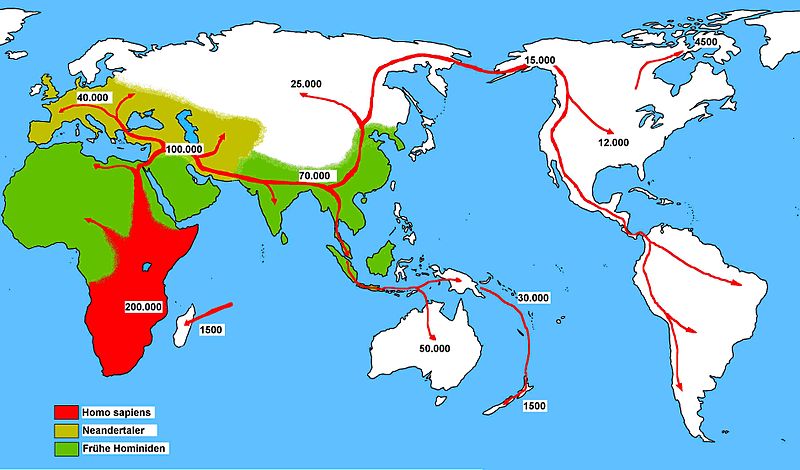
The Paleoindian period (ca. 13,000 – 7,900 BCE) consists of the occupation areas of the first Indians that crossed the land bridge, that connected Alaska and Siberia, in North America. The land bridge was formed by continent-size glaciers. Glaciers may have prevented the new inhabitants from expanded until after 12,000 BCE. These hunters are characterized by their Clovis points – long, fluted stone projectile points. The Paleoindian period is divided into three subperiods: Early Paleoindian, Middle Paleoindian, and Late Paleoindian.

Possible migration routes, Wikipedia Commons
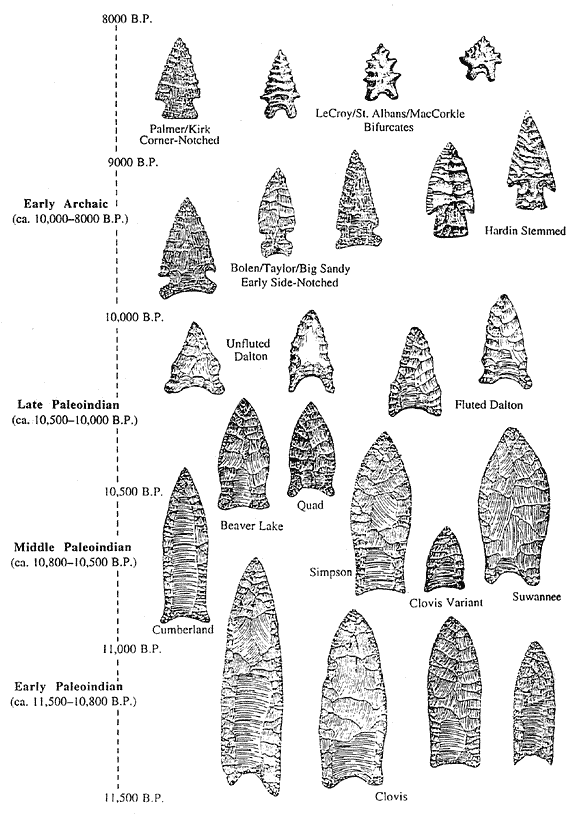
The Early Paleoindian (9,500 – 9,000 BCE) is believed to be a time of exploration and colonization. This has been deduced by examining the wide distribution of Clovis points that were transported large distances from their quarry sources. Large fluted points characterize this subperiod. There are three inhabited environmental zones for this subperiod: cool climate boreal forests, temperate forests, and subtropical sandy scrub. 

The Middle Paleoindian (9,000 – 8,500 BCE) is characterized by fluted and unfluted points that differ in size, larger and smaller, than traditional Clovis points found in the Southeast such as Cumberland, Redstone, Suwannee, Beaver Lake, Quad, Coldwater, and Simpson. The subperiod is viewed as a time for adaptation the optimal resource zones.

The Late Paleoindian (8,500 – 7,900 BCE) is characterized by Dalton and other side-notched points. The points demonstrate a change in adaptive hunting strategy from Late Pleistocene fauna to smaller game, like deer, in southern pine forests instead of boreal. Archaeologists believe that the settlements in the Southeast were permanent or semipermanent camps. Specific locations may have been inhabited around Chert deposits in order to replenish the manufactured stone tools. Settling down in specific areas may also have led to intensive regional specialization that ensured survival and movement into the Archaic period.
Since 1960, the studies of river basin projects, Paleoindian point finds, and site distributions in the Southeast have refined the sequencing of point types and refined the reconstruction of Paleoindian cultural activities.

Projectile Point Types, National Parks Service


Profile-photo
About the Author


I'm Melanie, the founder of BermudaQuest and an archaeology undergraduate at the University of New Mexico. I love writing about ancient and modern cultures. My goal is to make information about our origins available to everyone [in simple English!]

Painted Caves: Pech Merle

on 09 February 2012

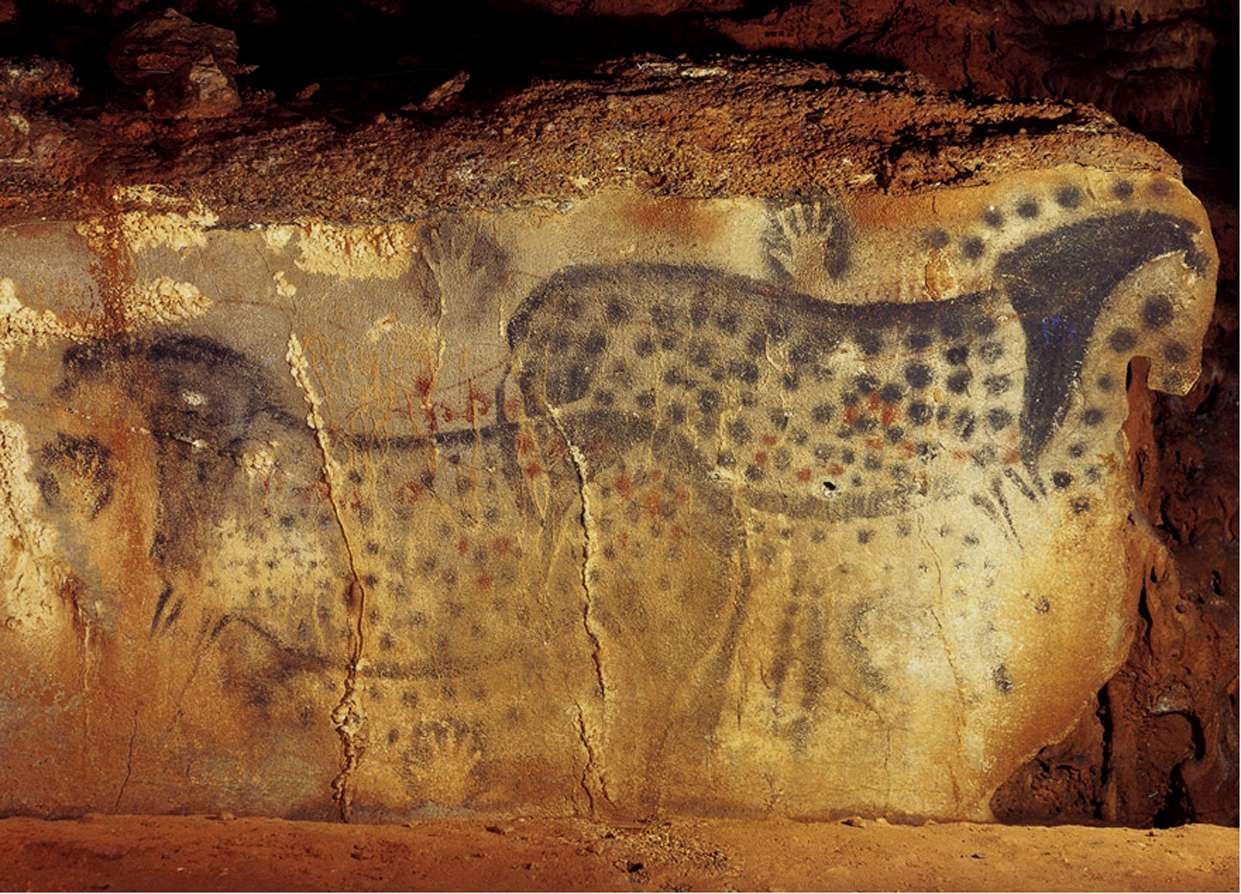
The Pech Merle cave is close to the Cabrerets village in France. Pech comes from the French word puèg that means hill. As for Merle, the origin is unknown. The cave has no signs of prehistoric use in the upper network. The lower network galleries were discovered in 1922 by André David and Henri Dutertre. The cave paintings and engravings were examined by Father Amédée Lemozi. The cave was opened to the public in 1926 as a “historic monument” and is property of Cabrerets. It is over two kilometers in length, and a third is open to visitors. The seven large halls display subterranean sceneries. Within ten kilometers, there another dozen painted caves sealed off from the public. 

Painting of horses and hands, SlideShare
In 1992, Michel Lorblanchet and Mrs. Hèléne Valladas took samples from the Cougnac cave. Valladas returned with her team and radiocarbon dated the megaloceros panel to 23,000 – 25,000 years old and the dots to 14,000 years old. In 1995, Michel Lorblanchet and his team of specialists took samples from the black contour of the “dotted horses” painting in Pech Merle. The samples were a mixture of manganese and barium oxide. Valladas later radiocarbon dated one of the twenty samples – the other nineteen had too little charcoal – to around 25,000 years old. 

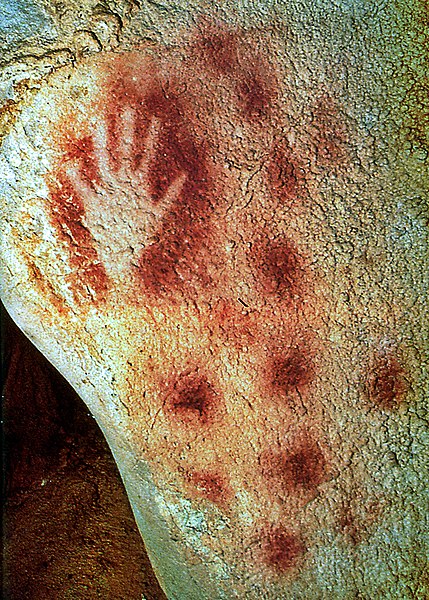
Cave painting of human hands, Wikipedia Commons
In 1998, bones were discovered in the Ossuary hall of Pech Merle. The hall is decorated with paintings and finger drawings. The floor of clay was crammed with animal bones and a path was created for visitors in the low dome room. Later, Jean Claude Faurie took bone samples and so far 118 have been marked, studied and drawn. The bones are from bears, cervidae, reindeers, horses, hyenas, lions, aurochs, and bison. Of these, a bone is engraved by man-made notches and others have been sawed. In 1998, an additional cave was found in the area, Pestillac.


Profile-photo
About the Author


I'm Melanie, the founder of BermudaQuest and an archaeology undergraduate at the University of New Mexico. I love writing about ancient and modern cultures. My goal is to make information about our origins available to everyone [in simple English!]

Share This

Never miss an article, subscribe here!

Credits & Policies

Banner created by Melanie Magdalena.

Images courtesy of: Ricardo Liberato (Pyramids of Giza), Aurbina (Moai), Maria Reiche (Nazca), Zunkir (Gobekli Tepe), Bjorn Christian Torrissen (Chichen Itza), Gareth Wiscombe (Stonehenge).

Images were released to the public and/or licensed under Creative Commons.

Editor's Note

Welcome to BermudaQuest, a free online journal primarily about Archaeology, Ancient History, and stories about different cultures from around the world.

Founded by Melanie E Magdalena, BermudaQuest and Origins (our magazine) have over a million readers! We would love to include your insight, experience, photos, and thoughts about your culture, heritage, and travels. Make sure you check out Origins, with over 4 million readers!