Showing posts with label Canada. Show all posts

Exploring Toronto's Abandoned Urban History

on 14 February 2013

The term urban exploration is defined as the exploration of man-made structures, usually abandoned ruins or not usually seen components of the man-made environment. Definitions tend to sound too boring, but the growing popularity of this hobby proves that the idea behind the words is actually very exciting. Many adventurous photographers consider it a new means of artistic expression enabling them to offer the public the shadowy and dusty face of cities as a contrast to their shiny surface. Other explorers do it for the sake of historical documentation, and there are even such people who do it merely for fun. The set of photographs I'd like to share with you reveals some of Toronto's concealed urban gems. If you decide to give urban exploration a try, please bear in mind that this activity can be quite dangerous, if you neglect proper preparation. Moreover, it may be considered trespassing in certain cases.


About the Author :: Heather Hadden

I am a Toronto real estate agent who enjoys meeting new people and helping them find their dream homes. When I'm not at work, I love spending time with my family and friends as well as traveling and painting, since I'm an artistic soul. Besides, I'm running a real estate blog focused also on healthy living, architecture, and the city of Toronto. http://ilovetoronto.com/

This project was created by Heather Hadden (author) and Jonathan Castellino (photographer).

Discovering the Past in Modern Vancouver

on 24 September 2012

If you find yourself in Vancouver with some free time to kill, a sense of adventure to satisfy, and an interest and appreciation of history to fulfill, then you’re in luck, as Vancouver offers numerous historical sites and landmarks that will without a doubt quench your thirst for history and adventure!

Gastown Steam Clock
[Leonard G./Wikipedia]

Proud Canadian Tradition

To start the sightseeing off, you can pass by Gastown, in downtown Vancouver. Going through Gastown will give you a very good idea of the rich and diverse roots of the rest of the city. Gastown takes its name from Jack “Gassy” Deighton, a sailor turned bar owner who established the city’s first saloon. The town quickly developed and flourished, as numerous businesses and establishments opened, making Gastown a melting pot of diversity, trade, and commerce. By 1886, Gastown had officially become part of Vancouver. Unfortunately, Gastown was not spared from the Great Vancouver Fire, which destroyed most of its buildings and history. However, in a testament to the spirit of Gastown’s citizens, the town was rebuilt and — driven by an interest to preserve the historical and architectural merit of the town — was recognized as one of Canada’s National Historic Sites. Today, Gastown is a popular tourist site that holds numerous antique and culturally significant landmarks, such as the Gastown Steam Clock, which is a proud, locally maintained site that also has become a hub of modern technologies and a lively nightlife.

The Great Outdoors

National Geographic Tree
[Public Domain]
Looking for a more outdoorsy, nature-intensive romp in Van-couver? Well, Stanley Park might just be the perfect place for you. Named after the former Governor General of Canada, Lord Stanley of Preston, and opened in 1888, Stanley Park can provide you with a physically as well as culturally stimulating visit. Stanley Park contains an impressive collection of gigantic, colossal trees such as the National Geographic Tree, an enormous western red cedar that was featured on the cover of National Geographic, and the Hollow Tree, popular because of its hollowed out insides that made it a great tourist stop. There are also various lakes, ponds, and lagoons that offer visitors great scenic views. Scattered throughout Stanley Park are monuments, statues, and landmarks that honour many Canadian heroes, former leaders, poets, and athletes. Totem poles are also a common site in Stanley Park, underscoring its past as home to the many indigenous tribes of Vancouver.

A Taste of Diversity

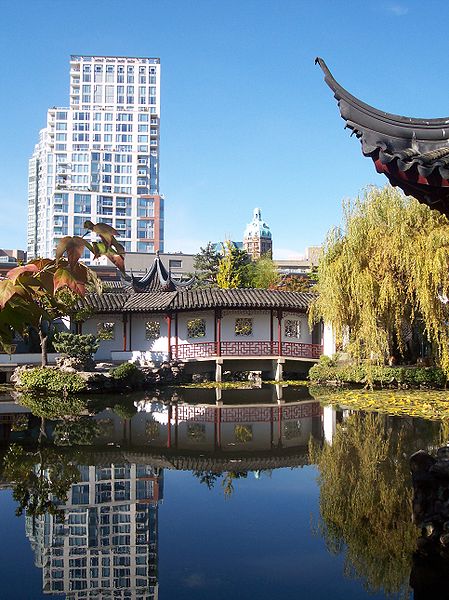
The great city of Vancouver is also home to a large and thriving Chinatown (in fact, one of the biggest and oldest Chinatowns that can be found in the whole of North America). In close proximity to Gastown, Vancouver’s Chinatown presents you with a unique opportunity to have an authentic and interesting Chinese experience right in the middle of Canada. With a community spanning generations of Chinese-Canadian immigrants, you can be sure that the shops, restaurants, markets, and other establishments there are 100 per cent authentic and traditional. Vancouver’s Chinatown is truly one of the ideal examples of marriage between a foreign culture and the Canadian lifestyle.

Dr. Sun Yat Sen Classical Garden
Chinatown, Vancouver
[Public Domain]

Explore Vancouver!

Vancouver holds the promise of many more gratifying and stimulating encounters, and these are just a sample of the many historical and cultural sites in Vancouver that you can enjoy. For a more rewarding experience, just go ahead and discover for yourself what the rest of Vancouver has to offer!

About the Author

Jay Banks of Vancouver Homes has been a Realtor from Vancouver BC for more than 16 years.

Ontario Pleistocene: The Ice Age Horse Debate

on 16 January 2012

Retrieval site, Lake Erie, Southern Ontario
Image courtesy of Jarrod Barker
Some of the most interesting finds in archaeology are discovered by amateurs. Jarrod Barker, publisher of www.thesilo.ca, licensed prospector, artist/musician, and antiquarian, stumbled upon evidence of the Equus scotti- Ice Age horse on the shore of Lake Erie in southern Ontario. Not only were there 9 teeth, teeth from the shoreline and one inland; but also numerous lithic finds of Paleo-Indian inhabitants.

And so, the debate began.

Barker contacted Dr. Gary Warrick, archaeologist, who acknowledged it was possible that several of the stone fragments were tools. He had difficulty identifying them as tools due to signs of wave and surf rolling. There were strong indicators (flaking and conchoidal fractures) that the finds were Paleolithic. Some of the most recent finds include brown chert lithics, much like the brown chert found in Texas, a stone not native to southern Ontario. There were strong indicators (flaking and conchoidal fractures) that the finds were Paleolithic. An interesting find is a possible hand axe, with clear bilateral flaking – a process not achievable by nature. Plus, there are multiple pierced pebbles!


So far, it seems like there were Paleo-Indian inhabitants around Lake Erie – odd since most of the archaeological community is against the possibility of a pre-Bering Strait migration. What about the teeth?
Background Information: Equus scotti is an extinct species of horse that inhabited North America during the Pleistocene epoch. Teeth of the Equus scotti are notably larger than the Equus caballus and Equus complicates. Both of the latter have teeth similar in size to the modern day horse, Equus ferus caballus. For more information on Equus teeth, please read “Aftonian Mammalian Fauna” by S. Calvin in Bulletin of the Geological Society of America, Volume 20, by Geological Society of America.
Barker sent out two sets of samples to Dr. Dan Walker, fossilized animal remains specialist and assistant state archaeologist of Wyoming. Walker identified three teeth that he was almost positive about dating as Pleistocene. Barker then contacted the Royal Ontario Museum. Seeing how he was working under a mentor, a respectable archaeologist, Barker assumed that maybe someone would want to come down and check it out.


Their response was unexpected.

David Seymour, assistant curator in the paleobiology section of the Royal Ontario Museum, claimed that Pleistocene horses did not travel north of Ohio. Adding to that, the teeth discovered were most likely eroded away by water and that Pleistocene horses had teeth that are very similar to those of the modern horse. Seymour told The Intelligencer that he had “only seen photos of the teeth” but did not want to “dismiss Barker’s discovery out of hand.”
According to the individuals Barker consulted, the teeth are Pleistocene. Wave patterns on the caps are easily identifiable – a pattern not seen on modern day horse teeth!
For those of you who need more background, the Ice Age horse originated in North America and traveled to Europe sometime before the Pleistocene epoch, which lasted 1.8 million years. The period ended with the mass extinction of large animals, such as the mastodons, mammoths, sabre-tooth tiger, and horses… or so we think. After the extinction of the Ice Age horse, horses were reintroduced to America during the Spanish Conquest.
Small problem with that – one tooth was found in a dry streambed, another in a stream pool that emptied into Lake Erie, and the rest were found on the high beach shore land on sand mixed with glacial pebbles. One tooth was actually discovered three kilometers inland. Contrary to the Museum’s claim, a bird most likely did not drop it off in the middle of nowhere. A couple teeth even look burnt: an excellent piece of information that could possibly support a pre-Clovis site if the site were excavated more thoroughly.
And so the debate continues…

Radiocarbon dating is expensive. In Texas, it costs at least $350 per sample. For Barker, testing the teeth in Ontario, would cost at least $700 per sample. The Royal Ontario Museum agreed that if Barker tested the teeth, and the dates came back as Pleistocene, they would publish the teeth could have come from the ballast tanks of Lake Erie freighters, freighters that would have come from Europe. Barker understands the need for a scientist to come forward and champion the finds with analysis, study and dating of the teeth and the lithics.

As a closing to our interview, Jarrod Barker said, “I think I’m sitting on an archaeological and anthropological gold mine...”

Read the article published by The Intelligencer.


Profile-photo
About the Author

I'm Melanie, the founder of BermudaQuest and an archaeology undergraduate at the University of New Mexico. I love writing about ancient and modern cultures. My goal is to make information about our origins available to everyone [in simple English!] This article was featured on Archaeology News Network on March 10, 2012.

Share This

Never miss an article, subscribe here!

Credits & Policies

Banner created by Melanie Magdalena.

Images courtesy of: Ricardo Liberato (Pyramids of Giza), Aurbina (Moai), Maria Reiche (Nazca), Zunkir (Gobekli Tepe), Bjorn Christian Torrissen (Chichen Itza), Gareth Wiscombe (Stonehenge).

Images were released to the public and/or licensed under Creative Commons.

Editor's Note

Welcome to BermudaQuest, a free online journal primarily about Archaeology, Ancient History, and stories about different cultures from around the world.

Founded by Melanie E Magdalena, BermudaQuest and Origins (our magazine) have over a million readers! We would love to include your insight, experience, photos, and thoughts about your culture, heritage, and travels. Make sure you check out Origins, with over 4 million readers!