Showing posts with label Central Europe. Show all posts

Ancient Rome

on 06 January 2013

Romulus & Remis, the fabled orphan founders of Rome.
[Laszlo Ilyes, Flickr, CC BY 2.0]

The Beginning


The first Roman Emperor was Caesar Augustus who ruled from 27 BCE to 14 CE, but Rome was founded around 510 BCE. In its founding story, there is the myth of Romulus and Remus, brothers who were casted out of society and then nurtured by a she wolf for a short time. When they were older they decided to found a city, but they argued over its placement and Romulus killed his brother Remus. He then founded a city and named it Rome.

Historic Actions


In 64 CE Neiro burnt down a village on Palatine Hill and then started construction on the Golden Palace. After Neiro’s reign the new Emperor Vespasian was the first to not come 
from the Caesar of Claudius line. In order to gain favor among the common people Vespasian tore down the Golden Palace and built the Coliseum from 75-80 CE. Emperor Titus conducted the opening ceremony for the Coliseum. 

Titus then had the Arch of Titus completed in 81 CE. At the Arch anyone entering the city had to lay down their weapons. Titus dedicated his arch to the Senate and the People (SPQR). Ceremonially, Romans built arches after conquering new territory.

Another important emperor was Trajan, 98-177 CE. He commissioned the Column of Trajan and the Arch of Trajan. The Column of Trajan was over 125ft tall and was built so that the relief sculpture looked the same size at every level. Both the arch and the column were used as propaganda to tell common folk of some of the achievements he had made over time. Trajan also had a city called Timgad built in north Africa for retired soldiers.

One of the last emperors before the Roman Empire’s switch from Paganism to Christianity was Hadrian, 117-138 CE. He built the Pantheon and revived Greek Art. While commissioning the Pantheon he had it built with lighter and lighter stones as it got taller, making it to have the largest oculus in history.

During the Christian times of the Roman Empire there were two major emperors Diocletion 284-305 CE and Constantine 306-377 CE. Diocletion is known for separating the Roman Empire into tetrarchs and established the chain of command. Constantine changed the capital of the empire to Constantinople and had the Basilica of Constantine built in 313 CE. He also commissioned a 30ft tall statue of himself that now stands in the Roman Forum. When the Arch of Constantine was built in 350 CE Constantine stole parts of other arches in order to complete it.

Fall of Rome


The Roman Empire fell to the Byzantine Empire around 320-325 CE. The Byzantine Empire held the Council of Nicea in 325 CE, which established the proper way to practice Christianity. The empire was not established until around the 6th century and they considered themselves Romans, but they spoke mostly Greek.

For Further Reading


Sayre, H. M. (2012). Chapter 17 The Ancient World: Roman Art. A World of Art. Boston: Prentice Hall, 431-38. ISBN: 987-0-205-88757-6

Old Pharsalos

on 04 January 2013

Geography


Farsalas or Ancient Pharsalos is a city located in Thessaly, Greece near the foot of Mt. Narthacium. The origin of Farsalas people and city construction is not fully known. The city was first mentioned in historical texts after the Persian Wars, but its construction shows evidence of earlier inhabitation. Within the acropolis there are remnants of Cyclopian walls near the northern gateway and subterraneous construction in the middle of the acropolis that are similarly built to Mycenae construction. This evidence supports theories that Farsalus was previously called Phthia and was the capital city of Phthiotis. In ancient times Farsalas was a strong military position because of its position over the plains and rich resources (Smith, 1984).

Battle of Pharsala by Georgios Roilos (1867-1928)
[PD-ART:US]

Black Figure Loutrophoros
Vourva, Attica, 580 BCE; Sophilos
[Sharon Mollerus, Flickr, CC BY 2.0]

Culture


Farsalas partook in mainstream ancient Greek culture. It participated in the trade of ceramics, including those made by the famous artists Sophilos. The city worshipped the Greek pantheon and participated in many of the rituals and customs of the time. A majority of the culture was agriculturally based and still is in present times, with many households owning sheep, cattle, and goats. Since Farsalas was a military stronghold it commonly had a military presence (Kimler, 2001).

Role in History


The city of Pharsalus is presumed to be one of the last cities to fall to Caesar during the Roman expansion through Greek territory, but many of the topographical characteristics described in his account of the battle do not resemble the features that were there. Leading the actual battlefield to be anywhere between Larissa and Metropolis. Within this area there are dozen of archaeological sites that could possibly be the actual battlefield. Researchers are still debating exactly where the battle took place and where the troops were positioned (Lucas, 1921).

What Remains


To the east of Pharsalos there are walls of a fortified enclosure and close by there are walls of houses. Many tombs were dated back to the Bronze Age through pottery found within them along with Bronze Age stratum that seems to underlie the site. There are also Mycenaean tombs with the foundations of a little temple and Byzantine remains. This leaves a wide range of dating for the development and construction of Pharsalos (Payne, 1932).

For Further Reading


Kilmer, M. F. and R. Develin. (2001). Sophilos' Vase Inscriptions and Cultural Literacy in Archaic Athens. Phoenix, 55(1/2), 9-43. Retrieved from: http://www.jstor.org/stable/1089022

Lucas, F. L. (1919/1920 - 1920/1921). The Battlefield of Pharsalos. The Annual of the British School at Athens, 24, 34-53. Retrieved from: http://www.jstor.org/stable/30102514

Payne, H. G. G. (1932). Archaeology in Greece, 1931-2. The Journal of Hellenic Studies, 52(2), 236-255. Retrieved from: http://www.jstor.org/stable/625990

Smith, W. (1854). Greek and Roman Geography. Dictionary of Greek and Roman Geography. Retrieved from: http://www.gtp.gr/LocInfo.asp?IncludeWide=0&InfoId=49&Code=EGRTLR5&PrimeCode=EGRTLR5&Level=5&PrimeLevel=5&LocId=12900&Entity=1016

Sampling Some Northern Italian Culture & History

on 11 November 2012

Waterfront in Italy
[La Citta Vita, CC BY-SA 2.0]
Italy has been home to technological advances and innovative ideas for hundreds of years. From Roman architecture to Italian fashion, Italy continues to grow and prosper despite the natural disasters and intense warfare attempting to set back its cultural progression. Through religious beliefs, cultural norms, archaeology, and architecture northern Italy has continue to prosper into the culturally diverse conundrum it is today. 

The Roman Empire


The Roman mythology that most of us know of today that developed throughout Italy and eventually the Roman Empire had roots based in not only in the Greek mythology that was adapted through colonies in southern Italy, but had bases in Etruscan and other Latin tribes as well. The Roman Empire developed an intricate belief system as it became a religious sponge while it continued to conquer neighboring lands. As regional deities became accepted into mainstream Roman traditions (like the Phoenician Goddess Cybele and the Persian God Mithra) these new gods and goddesses received their own temples and priests.

Venus de Milo
[Chadica, CC BY-2.0]
Tiberius Claudius Niro, Emperor
[Polybert49, CC BY-ND 2.0]
The Roman Empire and the few parts of it that will be later known as Italy adopted another religious tradition during the Imperial system of including emperors as living gods. At first, this system was widely rejected by the people of the Roman Empire, but it eventually inte-grated itself within the empires religious prac-tices which would help religious and other fu-ture leaders when making controversial policies later on.

As Christianity began to develop a foothold in Roman culture, there was a huge clash be-tween the Roman Pantheon believers and the neophyte Christians. As the religious conflict shifted cultural norms of society completely and established a new way of life. There are still reminisces of the Roman Pantheon belief system present in Italian society, but the myths are not nearly as prevalent or seriously considered.

Households and Economic Growth


Culture in Northern Italy is not as agriculturally based as southern Italy. The continued development of technology was adapted into Northern Italy for the growth industrialization. Economy, in turn, altered many aspects of its cultural norm by shifting the focus of importance among idealizations within its citizens.

Within families it became important for children to become hard workers and not focus so much on family. With an emphasis on individual production becoming more prevalent in society not only did families become less centralized, but religious practices became less time consuming. Family still plays a large role in Italian culture, but when comparing northern and southern Italian culture there are obvious differences in the amount of time devotion that are placed on developing a strong family ties and becoming an individual producer within society. Religious rituals such as attending church or mass also become less significant. Many still practice the Catholic traditions or a different Christianity based faith, but no longer place importance on attendance and instead they focus on individually strengthening their faith.

Archaeology and the Ice Man


Replica of Otzi at Naturhistoriches Museum Wein
[Sandstein, CC BY-SA 3.0]
Northern Italy is rich in archaeological dig sites from the intriguing Iceman to the city Luna - these sites provide evidence into the daily lives of Italian ancestors and the down fall of the Roman Empire. Since Italy has been home to different civilizations and nomadic people for so long it has many archaeological sites to study allowing the world to learn about its past.

The Iceman named Otzi was found in the Alps between Northern Italy and Austria. His stable isotopic signature suggests that he way born near a town that is now called Brixen. Otzi died around 5200 years ago, but his remains are perfectly preserved by the glacier he got trapped in, allowing new and interesting information to be revealed about the lifestyle of people during 3350-3300 BCE. His body shows evidence that he was most likely a Neolithic herder or pastoralist. Otzis’ body even displays tattoos including a cross on the inside of his left knee, parallel straight lines arranged in two rows on his back above his kidneys that are each about six inches long, and several parallel lines on his ankles. The end of his life was not peaceful at all, with evidence showing that his last two to three days were spent fighting for his life before he retreated to the mountains and died (Hirst, 2012).

Luna was a city under the Roman Empire's control during the 5th and 6th century. As such it provides strong evidence of Germanic attacks on the Roman Empire during its collapse and shows other factors as to its downfall. It is evident in Luna that the nearby quarry was abandoned, the aqueduct system was breaking down, and communal roads and buildings were no longer in use (Hirst, 2012).

Cave di Prun, Italy
[Hugo franchini, CC BY-SA 3.0]


Christ on the Cross
[Rennett Stowe, CC BY 2.0]

Christianity and Change


As Christianity continued to rise through out Italy and the Roman Empire new architectural styles were developed in order to build churches and later on other important structures. There were Byzantine style churches that were set up using the Greek cross and had a very linear set up. They had a very open set up to allow more people to get in and used typically used large amounts of small to medium sized windows in order to let in an optimum amount of light. Inside the churches were decorated with mosaics and paintings that depicted bible stories such as the Resurrection of Christ and The Garden of Eden. Having art work inside the churches was essential because many people who were illiterate came to worship and the mosaics and paintings made the stories relate more to the masses.

Over time the Gothic style of building became more prevalent in building. Gothic style churches were built to be very tall and used large windows in order to flood the churches with light as if it were the light of heaven. As the Gothic style grew more complex stain glass windows were incorporated into the method. Instead of using large amounts of stone to build the churches and later on other important buildings, the Gothic style used thin columns along with patterns of ribs, pointed arches, and windows. As time went on the Gothic style continued to try and build taller and taller building. In Italy the Gothic style was very unique. The Florence Cathedrals’ exterior is made to look like the Romanesque octagonal baptistery. While the inside uses pointed arches in order to create measured space in its enormous dome like size.

Church of San Rufino [left] and Basilica of Saint Clare [right]
[Randy OHC, CC BY 2.0]

For Further Reading


Hirst, K. Kris. (2012). "The Iceman." About.com Archaeology. About.com Guide, 2012. Accessed November 10, 2012 http://archaeology.about.com/od/iterms/qt/iceman.htm

 (2012). "Luna (Italy)." About.com Archaeology. About.com Guide, 2012. Accessed November 10, 2012 from http://archaeology.about.com/od/lterms/g/luna.htm

Sayre, Henry M. "Chapter 17 The Ancient World: Roman Art." A World of Art. Boston: Prentice Hall, 2012. pp. 431-438. Print. ISBN 987-0-205-88757-6

Schifini D'Andrea, Silvana. "Italian Quality of Life." Social Indicators Research, Vol. 44, No. 1, Studies on the Quality of Life in Italy (May, 1998), pp. 5-39  [Published by: Springer  Article Stable URL: http://www.jstor.org/stable/27507548]


Contribution by: Margaret Smith, University of New Mexico, Anthropology & Japanese undergraduate

The art of loving Neandertals – they're like us, but different

on 25 June 2012

By Iain Davidson, University of New England

Media commentators have been eager to paint Neanderthals as artists - but why?
An article published recently in Science sheds new light on paintings found in 11 cave sites in Spain. At 40,800 years old, some of these paintings could be among the oldest anywhere in the world.
But were these paintings done by Neandertals or the modern humans who replaced them? From the headlines you would think it was the Neandertals.

Taken together with other recent publications, summarised in the image of Google search results below, the Spanish results suggest the habit of producing art in various forms went back to the earliest appearance of modern humans in Europe.

This is only about 5,000 or 10,000 years after people also reached Australia. Why then did the media grab the idea that the paintings might have been made by Neandertals, who were replaced by these artistic modern humans in Europe?

Google Search Results
Google

Recent improvements in radiocarbon dating have shown modern humans were in southern England more than 41,500 years ago, that people left flutes and figurines in Swabia more than 38,000 years ago, engravings in the Dordogne region about 36,500 years ago, and paintings around 35,000 years ago at Chauvet Cave, west of the Rhone valley.


Taken together there is now no doubt there were distinct types of art in Europe close to 40,000 years old, and generally not associated with Neandertals.

Yet the headlines on at least four continents relating to the new Spanish results asserted that Neandertals could have been responsible for the art.

The big split


Neandertals became distinct from modern humans about 350,000 years ago but died out within a few thousand years (at most) of the arrival of modern humans.

They produced very little (if anything) in the way of art, but modern humans in Europe went on to produce several different forms of art over most of the next 30,000 years. In Australia, art may have arrived with the first people and was certainly being produced by different Aboriginal groups into the 20th century.

The media coverage of the latest Spanish results is all the more surprising given it relies on a throwaway line at the end of the Science paper on the Spanish cave art dating: “it cannot be ruled out that the earliest paintings were symbolic expressions of the Neandertals”, though no evidence is produced.

Remains of the day


Neandertal remains were first discovered in 1829, 30 years before the publication of Charles Darwin’s On the Origin of Species, but it was not until five years later that anyone suggested they were a different species from ourselves. The status of Neandertals has been the subject of varying interpretations, like the more recently discovered Homo floresiensis.

Interpretations of fossils and their relationships to us are not easy and, where Neandertals are concerned, they depend more than we would like to admit on attitudes that are often not expressed.

First reconstruction of Neanderthal Man, 1888
Wikimedia
The most famous example is the suggestion in 1957, by the anatomists William Straus and AJ Cave, that a Neandertal wearing modern clothes would look no different from other passengers on the New York Subway. It is difficult to decide whether this is a compliment to Neandertals, or not.


There are some substantial reasons why it’s difficult to get a full picture of Neandertals. A pattern was described in the 19th century that Neandertals made stone tools using flakes that archaeologists called Mousterian, and did not make bone tools, art or ornaments.

Following them, modern humans made stone tools using parallel-sided blades that were rare earlier, and did make bone tools, art and ornaments. Scholars and the general public lined up with the view that people like us replaced people who were not like us.

But as is to be expected, the story is not quite as neat. The earliest paint has been found in South Africa dated to 100,000 years ago, far away from Neandertals and long before modern humans in Europe.

Recent discoveries tend to suggest more overlap between the species in stone and bone tools, art and ornaments. But against this, there have been very few dated fossils and early attempts to provide dates were distorted by the fact that the supposed transition between Neandertals and modern humans occurred at about the period when radiocarbon dating ceases to be useful.


Neanderthals and Humans
KRT/AAP

Close scrutiny sometimes shows, as here, that evidence showing modern behaviour among Neandertals is thin, so why did one journalist – according to a colleague of mine who was interviewed about the Spanish cave art – say he “really, really wanted" to write a story that Neandertals created the art? Why did so many news outlets happily rush to this same, somewhat flawed, conclusion?

The reasons lie partly in our ambivalent relations with creatures that are like us but not quite the same. Perhaps the most obvious are dogs, which are like us because they attend assiduously to our blandishments, or bears which can have a similar body plan and proportion, yet are dangerous, so we infantilise them as teddy bears.

And then there are imaginary creatures such as yetis, hobbits, trolls, and gods, invented to remind us where the boundaries of humanity lie.

Perhaps the media’s fascination arises from the fact archaeologists and biological anthropologists are testing which side of that boundary Neandertals lie.

Profile-photo
About the Author

Iain completed his Ph.D at Cambridge based on Spanish Palaeolithic fauna and economy, and has since carried out research and publication on the Spanish Palaeolithic and on Australian prehistory. He has published extensively on the archaeology of language origins. He conducts research on all aspects of archaeology including painted caves in Northwestern Queensland and consultancy in Queensland, N.S.W. and Western Australia. His current research interests include rock art and the narrative of Australian archaeology.
Iain Davidson has received funding from the ARC, AIATSIS, and AINSE. He has conducted archaeological research on Spanish cave art. He is affiliated with the University of New England, Flinders University, University of Queensland and Harvard University.
The Conversation
This article was originally published at The Conversation. Read the original article.

Cosquer Cave

on 24 February 2012

Cosquer Cave
Image courtesy culture.gouv.fr
Cosquer Cave is located at Cape Morgiou, in the Calanques (Calanques are limestone cliffs very steep and with very deep waters with steep and dangerous shores), near Marseilles. It can be accessed through a tunnel 175 metres in length, which is 37 metres under the sea level due to the rise of the Mediterranean in Paleolithic times. It was discovered by diver Henri Cosquer in 1985, but its contents were not made public until 1991, when three divers became lost in the cave and tragically died.

In 1991 Cosquer made his fifth attempt to reenter with a new batch of experienced divers from his own club. This time they entered the other lake; from there Cosquer noticed an image of a human hand on the walls and was photographed. Reaching home when the films were developed he could notice two more hands and a feeling that they have bumped upon something marvelous began to haunt them. If Cosquer was not lucky enough to notice the ‘hand’ and the outside world would never have come to know about this prehistoric treasure that existed.

Stencil of a human hand dated 27,000 BCE, 
shown at the Musée d'Archéologie Nationale
(National Museum Archeology)
in Saint-Germain-en-Laye, France
The most unique feature of this cave is that it contains several dozen works painted and engraved between 27,000 and 19,000 years ago, decorated with a variety of land animals, penguins, cats, and engravings on the walls, but also with seals and auks, fifty-five hand stencils, and numerous digital markings, dozens of geometric symbols, as well as the extraordinary representation of a "slain man".


Caves were the initial homes of men and he could not but give expression to his artistic talents on its walls during resting or idle times may be the usual concept of the images those appear on the walls of caves. But David Lewis Williams states that there is a pattern in the carvings and images on the walls of caves and that would not have done as a time pass. His studies based on ethnography pictures of things happened in the ‘Cro-Magnon arts in the following pattern.


References:

"Cosquer Cave" - Accessed on 25 January 2012


Profile-photo
About the Author


I'm Jose Pierre and I like learning about all aspects of culture, both ancient and modern. I enjoy learning how they communicated, expressed themselves, and their technology.

Painted Caves: Pech Merle

on 09 February 2012

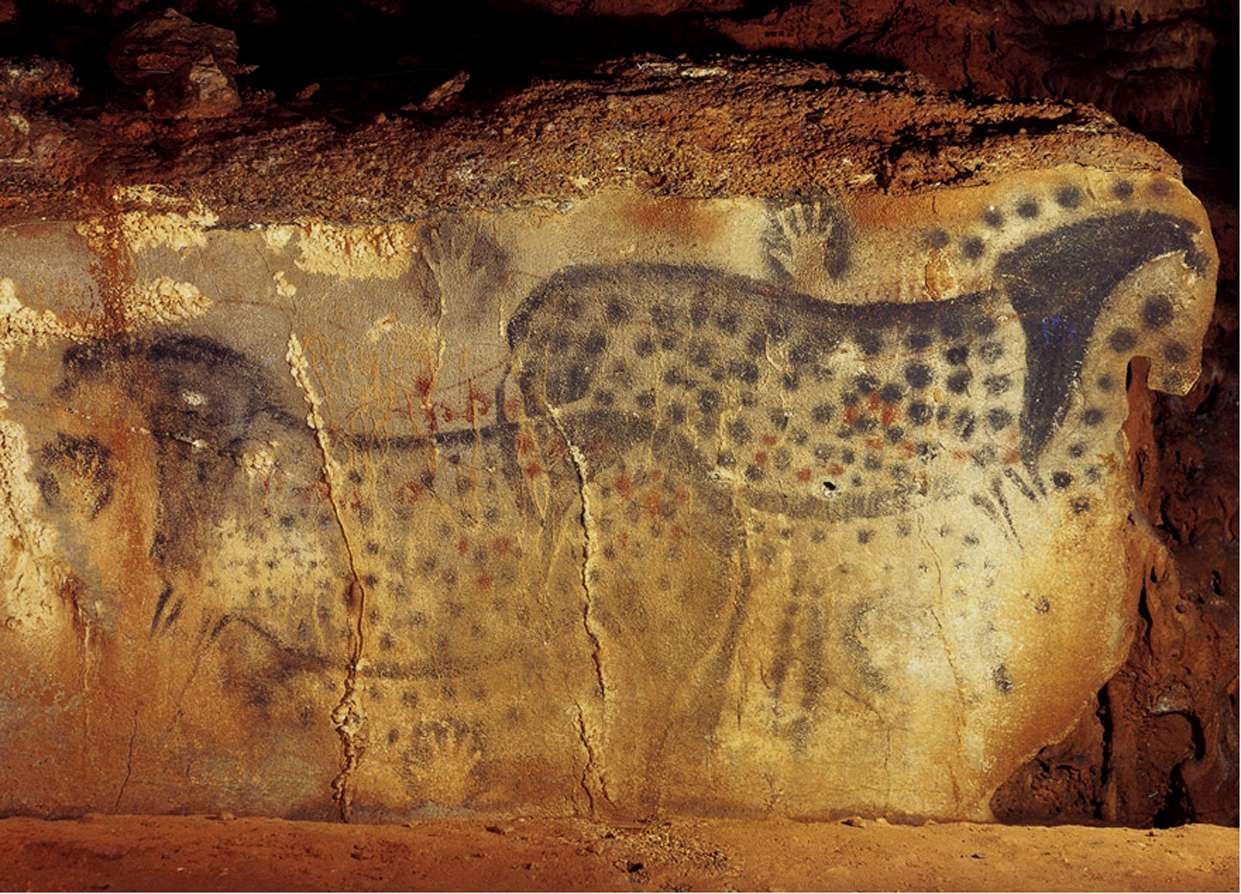
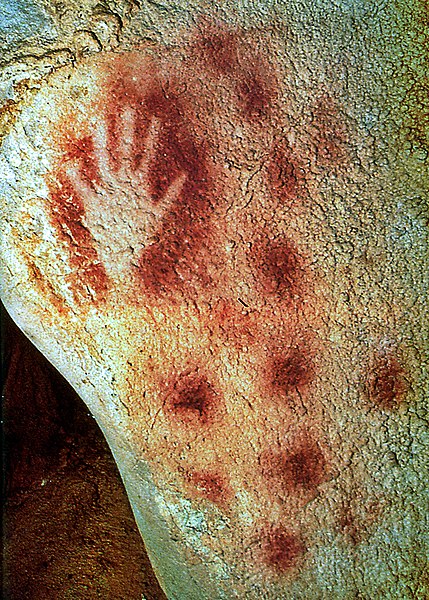
The Pech Merle cave is close to the Cabrerets village in France. Pech comes from the French word puèg that means hill. As for Merle, the origin is unknown. The cave has no signs of prehistoric use in the upper network. The lower network galleries were discovered in 1922 by André David and Henri Dutertre. The cave paintings and engravings were examined by Father Amédée Lemozi. The cave was opened to the public in 1926 as a “historic monument” and is property of Cabrerets. It is over two kilometers in length, and a third is open to visitors. The seven large halls display subterranean sceneries. Within ten kilometers, there another dozen painted caves sealed off from the public. 

Painting of horses and hands, SlideShare
In 1992, Michel Lorblanchet and Mrs. Hèléne Valladas took samples from the Cougnac cave. Valladas returned with her team and radiocarbon dated the megaloceros panel to 23,000 – 25,000 years old and the dots to 14,000 years old. In 1995, Michel Lorblanchet and his team of specialists took samples from the black contour of the “dotted horses” painting in Pech Merle. The samples were a mixture of manganese and barium oxide. Valladas later radiocarbon dated one of the twenty samples – the other nineteen had too little charcoal – to around 25,000 years old. 

Cave painting of human hands, Wikipedia Commons
In 1998, bones were discovered in the Ossuary hall of Pech Merle. The hall is decorated with paintings and finger drawings. The floor of clay was crammed with animal bones and a path was created for visitors in the low dome room. Later, Jean Claude Faurie took bone samples and so far 118 have been marked, studied and drawn. The bones are from bears, cervidae, reindeers, horses, hyenas, lions, aurochs, and bison. Of these, a bone is engraved by man-made notches and others have been sawed. In 1998, an additional cave was found in the area, Pestillac.


Profile-photo
About the Author


I'm Melanie, the founder of BermudaQuest and an archaeology undergraduate at the University of New Mexico. I love writing about ancient and modern cultures. My goal is to make information about our origins available to everyone [in simple English!]

Share This

Never miss an article, subscribe here!

Credits & Policies

Banner created by Melanie Magdalena.

Images courtesy of: Ricardo Liberato (Pyramids of Giza), Aurbina (Moai), Maria Reiche (Nazca), Zunkir (Gobekli Tepe), Bjorn Christian Torrissen (Chichen Itza), Gareth Wiscombe (Stonehenge).

Images were released to the public and/or licensed under Creative Commons.

Editor's Note

Welcome to BermudaQuest, a free online journal primarily about Archaeology, Ancient History, and stories about different cultures from around the world.

Founded by Melanie E Magdalena, BermudaQuest and Origins (our magazine) have over a million readers! We would love to include your insight, experience, photos, and thoughts about your culture, heritage, and travels. Make sure you check out Origins, with over 4 million readers!