

Hunting or climate change? Megafauna extinction debate narrows
By Christopher Johnson, University of TasmaniaWhat is the oldest debate in Australian science? Probably, the argument over what caused extinction of our Pleistocene megafauna – the diprotodons, giant kangaroos, marsupial tapirs, über-echidnas and other big and bizarre creatures that used to live here.
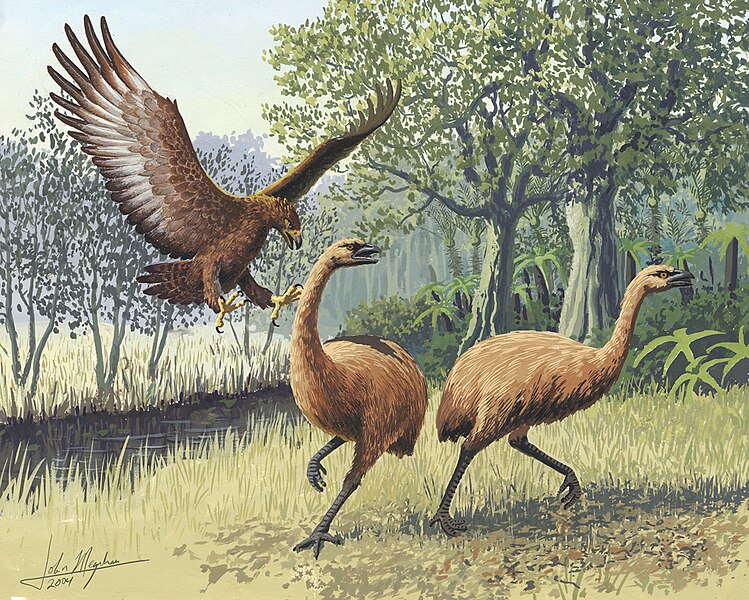 |
| Giant Haast's Eagle attacking New Zealand Moa [John Megahan, PLoS Biology, CC BY- 2.5] |
In 1877 the great English anatomist Sir Richard Owen suggested that these big animals had been driven extinct by “the hostile agency of man”. That is, hunting did it, in a process we now call overkill. Other people responded that climate change must have been the cause, and it was on.
A string of recent studies from a wide range of disciplines – geochronology, palaeoecology, palaeontology, and ecological modelling – have supported Owen’s opinion. But the argument continues. Why?
The main reason is that many Australian archaeologists reject overkill. They have looked for direct evidence that people killed megafauna, and they haven’t found it. No great piles of bones around ancient campsites; no diprotodon skeletons with spears stuck in their ribs; no arsenal of specialised weapons for bringing down large prey. Very few archaeological sites even have remains of people and megafauna in close association.
Some archaeologists conclude that megafauna-hunting just did not happen, or if it happened it was rare and insignificant. Often this conclusion is stated with a ringing confidence that dismisses all non-archaeological evidence for overkill.
But they have not asked a crucial question: if people did hunt megafauna to extinction, how much evidence of killing should we now be able to get from archaeological sites? A new paper by archaeologists Todd Surovell and Brigid Grund suggests the answer to that question is “very little or none”.
Surovell and Grund point out, first, that the period when archaeological evidence of killing of megafauna could have been formed is a small fraction of the total archaeological record of Australia. People arrived here between about 50,000 and 40,000 years ago. This is also the interval during which animals like diprotodon disappeared. A comparison of archaeological and fossil dates suggests humans and megafauna overlapped for only about 4,000 years continent-wide, and modelling suggests that if hunting caused extinction it would have been all over in less than 1,000 years in any place.
This means that no more than 8%, perhaps as little as 2%, of the Australian archaeological record covers the period of human-megafauna interaction. The “smoking gun” evidence of overkill should therefore be rare. Surovell and Grund show that the problem of finding such evidence is even worse than that, for two reasons.
First, when people first arrived their populations were necessarily small. Living sites therefore occurred at low density. As population size grew exponentially, site density increased. So, the very earliest sites must be far rarer than later ones.
But if overkill happened, populations of megafauna would have been going down as humans went up: as the density of sites was rising the proportion of them that could have contained evidence of megafauna kills was falling. Thus, sites with potential to preserve that evidence are actually a tiny proportion, perhaps much less than .01%, of the total archaeological record.
Second, material in archaeological sites degrades with time due to breakdown, weathering and scavenging of bone and removal by erosion. Old sites are eventually buried under sediments. The probability of discovering archaeological sites from the earliest occupation of Australia is intrinsically much lower than for later times, and most of the contents of those sites will have disappeared.
In fact, the very oldest archaeological sites in Australia typically contain only a few stone tools. They can tell us very little about interaction of the first Australians with any animals or plants, let alone reveal a picture of megafauna-killing.
Our fundamental task as scientists is to test hypotheses using evidence. To test the overkill hypothesis, we need a kind of evidence that would differ according to whether the hypothesis is true or false. Obviously, if overkill did not happen, evidence of megafauna-killing should be rare in the archaeological record. But, Surovell and Grund’s analysis makes it clear that if overkill happened, we should still expect evidence of killing to be rare. Therefore, failure to find such evidence does not amount to a test of the overkill hypothesis.
This does not mean that archaeological evidence of killing (or absence of such evidence) is useless in testing the overkill hypothesis. Surovell and Grund show it can be useful, by comparing the archaeological records of Australia, North America and New Zealand. All three places lost their megafaunas when people arrived, but this happened a very long time ago in Australia, and very recently (700 years ago) in New Zealand. North America is intermediate, with human arrival and extinction from 14,000 to 13,000 years ago.
Applying the same logic to all three cases, we predict that if overkill caused megafaunal extinction in each place the archaeological evidence of killing should be abundant in New Zealand, rare in North America, and vanishingly rare in Australia. That is exactly what we find.
There is so much evidence showing New Zealand’s moa were heavily hunted that nobody doubts overkill was the main cause of their extinction. In North America, there are undoubted kill sites for mammoths, mastodons and a few other species, but this evidence is far thinner than in New Zealand. Australian archaeology is yet to reveal any convincing evidence for megafauna-killing.
So, far from disproving overkill, the archaeological evidence from Australia is actually consistent with the overkill hypothesis.

About the Author
Christopher Johnson is an ecologist, interested in pure and applied ecology, environmental history, the biology of extinction, conservation and wildlife management. He is a Professor of Wildlife Conservation and ARC Australian Professorial Fellow at University of Tasmania.
Christopher Johnson receives funding from the Australian Research Council.


