Showing posts with label Fossils. Show all posts

Megafauna Extinction: Hunting or Climate?

on 12 March 2013

Hunting or climate change? Megafauna extinction debate narrows

By Christopher Johnson, University of Tasmania

What is the oldest debate in Australian science? Probably, the argument over what caused extinction of our Pleistocene megafauna – the diprotodons, giant kangaroos, marsupial tapirs, über-echidnas and other big and bizarre creatures that used to live here.
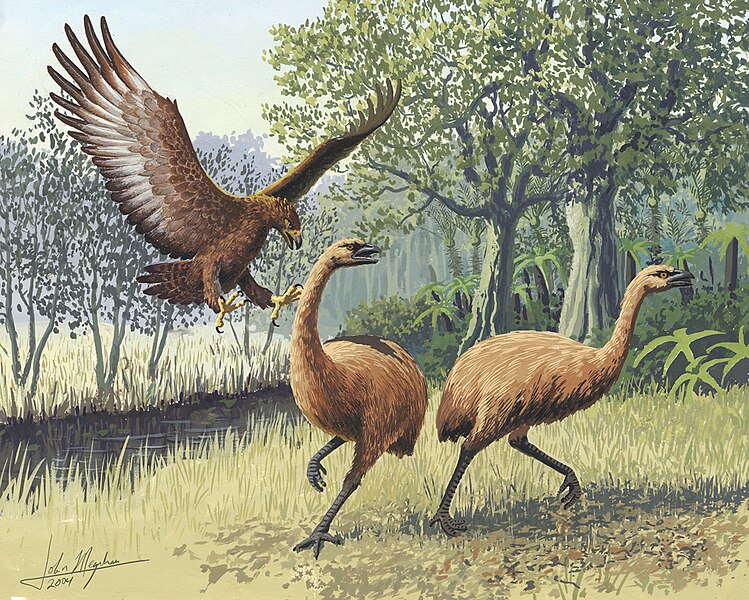
Giant Haast's Eagle attacking New Zealand Moa
[John Megahan, PLoS Biology, CC BY- 2.5]

In 1877 the great English anatomist Sir Richard Owen suggested that these big animals had been driven extinct by “the hostile agency of man”. That is, hunting did it, in a process we now call overkill. Other people responded that climate change must have been the cause, and it was on.

A string of recent studies from a wide range of disciplines – geochronology, palaeoecology, palaeontology, and ecological modelling – have supported Owen’s opinion. But the argument continues. Why?

The main reason is that many Australian archaeologists reject overkill. They have looked for direct evidence that people killed megafauna, and they haven’t found it. No great piles of bones around ancient campsites; no diprotodon skeletons with spears stuck in their ribs; no arsenal of specialised weapons for bringing down large prey. Very few archaeological sites even have remains of people and megafauna in close association.

Some archaeologists conclude that megafauna-hunting just did not happen, or if it happened it was rare and insignificant. Often this conclusion is stated with a ringing confidence that dismisses all non-archaeological evidence for overkill.

But they have not asked a crucial question: if people did hunt megafauna to extinction, how much evidence of killing should we now be able to get from archaeological sites? A new paper by archaeologists Todd Surovell and Brigid Grund suggests the answer to that question is “very little or none”.

Surovell and Grund point out, first, that the period when archaeological evidence of killing of megafauna could have been formed is a small fraction of the total archaeological record of Australia. People arrived here between about 50,000 and 40,000 years ago. This is also the interval during which animals like diprotodon disappeared. A comparison of archaeological and fossil dates suggests humans and megafauna overlapped for only about 4,000 years continent-wide, and modelling suggests that if hunting caused extinction it would have been all over in less than 1,000 years in any place.

This means that no more than 8%, perhaps as little as 2%, of the Australian archaeological record covers the period of human-megafauna interaction. The “smoking gun” evidence of overkill should therefore be rare. Surovell and Grund show that the problem of finding such evidence is even worse than that, for two reasons.

First, when people first arrived their populations were necessarily small. Living sites therefore occurred at low density. As population size grew exponentially, site density increased. So, the very earliest sites must be far rarer than later ones.

But if overkill happened, populations of megafauna would have been going down as humans went up: as the density of sites was rising the proportion of them that could have contained evidence of megafauna kills was falling. Thus, sites with potential to preserve that evidence are actually a tiny proportion, perhaps much less than .01%, of the total archaeological record.

Second, material in archaeological sites degrades with time due to breakdown, weathering and scavenging of bone and removal by erosion. Old sites are eventually buried under sediments. The probability of discovering archaeological sites from the earliest occupation of Australia is intrinsically much lower than for later times, and most of the contents of those sites will have disappeared.

In fact, the very oldest archaeological sites in Australia typically contain only a few stone tools. They can tell us very little about interaction of the first Australians with any animals or plants, let alone reveal a picture of megafauna-killing.

Our fundamental task as scientists is to test hypotheses using evidence. To test the overkill hypothesis, we need a kind of evidence that would differ according to whether the hypothesis is true or false. Obviously, if overkill did not happen, evidence of megafauna-killing should be rare in the archaeological record. But, Surovell and Grund’s analysis makes it clear that if overkill happened, we should still expect evidence of killing to be rare. Therefore, failure to find such evidence does not amount to a test of the overkill hypothesis.

This does not mean that archaeological evidence of killing (or absence of such evidence) is useless in testing the overkill hypothesis. Surovell and Grund show it can be useful, by comparing the archaeological records of Australia, North America and New Zealand. All three places lost their megafaunas when people arrived, but this happened a very long time ago in Australia, and very recently (700 years ago) in New Zealand. North America is intermediate, with human arrival and extinction from 14,000 to 13,000 years ago.

Applying the same logic to all three cases, we predict that if overkill caused megafaunal extinction in each place the archaeological evidence of killing should be abundant in New Zealand, rare in North America, and vanishingly rare in Australia. That is exactly what we find.

There is so much evidence showing New Zealand’s moa were heavily hunted that nobody doubts overkill was the main cause of their extinction. In North America, there are undoubted kill sites for mammoths, mastodons and a few other species, but this evidence is far thinner than in New Zealand. Australian archaeology is yet to reveal any convincing evidence for megafauna-killing.

So, far from disproving overkill, the archaeological evidence from Australia is actually consistent with the overkill hypothesis.


Profile-photo
About the Author

Christopher Johnson is an ecologist, interested in pure and applied ecology, environmental history, the biology of extinction, conservation and wildlife management. He is a Professor of Wildlife Conservation and ARC Australian Professorial Fellow at University of Tasmania.
Christopher Johnson receives funding from the Australian Research Council.
This article was originally published at The Conversation. Read the original article.

What's the deal with all the dates?!

on 10 October 2011

Dating Techniques by Jose-Estrada and Melanie Magdalena


There are many dating techniques used in the scientific world. Archaeologists, geologists, and paleontologists use dating techniques to determine the age and time frames for civilizations, geologic patterns, and organisms. There are two main types: relative and absolute. Relative dating is abstract while absolute dating requires lab tests... (and money!)

RELATIVE DATING
In simple English, relative dating is using geologic record to find out just how old a rock or artifact is by using the surrounding context. These are not calendar dates, basically what is closer to the surface is younger than what is under the surface. Archaeologists use several techniques to develop a chronological sequence to order styles, types, and assemblages. Geologists also use different relative dating techniques to identify different rock layers; paleontologists date fossils using geologic record.

Relative Dating Techniques:

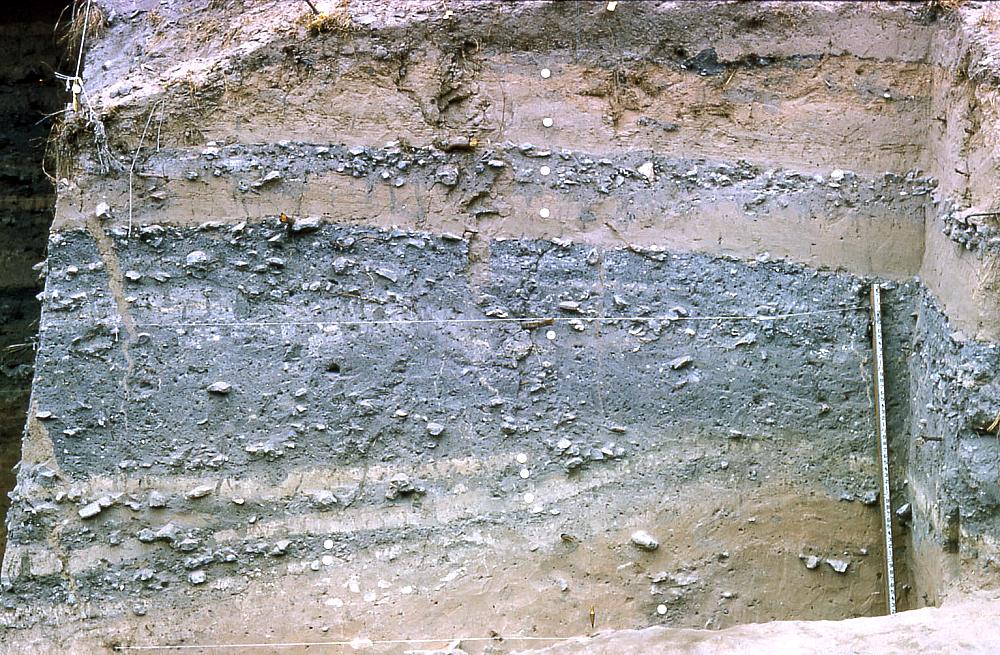
  • The Law of Superposition or Steno’s law is the principle that each bed of sedimentary rock is older than the layers above and younger than the layers below. This concept of rock layers is also known as stratigraphy. An example of stratigraphy is the Arenosa shelter in Texas.
  • Index Fossil Concept is the idea that similar fossils are of similar age or limited to a time span.
  • Time-Markers are artifacts that are proven to be from a particular period of time.
  • Seriation is a change of style, usually in artifacts. as new technologies arise they replace the older over time. Seriation does not tell us the age of a site, it only tells us if a site is older or younger than another based on the style of artifacts.
Arenosa Shelter, Lower Pecos Canyonland
Index fossils and seriation
ABSOLUTE DATING

Absolute dating “provides calendar reference to dates” (Shafer 2007). There are multiple techniques for absolute dating, some can be used for multiple types of samples while others are specialized.

Absolute Dating Techniques:

  • Dendrochronology, or tree ring dating, uses the annual growth rings in trees to assign a calender age to ancient wood. Tree-ring dating was developed by astronomer A. E. Douglass based on the principle that moisture varies from year to year - this moisture ratio is preserved in trees making trees an effective climate change map. One ring is developed each year, the color intensity (light/dark) can distinguish if it was formed in the spring/summer (light ring), or in the summer/fall (dark ring). By combining dendrochronology samples with radiocarbon dates, tree rings have revealed atmospheric changes and the changes in Carbon-14 quantities. A mathematical formula is applies to radiocarbon dates to make up for these fluxes.
  • Radiocarbon Dating is only good for organic remains that are younger than about 45,000 years old. Willard Libby developed this technique based on the fact every living thing absorbs the radioactive Carbon 14 (C-14) isotope. C-14 is produced in the atmosphere by cosmic rays and every living thing breathes in Carbon from the atmosphere. When an organism is alive it maintains equilibrium of ^14C. When it dies its C-14 count begins to decay. The amount of C-14 halves every 5,730 years (half-life) after the death of the organism. Carbon-14 is commonly measured in two ways:

    1. Conventional Radiocarbon Dating uses a Geiger counter and measures the beta particle emission from a sample. The slower the emission rate, the older the sample. This method is destructive and requires a twenty-five gram sample at the very least.
    2. Accelerator Mass Spectrometry (AMS) is a method of Radiocarbon dating that directly counts the proportion of carbon isotopes in samples of one gram or less. Compared to conventional radiocarbon dating, AMS requires less material and is also non-destructive (meaning the sample can be kept after the dating test).

  • Trapped Charge Dating is based on the fact electrons become trapped in mineral crystal lattices due to background radiation. The total amount of radiation the specimen received is divided by the annual dose of radiation. There are three sub-dating techniques for trapped charge dating:
    1. Thermoluminescence (TL) is used to date ceramics and burned stone artifacts. TL measures the total radiation dose of a artifact by heating the specimen to 500 degrees centigrade. the trapped electrons in quarts or feldspar crystals move back to their orbits, releasing energy in the form of light. the amount of light released gives the needed measurement of total radiation dose, which is then divided by the annual dose of radiation.
    2. Optically Simulated Luminescence (OSL) is used to date dirt by determining last time it was exposed to sunlight. It is measured by passing a light of particular wavelength over the sample, the trapped electrons go into orbit again emitting their own light; the intensity of the light reveals the total radiation measurement. soil samples must be collected carefully and cannot be exposed to sunlight.
    3. Electron Spin Resonance (ESR) is used to date tooth enamel. tooth enamel contains hydroxyapatite, which does not trap charges when formed. Once the tooth is deposited in the ground, it starts to a accumulate background radiation. The tooth is exposed to electron magnetic radiation and the amount that it absorbs is proportional to it total radiation dose.  
  • Argon-Argon Dating is used to date volcanic ashes to when they they were erupted that are between 500,000  and several million years old. Argon-Argon dating measures the ratio of argon-39 and argon-40 in volcanic ashes. This dating technique only requires a small sample.
Tree rings
An example of Radiocarbon dating
So now the mystery of dating techniques has been solved. Different types of dating are used for different situations and different types of finds. Every scientist has their own favorite, but now you can go out and make rough estimates for your finds!

References:
Kelly, Robert L. and David Hurst Thomas. (2010) Archaeology (5th ed.). Belmont, CA: Wadsworth/Cengage Learning.
Shafer, Harry J. (2007) Archaeology 101. Texas Archaeological Academy.

New to the Genus: Australopithecus Sediba

on 12 September 2011


download


The new kid on the block is Australopithecus Sediba, a recently found member of the hominid species from South Africa’s Malapa cave site. A. Sediba is estimated to be 2 million years old, so in the evolutionary time line, it will fit as an end of the Australopithecus genus or as an early homo.  


What I find most interesting about A. Sediba is that its hand and wrists were more developed and human-like than the famous tool using Homo Habilis. H. Habilis was proven to be a tool wielder because of stone tools found with some of its remains. A. Sediba has not been confirmed as tool user because there is no evidence indicating tool use.

Australopithecus Sediba is still under controversial decision of its location in the evolution time line. The evidence attained so far is not enough to place A. Sediba  in the right location. So far it shows that it was far less primitive than A. Africanus but just as developed as H. Habilis. Stayed tuned for future updates!!

Profile-photo
About the Author


I'm Jose Pierre and I like learning about all aspects of culture, both ancient and modern. I enjoy learning how they communicated, expressed themselves, and their technology.

Share This

Never miss an article, subscribe here!

Credits & Policies

Banner created by Melanie Magdalena.

Images courtesy of: Ricardo Liberato (Pyramids of Giza), Aurbina (Moai), Maria Reiche (Nazca), Zunkir (Gobekli Tepe), Bjorn Christian Torrissen (Chichen Itza), Gareth Wiscombe (Stonehenge).

Images were released to the public and/or licensed under Creative Commons.

Editor's Note

Welcome to BermudaQuest, a free online journal primarily about Archaeology, Ancient History, and stories about different cultures from around the world.

Founded by Melanie E Magdalena, BermudaQuest and Origins (our magazine) have over a million readers! We would love to include your insight, experience, photos, and thoughts about your culture, heritage, and travels. Make sure you check out Origins, with over 4 million readers!