Showing posts with label Megafauna. Show all posts

Megafauna Extinction: Hunting or Climate?

on 12 March 2013

Hunting or climate change? Megafauna extinction debate narrows

By Christopher Johnson, University of Tasmania

What is the oldest debate in Australian science? Probably, the argument over what caused extinction of our Pleistocene megafauna – the diprotodons, giant kangaroos, marsupial tapirs, über-echidnas and other big and bizarre creatures that used to live here.
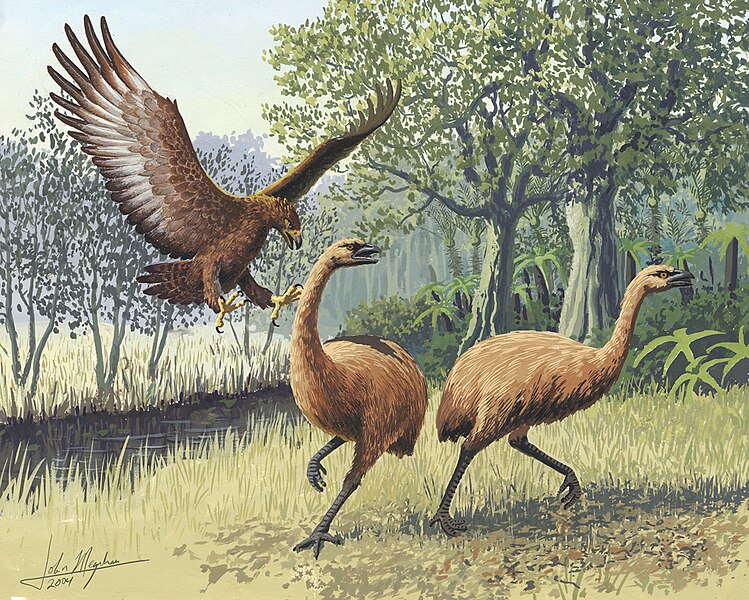
Giant Haast's Eagle attacking New Zealand Moa
[John Megahan, PLoS Biology, CC BY- 2.5]

In 1877 the great English anatomist Sir Richard Owen suggested that these big animals had been driven extinct by “the hostile agency of man”. That is, hunting did it, in a process we now call overkill. Other people responded that climate change must have been the cause, and it was on.

A string of recent studies from a wide range of disciplines – geochronology, palaeoecology, palaeontology, and ecological modelling – have supported Owen’s opinion. But the argument continues. Why?

The main reason is that many Australian archaeologists reject overkill. They have looked for direct evidence that people killed megafauna, and they haven’t found it. No great piles of bones around ancient campsites; no diprotodon skeletons with spears stuck in their ribs; no arsenal of specialised weapons for bringing down large prey. Very few archaeological sites even have remains of people and megafauna in close association.

Some archaeologists conclude that megafauna-hunting just did not happen, or if it happened it was rare and insignificant. Often this conclusion is stated with a ringing confidence that dismisses all non-archaeological evidence for overkill.

But they have not asked a crucial question: if people did hunt megafauna to extinction, how much evidence of killing should we now be able to get from archaeological sites? A new paper by archaeologists Todd Surovell and Brigid Grund suggests the answer to that question is “very little or none”.

Surovell and Grund point out, first, that the period when archaeological evidence of killing of megafauna could have been formed is a small fraction of the total archaeological record of Australia. People arrived here between about 50,000 and 40,000 years ago. This is also the interval during which animals like diprotodon disappeared. A comparison of archaeological and fossil dates suggests humans and megafauna overlapped for only about 4,000 years continent-wide, and modelling suggests that if hunting caused extinction it would have been all over in less than 1,000 years in any place.

This means that no more than 8%, perhaps as little as 2%, of the Australian archaeological record covers the period of human-megafauna interaction. The “smoking gun” evidence of overkill should therefore be rare. Surovell and Grund show that the problem of finding such evidence is even worse than that, for two reasons.

First, when people first arrived their populations were necessarily small. Living sites therefore occurred at low density. As population size grew exponentially, site density increased. So, the very earliest sites must be far rarer than later ones.

But if overkill happened, populations of megafauna would have been going down as humans went up: as the density of sites was rising the proportion of them that could have contained evidence of megafauna kills was falling. Thus, sites with potential to preserve that evidence are actually a tiny proportion, perhaps much less than .01%, of the total archaeological record.

Second, material in archaeological sites degrades with time due to breakdown, weathering and scavenging of bone and removal by erosion. Old sites are eventually buried under sediments. The probability of discovering archaeological sites from the earliest occupation of Australia is intrinsically much lower than for later times, and most of the contents of those sites will have disappeared.

In fact, the very oldest archaeological sites in Australia typically contain only a few stone tools. They can tell us very little about interaction of the first Australians with any animals or plants, let alone reveal a picture of megafauna-killing.

Our fundamental task as scientists is to test hypotheses using evidence. To test the overkill hypothesis, we need a kind of evidence that would differ according to whether the hypothesis is true or false. Obviously, if overkill did not happen, evidence of megafauna-killing should be rare in the archaeological record. But, Surovell and Grund’s analysis makes it clear that if overkill happened, we should still expect evidence of killing to be rare. Therefore, failure to find such evidence does not amount to a test of the overkill hypothesis.

This does not mean that archaeological evidence of killing (or absence of such evidence) is useless in testing the overkill hypothesis. Surovell and Grund show it can be useful, by comparing the archaeological records of Australia, North America and New Zealand. All three places lost their megafaunas when people arrived, but this happened a very long time ago in Australia, and very recently (700 years ago) in New Zealand. North America is intermediate, with human arrival and extinction from 14,000 to 13,000 years ago.

Applying the same logic to all three cases, we predict that if overkill caused megafaunal extinction in each place the archaeological evidence of killing should be abundant in New Zealand, rare in North America, and vanishingly rare in Australia. That is exactly what we find.

There is so much evidence showing New Zealand’s moa were heavily hunted that nobody doubts overkill was the main cause of their extinction. In North America, there are undoubted kill sites for mammoths, mastodons and a few other species, but this evidence is far thinner than in New Zealand. Australian archaeology is yet to reveal any convincing evidence for megafauna-killing.

So, far from disproving overkill, the archaeological evidence from Australia is actually consistent with the overkill hypothesis.


Profile-photo
About the Author

Christopher Johnson is an ecologist, interested in pure and applied ecology, environmental history, the biology of extinction, conservation and wildlife management. He is a Professor of Wildlife Conservation and ARC Australian Professorial Fellow at University of Tasmania.
Christopher Johnson receives funding from the Australian Research Council.
This article was originally published at The Conversation. Read the original article.

Evolution: Size Matters

on 01 March 2012

Nature comes in many sizes: leaf sizes
[bonsaitonight.com]
The size of an animal is not fixed. Size is determined by the environment the animal lives in to maximize its survival. Size determines how much you need to feed, what you’re going to feed, and what’s going to feed on you. Everything depends on size.

The elephant is the largest land animal today with the height up to eight feet to the shoulders. But the elephants’ ancestors, the mammoth, were much larger with the exception of the Pygmy Mammoth. Pygmy Mammoths lived off the coast of California twenty-thousand years ago. An adult Pygmy mammoth stands at five feet, seven inches at the shoulders and were one tenth of the size of their cousin mammoths on the mainland. Why was the Pygmy Mammoth so small? Adaptation. The coast of the island, where the mammoths lived, shrunk due to higher water levels and forced the mammoths to reach higher grounds. The only good food source available was at the top of mountains. Larger mammoths had trouble going up the mountains so they slowly died off. Smaller, more maneuverable mammoths survived and breed so the trait of being smaller was passed on through generations.

Size comparison: elephants and mammoths
[BBC Nature Wildlife]
Insects are known to be small, some only centimeters long. Fossil records show that two-hundred sixty million years ago there were Dragonfly’s with wingspans up to three feet wide, millipedes up to eight feet long, and fly’s the size of small birds. How did insects get so big at that time? Back then oxygen levels in the atmosphere were larger than they are now. The amount of oxygen present determines the size of the insects because with more oxygen intake, the muscles expand to larger sizes and increasing the maximum size or insects. An experiment conducted in the video had normal insects raised in a environment with increased oxygen levels. Today’s levels reach percentages up to twenty-one percent, but the insects used in the experiment were exposed to thirty percent oxygen levels. With this insects grew twenty-five to thirty present larger than normal. If this continued, who knows how big insects can get. But there are some limitations to size such as environmental factors, predators, nutrition, and mobility.

All life forms either grow larger or smaller depending on their environment and ability of survival. But one life form has never gown or shrunk, bacteria. Bacteria is the most essential life form. If humans were to disappear from the face of the earth, ninety percent of species wouldn’t notice. If bacteria were to disappear all life forms will disappear in a matter of hours. 

The Blue Whale is the largest life form that ever lived. Whale ancestors were once land animals but after millions of years and frequent aquatic life, they became completely aquatic. The sudden growth sprout whales went through baffled scientist. How can a large animal like the Blue Whale survive by only eating small creatures such as krill? Blue whales feed on large amounts of krill four hours a day to keep up with energy necessity. Also the buoyancy of water helps counteract the effects of gravity on size limitation. So the whale can grow large without any problems.

Sauropods were the largest land animals to ever live. Sauropods included the Brachiosaurus, the Diplodocus, and the Brontosaurs during the Triassic period about one hundred seventy million years ago. How could these beasts grow up to seventy five feet long and weigh up to thirty tons without any limitations or problems? Back during the Triassic period, carbon dioxide levels so high that it caused plant levels and growth to explode to great amounts. The massive amounts of plants provided enough food for the enormous vegetarians to survive and live. Another question that was brought up is how heavy must their bones be to support such weight? Most would think the bones weighted more but actually the muscle is what gave the giants their weight. The bones were hallow just like modern birds today.

Megafauna comparison chart
[Harry-the-Fox]
So where are the dinosaurs’s today? What killed off the dinosaurs? Well, one of the many hypotheses is that about sixty five million years ago, an asteroid with the energy of about one hundred million tons of TNT struck the earth and raised the earth’s temperature to thirteen hundred degrees Fahrenheit. Most of the lush vegetation was gone. All of the giant vegetarians died off because of no food, and then died the carnivores because off all other animals died. Most giant dinosaurs went extinct. Only animals that survived the blast were the warm blooded mammals similar to today’s rodents.

Today’s humans are an average of five foot eight inches. Fifty thousand years ago the average height was six feet. So what caused the shrinkage of humans? A changing environment. The changing environment killed off most of the humans prey they feed on. So they were forced to find a newer source of food, agriculture. They began to grow seeds and eating what grew out of the ground. This new life style couldn’t support their size so just like the pygmy mammoth, they shrunk. Now in days we have a better nutrition diet and so we are starting to grow in average height. And also what is promoting taller humans are women choosing mates that are tall. If taller men continue to reproduce than later generations will continue to be taller. With time the average height can jump from today’s five foot eight to six feet again.
“As human beings and all life on earth moves to the future, all the factors affecting body size from mating, to predation and to environment will continue to be in play and are likely to produce amazing and unexpected results as size continues to evolve.” [unknown author]


Profile-photo
About the Author


I'm Jose Pierre and I like learning about all aspects of culture, both ancient and modern. I enjoy learning how they communicated, expressed themselves, and their technology.


Profile-photo
About the Author


I'm Jose Pierre and I like learning about all aspects of culture, both ancient and modern. I enjoy learning how they communicated, expressed themselves, and their technology.

Share This

Never miss an article, subscribe here!

Credits & Policies

Banner created by Melanie Magdalena.

Images courtesy of: Ricardo Liberato (Pyramids of Giza), Aurbina (Moai), Maria Reiche (Nazca), Zunkir (Gobekli Tepe), Bjorn Christian Torrissen (Chichen Itza), Gareth Wiscombe (Stonehenge).

Images were released to the public and/or licensed under Creative Commons.

Editor's Note

Welcome to BermudaQuest, a free online journal primarily about Archaeology, Ancient History, and stories about different cultures from around the world.

Founded by Melanie E Magdalena, BermudaQuest and Origins (our magazine) have over a million readers! We would love to include your insight, experience, photos, and thoughts about your culture, heritage, and travels. Make sure you check out Origins, with over 4 million readers!