Stay Risk Free and Save the World
By Melanie Magdalena
As a Thanksgiving tribute, who traditionally has turkey for dinner? And at a broader scope, how about meat on a daily to semi-daily basis? Turkey is a genetically enhanced poultry with antibiotics and estrogenic hormones that in the long run, not only turkey but other genetically modified animal products as well, pollute the soil and increase the risk of breast and reproductive cancers (Weil). Wanda Embar explains the commercial turkey as, “Altered to grow twice as fast, become twice as large, have white feathers and abnormally large breasts. All these changes have caused serious health problems like collapsed lungs, swollen joints, crippled feet and heart attacks. Commercial turkeys are also unable to reproduce naturally and are artificially inseminated instead.” Debeaked turkey with their toes trimmed are raised in an overcrowded shed in a warehouse and slaughtered 14-21 weeks old, depending on how enhanced they are. Maintaining an animal product free diet not only increases your chances of being healthier, but also decreases the impact of animal agriculture on our earth, air, and water supplies with a substantial knock-out of important global warming factors.
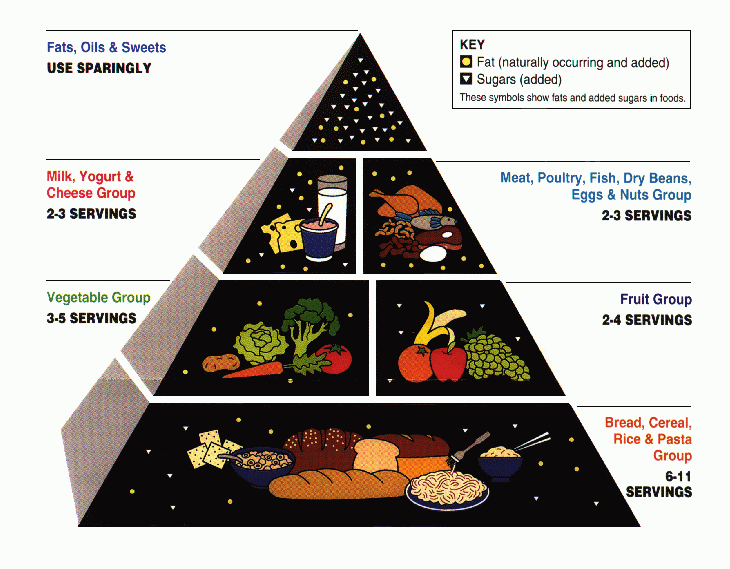
Glancing at the familiar food pyramid (Figure 1) a balanced diet consists of 6-11 servings of grains, 3-5 servings of vegetables, 2-4 servings of fruit, 2-3 servings of protein, 2-3 servings of dairy, and sparing intake of fats, oils and sweets. Switching to a vegetarian pyramid (Figure 2) there are 6-11 servings of grains, 3-5 servings vegetables, 2-4 of fruit, 2-3 servings of dairy/fortified foods, 2-3 servings of protein, and sparing intake of fats, oils, and sweets. Where’s the difference? There is simply no intake of animal meats. However, other than the health risks from genetic enhancements for animal growth animal agriculture also have a damaging impact on the Earth.
Figure
Vegetarianism spurred in the early 1800s with Reverend William Cowherd and his sermon quoting Genesis 9:3, “And God said, every moving thing that liveth shall be meat for you: even as the green herb I have given you all things, but the flesh, with the life thereof, which is the blood thereof, shall ye not eat” (Antrobus). This sermon given to the congregation of a small chapel in Salford, Sweden was the beginning of abstinence from meat.
Until the 1950s people cooked at home until “casual dining” gained unreasonable popularity and poorer foods were eaten more often, if not regularly. Fast food caused an unprecedented rise in obesity levels and a not unrelated climb in healthcare crisis (Bittman). The Green Revolution of the 1970s introduced hybridized seeds to increase produce populations. These were dependent on fossil fuels, which increased carbon dioxide emissions causing global climate changes that negatively affected global agriculture productivity (Katz). Therefore, meat began tasting less and less, morality disappeared from animal treatment, and nobody cared to stand up for a change until outbreaks of mad cow disease and salmonella became an issue (Bittman). More seeds were used to produce more food for animals creating a vicious never-ending cycle. No, not even this caused much change, simply an increase in governmental policy regarding food handling. Vegetarianism took a leap of faith from Biblical reference to a world-crisis solution.
American best-selling author and talk show guest Kathy Frestonwrote the article “Vegetarian is the New Prius,” for the Huffington Post in 2007, explaining the consequences of animal agriculture. Her reference to the UN states, “[…] almost a fifth of global warming emissions come from livestock.” She goes on to clarify, “that’s more emissions than from all of the world’s transportation combined.” Her claim in the article is that every car in the world could be electric and animal agriculture would still impact the world. Animal agriculture takes up an incredible 70% of all agricultural land, and 30% of the total land surface of the planet (Freston).
Why is animal agriculture so environmentally damaging? Land has to be cleared for agriculture, animals have to be fed, and animals have to be transported to a slaughterhouse, packaged, and shipped to their consumer destination. Water is needed to water the crops being fed to the animals, plus animals need water to survive as well, along with cleaning factories, transportation equipment and vehicles, and the slaughterhouses (PETA). Animal agriculture accounts for 9% of carbon dioxide emissions while the manure produced releases 37% of methane emissions and 65% of nitrous oxide (Freston) and requires more than 2,400 gallons of water per pound of meat (PETA).
The North American Vegetarian Society (NAVS) launched a poster on October 1, 2010 for World Vegetarian Day and Vegetarian Awareness Month with the following, “By maintaining a vegetarian diet you can:
· Reduce the risk of major killers such as heart disease, stroke and cancer while cutting exposure to food borne pathogens;
· Provide a viable answer to feeding the world’s hungry population through more efficient use of grains and other crops;
· Save animals from suffering in factory-farm conditions and from the pain and terror of slaughter;
· Conserve vital and limited freshwater, fertile topsoil, and other precious resources;
· Preserve irreplaceable ecosystems such as rainforests and other wildlife habitats;
· Mitigate the ever-expanding environmental pollution of animal agriculture;
· And decrease greenhouse gases that are accelerating global warming.”
So where is my credibility? Dr. Weil, the North American Vegetarian Society, and Kathy Freston all have reasonable arguments to be vegetarian. From personal experience, I was raised around animals since my father is an animal broker. My passion for animals was visible since I was child by despising Barbie dolls and playing with stuffed animals and TY Beanie Babies. In my teenage years that I was given a choice: to play my part in stopping animal agriculture or doing nothing at all. There is no in between. Not only was I able to challenge my high metabolism and gain weight, but I reached a moral satisfaction by helping stop a greater problem. So now I ask you, will you continue your ways and encourage animal agriculture or will you face it and stop it with vegetarian or vegan lifestyles? Stay risk free, save the world, and have a Happy Thanksgiving.
Works Cited.
Antrobus, Derek. “Vegetarianism: Neither Phoenix nor Fad.” New Vegetarian & Natural Health Spring, 2003, p26-29. Print.
Bittman, Mark. Why take food seriously? Because your life depends on it: Everything’s an Argument. USA: Bedford/St. Martin’s, 2010.
Embar, Wanda. “Animal Cruelty: Turkey.” Veganpeace.com. N.d. Web. 20 November 2010.
Freston, Kathy. “Vegetarian is the New Prius.” Huffingtonpost.com. The Huffington Post, 18 January 2007. Web. 15 November 2010.
“Food Pyramids: What They Are and Why You Should Avoid Them.” Chart. Open Water Chicago. Web. 22 November 2010.
“‘Good Eating’ Guidelines.” Chart. Seventh Day Adventists. Web. 22 November 2010.
Katz, Solomon H. The World’s Food Crisis, An Overview of the Causes and Consequences: Everything’s an Argument. USA: Bedford/St. Martin’s, 2010.
“Meat Production Wastes Natural Resources.” PETA.org. People for Ethical Treatment of Animals, 2010. Web. 15 November 2010.
“Vegetarian Awareness Month.” Chart. North American Vegetarian Society. NAVS. 18 November 2010. Print.
Weil, Andrew. “Hearty Helping of Cancer Prevention?” AlkalizeForHealth. Alkalize for Health, N.d. Web. 22 November 2010.