Showing posts with label Neolithic. Show all posts

Cosquer Cave

on 24 February 2012

Cosquer Cave
Image courtesy culture.gouv.fr
Cosquer Cave is located at Cape Morgiou, in the Calanques (Calanques are limestone cliffs very steep and with very deep waters with steep and dangerous shores), near Marseilles. It can be accessed through a tunnel 175 metres in length, which is 37 metres under the sea level due to the rise of the Mediterranean in Paleolithic times. It was discovered by diver Henri Cosquer in 1985, but its contents were not made public until 1991, when three divers became lost in the cave and tragically died.

In 1991 Cosquer made his fifth attempt to reenter with a new batch of experienced divers from his own club. This time they entered the other lake; from there Cosquer noticed an image of a human hand on the walls and was photographed. Reaching home when the films were developed he could notice two more hands and a feeling that they have bumped upon something marvelous began to haunt them. If Cosquer was not lucky enough to notice the ‘hand’ and the outside world would never have come to know about this prehistoric treasure that existed.

Stencil of a human hand dated 27,000 BCE, 
shown at the Musée d'Archéologie Nationale
(National Museum Archeology)
in Saint-Germain-en-Laye, France
The most unique feature of this cave is that it contains several dozen works painted and engraved between 27,000 and 19,000 years ago, decorated with a variety of land animals, penguins, cats, and engravings on the walls, but also with seals and auks, fifty-five hand stencils, and numerous digital markings, dozens of geometric symbols, as well as the extraordinary representation of a "slain man".


Caves were the initial homes of men and he could not but give expression to his artistic talents on its walls during resting or idle times may be the usual concept of the images those appear on the walls of caves. But David Lewis Williams states that there is a pattern in the carvings and images on the walls of caves and that would not have done as a time pass. His studies based on ethnography pictures of things happened in the ‘Cro-Magnon arts in the following pattern.


References:

"Cosquer Cave" - Accessed on 25 January 2012


Profile-photo
About the Author


I'm Jose Pierre and I like learning about all aspects of culture, both ancient and modern. I enjoy learning how they communicated, expressed themselves, and their technology.
Painted Caves: Pech Merle

on 09 February 2012

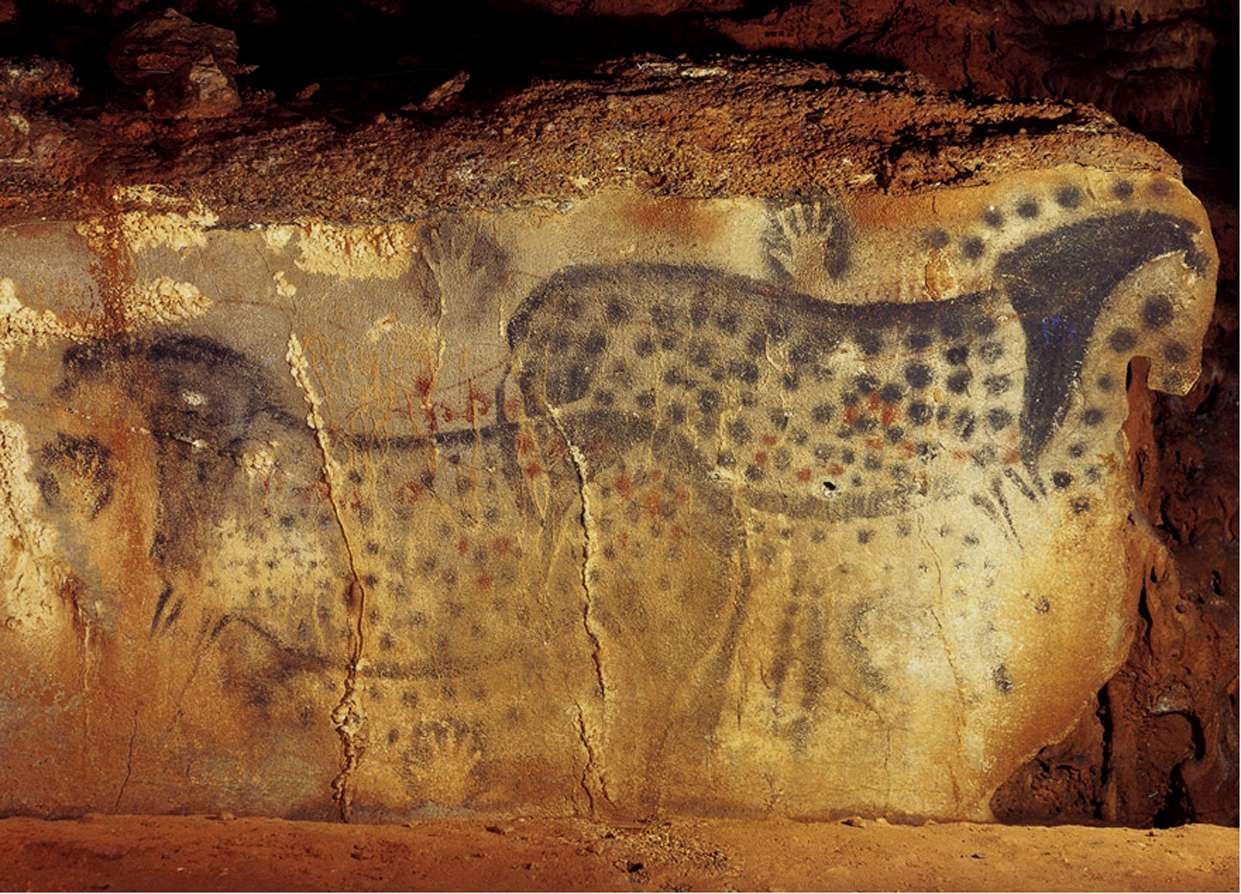
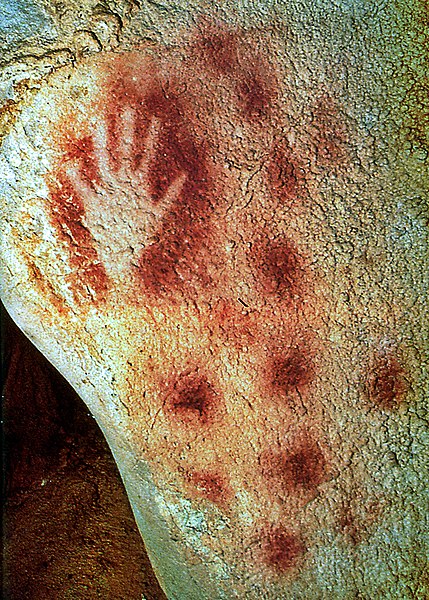
The Pech Merle cave is close to the Cabrerets village in France. Pech comes from the French word puèg that means hill. As for Merle, the origin is unknown. The cave has no signs of prehistoric use in the upper network. The lower network galleries were discovered in 1922 by André David and Henri Dutertre. The cave paintings and engravings were examined by Father Amédée Lemozi. The cave was opened to the public in 1926 as a “historic monument” and is property of Cabrerets. It is over two kilometers in length, and a third is open to visitors. The seven large halls display subterranean sceneries. Within ten kilometers, there another dozen painted caves sealed off from the public. 

Painting of horses and hands, SlideShare
In 1992, Michel Lorblanchet and Mrs. Hèléne Valladas took samples from the Cougnac cave. Valladas returned with her team and radiocarbon dated the megaloceros panel to 23,000 – 25,000 years old and the dots to 14,000 years old. In 1995, Michel Lorblanchet and his team of specialists took samples from the black contour of the “dotted horses” painting in Pech Merle. The samples were a mixture of manganese and barium oxide. Valladas later radiocarbon dated one of the twenty samples – the other nineteen had too little charcoal – to around 25,000 years old. 

Cave painting of human hands, Wikipedia Commons
In 1998, bones were discovered in the Ossuary hall of Pech Merle. The hall is decorated with paintings and finger drawings. The floor of clay was crammed with animal bones and a path was created for visitors in the low dome room. Later, Jean Claude Faurie took bone samples and so far 118 have been marked, studied and drawn. The bones are from bears, cervidae, reindeers, horses, hyenas, lions, aurochs, and bison. Of these, a bone is engraved by man-made notches and others have been sawed. In 1998, an additional cave was found in the area, Pestillac.


Profile-photo
About the Author


I'm Melanie, the founder of BermudaQuest and an archaeology undergraduate at the University of New Mexico. I love writing about ancient and modern cultures. My goal is to make information about our origins available to everyone [in simple English!]

Share This

Never miss an article, subscribe here!

Credits & Policies

Banner created by Melanie Magdalena.

Images courtesy of: Ricardo Liberato (Pyramids of Giza), Aurbina (Moai), Maria Reiche (Nazca), Zunkir (Gobekli Tepe), Bjorn Christian Torrissen (Chichen Itza), Gareth Wiscombe (Stonehenge).

Images were released to the public and/or licensed under Creative Commons.

Editor's Note

Welcome to BermudaQuest, a free online journal primarily about Archaeology, Ancient History, and stories about different cultures from around the world.

Founded by Melanie E Magdalena, BermudaQuest and Origins (our magazine) have over a million readers! We would love to include your insight, experience, photos, and thoughts about your culture, heritage, and travels. Make sure you check out Origins, with over 4 million readers!