Showing posts with label Oceania. Show all posts

Megafauna Extinction: Hunting or Climate?

on 12 March 2013

Hunting or climate change? Megafauna extinction debate narrows

By Christopher Johnson, University of Tasmania

What is the oldest debate in Australian science? Probably, the argument over what caused extinction of our Pleistocene megafauna – the diprotodons, giant kangaroos, marsupial tapirs, über-echidnas and other big and bizarre creatures that used to live here.
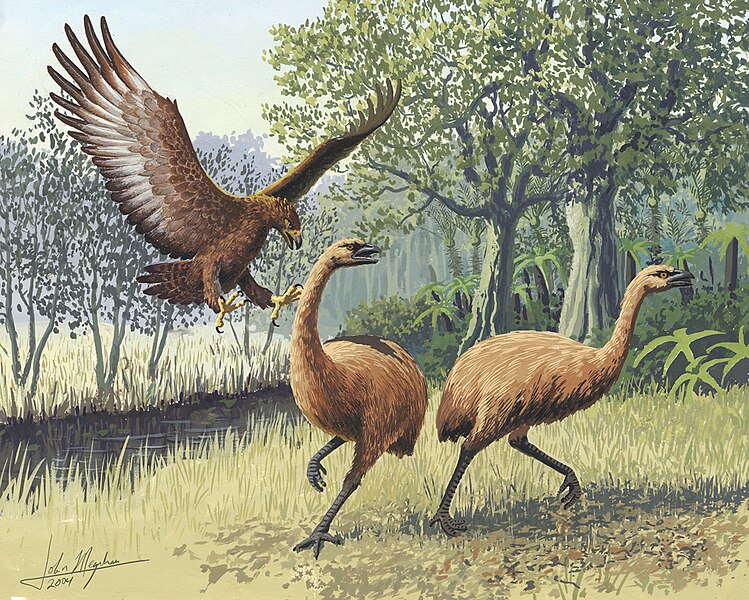
Giant Haast's Eagle attacking New Zealand Moa
[John Megahan, PLoS Biology, CC BY- 2.5]

In 1877 the great English anatomist Sir Richard Owen suggested that these big animals had been driven extinct by “the hostile agency of man”. That is, hunting did it, in a process we now call overkill. Other people responded that climate change must have been the cause, and it was on.

A string of recent studies from a wide range of disciplines – geochronology, palaeoecology, palaeontology, and ecological modelling – have supported Owen’s opinion. But the argument continues. Why?

The main reason is that many Australian archaeologists reject overkill. They have looked for direct evidence that people killed megafauna, and they haven’t found it. No great piles of bones around ancient campsites; no diprotodon skeletons with spears stuck in their ribs; no arsenal of specialised weapons for bringing down large prey. Very few archaeological sites even have remains of people and megafauna in close association.

Some archaeologists conclude that megafauna-hunting just did not happen, or if it happened it was rare and insignificant. Often this conclusion is stated with a ringing confidence that dismisses all non-archaeological evidence for overkill.

But they have not asked a crucial question: if people did hunt megafauna to extinction, how much evidence of killing should we now be able to get from archaeological sites? A new paper by archaeologists Todd Surovell and Brigid Grund suggests the answer to that question is “very little or none”.

Surovell and Grund point out, first, that the period when archaeological evidence of killing of megafauna could have been formed is a small fraction of the total archaeological record of Australia. People arrived here between about 50,000 and 40,000 years ago. This is also the interval during which animals like diprotodon disappeared. A comparison of archaeological and fossil dates suggests humans and megafauna overlapped for only about 4,000 years continent-wide, and modelling suggests that if hunting caused extinction it would have been all over in less than 1,000 years in any place.

This means that no more than 8%, perhaps as little as 2%, of the Australian archaeological record covers the period of human-megafauna interaction. The “smoking gun” evidence of overkill should therefore be rare. Surovell and Grund show that the problem of finding such evidence is even worse than that, for two reasons.

First, when people first arrived their populations were necessarily small. Living sites therefore occurred at low density. As population size grew exponentially, site density increased. So, the very earliest sites must be far rarer than later ones.

But if overkill happened, populations of megafauna would have been going down as humans went up: as the density of sites was rising the proportion of them that could have contained evidence of megafauna kills was falling. Thus, sites with potential to preserve that evidence are actually a tiny proportion, perhaps much less than .01%, of the total archaeological record.

Second, material in archaeological sites degrades with time due to breakdown, weathering and scavenging of bone and removal by erosion. Old sites are eventually buried under sediments. The probability of discovering archaeological sites from the earliest occupation of Australia is intrinsically much lower than for later times, and most of the contents of those sites will have disappeared.

In fact, the very oldest archaeological sites in Australia typically contain only a few stone tools. They can tell us very little about interaction of the first Australians with any animals or plants, let alone reveal a picture of megafauna-killing.

Our fundamental task as scientists is to test hypotheses using evidence. To test the overkill hypothesis, we need a kind of evidence that would differ according to whether the hypothesis is true or false. Obviously, if overkill did not happen, evidence of megafauna-killing should be rare in the archaeological record. But, Surovell and Grund’s analysis makes it clear that if overkill happened, we should still expect evidence of killing to be rare. Therefore, failure to find such evidence does not amount to a test of the overkill hypothesis.

This does not mean that archaeological evidence of killing (or absence of such evidence) is useless in testing the overkill hypothesis. Surovell and Grund show it can be useful, by comparing the archaeological records of Australia, North America and New Zealand. All three places lost their megafaunas when people arrived, but this happened a very long time ago in Australia, and very recently (700 years ago) in New Zealand. North America is intermediate, with human arrival and extinction from 14,000 to 13,000 years ago.

Applying the same logic to all three cases, we predict that if overkill caused megafaunal extinction in each place the archaeological evidence of killing should be abundant in New Zealand, rare in North America, and vanishingly rare in Australia. That is exactly what we find.

There is so much evidence showing New Zealand’s moa were heavily hunted that nobody doubts overkill was the main cause of their extinction. In North America, there are undoubted kill sites for mammoths, mastodons and a few other species, but this evidence is far thinner than in New Zealand. Australian archaeology is yet to reveal any convincing evidence for megafauna-killing.

So, far from disproving overkill, the archaeological evidence from Australia is actually consistent with the overkill hypothesis.


Profile-photo
About the Author

Christopher Johnson is an ecologist, interested in pure and applied ecology, environmental history, the biology of extinction, conservation and wildlife management. He is a Professor of Wildlife Conservation and ARC Australian Professorial Fellow at University of Tasmania.
Christopher Johnson receives funding from the Australian Research Council.
This article was originally published at The Conversation. Read the original article.

How Australia can become Asia's food bowl

on 06 June 2012

By Peter Batt, Curtin University

AUSTRALIA IN THE ASIAN CENTURY – A series examining Australia’s role in the rapidly transforming Asian region. Delivered in partnership with the Australian government. Here, Dr Peter Batt looks at Australia’s potential to feed Asia’s rapidly growing population.

Reaping the benefits of the Asian Century starts with food security.
Parker Michael Knight
Asia has the fastest-growing population in world. This will increase the demand for food, but greater urbanisation, westernisation and rising personal wealth is changing the form in which food is consumed.
There is a rising demand for more animal protein in the diet, more dairy products and a greater variety of fresh fruit and vegetables. There is also more demand for value-added food: food that is convenient, safe and which has been produced more sustainably.

While it is the objective of most sovereign nations to be self-sufficient in food, in much of Asia it will be exceedingly difficult to produce enough food. There are major resource constraints in the form of arable land and water. Farmers are often unable to access appropriate technology, and the lack of infrastructure imposes major constraints on the efficient distribution of food.

Opportunities and challenges


To the south, Australia is well positioned to take advantage of the emerging opportunities. However, Australia must also find a way to address the many impediments that threaten to restrict market opportunities in the future.

Agriculture is the most volatile sector of the Australian economy. Seasonal variations, primarily in rainfall, have a direct impact on productivity. While productivity per area continues to grow, the rate of growth has slowed considerably. This is because the public is contributing less to research and development expenditure, and because many farmers can’t make the necessary investments in technology, equipment and machinery, due to their diminishing equity position and lack of confidence.

The economies of scale, which once favoured greater farm aggregation, are becoming more elusive. As input costs continue to rise and prices trend downward, the terms of trade are eroding.

While more accurate long-term weather forecasts may provide farmers with the information to make better decisions, the full impact of climate change is expected to place a considerable burden on the public purse. Huge investments in infrastructure will be necessary in much of the country to provide a regular and reliable source of water.

If the potential for agriculture in north Australia is to be realised, transport and logistics systems will need to be enhanced to ship the products to population centres.

Selling GM


Conventional plant breeding systems are likely to give way to the increasing use of genetic modification. Many consumers have concerns about the introduction of genetically modified plants.

But if the technology can be shown to reduce the use of agricultural chemicals and fertilisers, water and fossil fuels, and to deliver positive benefits to health and nutrition through enrichment, consumer resistance should diminish. This is even more likely if the use of GM reduces the costs of production and if that cost reduction flows through to consumers.

The high value of the Australian dollar is putting pressure on producers both domestically and abroad. Domestically, competition between the two major supermarket chains is driving food prices lower, often to the point where farmers' profit margins are so small they can’t invest in new technology and new product development.

And more liberal terms of trade enable many food ingredients to be imported at prices well below the costs of production. This is forcing many food processing plants to close, with a commensurate negative impact on employment, farmers and rural communities.

The food bowl of Asia


As markets evolve, there is an increasing demand for higher quality products. Beyond the tangible characteristics of the product itself – such as size, shape, colour and appearance – consumers are now also expecting sustainably produced food. Australia leads the world in the implementation of quality assurance systems, but the uptake of sustainable farming practices has been slow, despite Australia having one of the most fragile ecologies.

To access world markets, Australian food producers have to show that their product has been produced using good agricultural practice. But competition between global retailers is continuously raising the bar, imposing additional costs on all food producers. These costs are seldom recovered, and this absence of sufficient financial incentives provides the major barrier to the more widespread adoption of sustainable farming practices.

However, there is a long-term public benefit in supporting the more sustainable use of resources and encouraging the more widespread adoption of integrated crop management.

If Australia is to become the food bowl of Asia, we need to start making changes now.


This is part fifteen of Australia in the Asian Century. You can read other instalments by clicking the links below:


Profile-photo
About the Author

Dr Peter J. Batt is professor and head of agribusiness within the School of Management, Curtin Business School. He has been internationally recognised for his work in linking smallholder producers to institutional buyers through facilitating collaborative long-term relationships. With an undergraduate degree in Horticulture Science and post graduate qualifications in business and marketing, Peter has the unique ability to analyze agriculture supply chains from pre-farm gate to the ultimate consumer.
Peter Batt does not work for, consult to, own shares in or receive funding from any company or organisation that would benefit from this article, and has no relevant affiliations.
This article was originally published at The Conversation. Read the original article.

Civilizations Around the World: Australian Aborigines

on 02 November 2011

The Most Sacred Place in Australia

Uluru or Ayers Rock is located at the southern part of Northern Territory in Central Australia. The landmark is located within Uluru-Kata Tiu’a National Park. It is a large sandstone rock formation that rises up from the Australian flatland. The area has been declared as a UNESCO World Heritage Site.

Uluru is sacred to the Anangu, the local population of Aborigines in the area. What seems like a flat mountain on a flatland, is actually an oasis in the area. There are many springs, waterholes, rock caves and many ancient paintings of the indigenous population in the area.


The landmark was named Ayers Rock by then surveyor William Gosse in July 19, 1873, in honor of then Chief Secretary of South Australia, Sir Henry Ayers. The local populace calls the landmark as Uluru. In 1993, the dual naming policy was put in place and in December of that year, the landmark has been named Ayers Rock/Uluru, in consonance with the English and Aboriginal official names. In November of 2002, the names were reversed to Uluru/Ayers Rock upon the request of the Regional Tourism Association of Alice Springs.

Uluru is made of sandstone rising 1,142 feet from the flatland. The rock has a total circumference of 9.4 km. The formation has great cultural as well as religious value for the Anangu people, the local indigenous people of the area. It is also noticeable that the formation changes color at different times of the day. It glows a glorious red at dawn and at sunset. When there is rainfall in the area, the Uluru changes to silvery-gray with streaks of black, where algae formations occur as water channels over the formation.

The area is also rich in animal and plant life. There are known to be forty-six separate species of mammals in the area but this has decreased notably over the years. The local animal life includes the Malleefowl, the Common Brushtail Possum, the Rufous Hare-Wallaby or also known as the Mala, the Bilby, the Burrowing Betong and the Black-Flanked Wallaby. Also indigenous to the area is the Mulgara, which is now vulnerable to extinction. The region is also home to the Marsupial Mole, the Woma Python and the Great Desert Skink. In the plain areas, there is the Red Kangaroo, the Bush Turkey, the Emu, the Sand Goanna and the Perentie. Other mammalian life is the house mouse, the camel, the fox,
the dog, the cat and the rabbit.

According to the Anangu, the original landowners of the Uluru, the world was once a featureless place. None of the places known existed until the creators, in the forms of people, plants and animals traveled all across the land. During the process of creation and destruction, the creator spirits formed the landscape as it is known today. Now, the Anangu land still is home to the spirit people, known as Tjukuritja or Waparitja. There are other stories about the creation of the Uluru, mainly due to wars and conflicts between the spirit beings.

One of the myths regarding Uluru would be the curse befalling on those who take rocks from the formation. Besides these myths and curses, the area is beautiful and rich in history. As it is, it is one of the places to see in the world that needs to be seen before one dies.
Marc Castro is the online editor for the popular community Australian Forum. For a more comprehensive discussion on Uluru, do visit us at Aviation Deal Expands Choice for Visitors to Australia.

Share This

Never miss an article, subscribe here!

Credits & Policies

Banner created by Melanie Magdalena.

Images courtesy of: Ricardo Liberato (Pyramids of Giza), Aurbina (Moai), Maria Reiche (Nazca), Zunkir (Gobekli Tepe), Bjorn Christian Torrissen (Chichen Itza), Gareth Wiscombe (Stonehenge).

Images were released to the public and/or licensed under Creative Commons.

Editor's Note

Welcome to BermudaQuest, a free online journal primarily about Archaeology, Ancient History, and stories about different cultures from around the world.

Founded by Melanie E Magdalena, BermudaQuest and Origins (our magazine) have over a million readers! We would love to include your insight, experience, photos, and thoughts about your culture, heritage, and travels. Make sure you check out Origins, with over 4 million readers!