Media commentators have been eager to paint Neanderthals as artists - but why?
An article published recently in Science sheds new light on paintings found in 11 cave sites in Spain. At 40,800 years old, some of these paintings could be among the oldest anywhere in the world.
But were these paintings done by Neandertals or the modern humans who replaced them? From the headlines you would think it was the Neandertals.
Taken together with other recent publications, summarised in the image of Google search results below, the Spanish results suggest the habit of producing art in various forms went back to the earliest appearance of modern humans in Europe.
This is only about 5,000 or 10,000 years after people also reached Australia. Why then did the media grab the idea that the paintings might have been made by Neandertals, who were replaced by these artistic modern humans in Europe?
Google Search Results
Google
Recent improvements in radiocarbon dating have shown modern humans were in southern England more than 41,500 years ago, that people left flutes and figurines in Swabia more than 38,000 years ago, engravings in the Dordogne region about 36,500 years ago, and paintings around 35,000 years ago at Chauvet Cave, west of the Rhone valley.
Taken together there is now no doubt there were distinct types of art in Europe close to 40,000 years old, and generally not associated with Neandertals.
Yet the headlines on at least four continents relating to the new Spanish results asserted that Neandertals could have been responsible for the art.
They produced very little (if anything) in the way of art, but modern humans in Europe went on to produce several different forms of art over most of the next 30,000 years. In Australia, art may have arrived with the first people and was certainly being produced by different Aboriginal groups into the 20th century.
The media coverage of the latest Spanish results is all the more surprising given it relies on a throwaway line at the end of the Science paper on the Spanish cave art dating: “it cannot be ruled out that the earliest paintings were symbolic expressions of the Neandertals”, though no evidence is produced.
Remains of the day
Neandertal remains were first discovered in 1829, 30 years before the publication of Charles Darwin’s On the Origin of Species, but it was not until five years later that anyone suggested they were a different species from ourselves. The status of Neandertals has been the subject of varying interpretations, like the more recently discovered Homo floresiensis.
Interpretations of fossils and their relationships to us are not easy and, where Neandertals are concerned, they depend more than we would like to admit on attitudes that are often not expressed.
First reconstruction of Neanderthal Man, 1888
Wikimedia
The most famous example is the suggestion in 1957, by the anatomists William Straus and AJ Cave, that a Neandertal wearing modern clothes would look no different from other passengers on the New York Subway. It is difficult to decide whether this is a compliment to Neandertals, or not.
There are some substantial reasons why it’s difficult to get a full picture of Neandertals. A pattern was described in the 19th century that Neandertals made stone tools using flakes that archaeologists called Mousterian, and did not make bone tools, art or ornaments. Following them, modern humans made stone tools using parallel-sided blades that were rare earlier, and did make bone tools, art and ornaments. Scholars and the general public lined up with the view that people like us replaced people who were not like us.
But as is to be expected, the story is not quite as neat. The earliest paint has been found in South Africa dated to 100,000 years ago, far away from Neandertals and long before modern humans in Europe.
Recent discoveries tend to suggest more overlap between the species in stone and bone tools, art and ornaments. But against this, there have been very few dated fossils and early attempts to provide dates were distorted by the fact that the supposed transition between Neandertals and modern humans occurred at about the period when radiocarbon dating ceases to be useful.
Neanderthals and Humans
KRT/AAP
Close scrutiny sometimes shows, as here, that evidence showing modern behaviour among Neandertals is thin, so why did one journalist – according to a colleague of mine who was interviewed about the Spanish cave art – say he “really, really wanted" to write a story that Neandertals created the art? Why did so many news outlets happily rush to this same, somewhat flawed, conclusion?
The reasons lie partly in our ambivalent relations with creatures that are like us but not quite the same. Perhaps the most obvious are dogs, which are like us because they attend assiduously to our blandishments, or bears which can have a similar body plan and proportion, yet are dangerous, so we infantilise them as teddy bears.
And then there are imaginary creatures such as yetis, hobbits, trolls, and gods, invented to remind us where the boundaries of humanity lie.
Perhaps the media’s fascination arises from the fact archaeologists and biological anthropologists are testing which side of that boundary Neandertals lie.
About the Author
Iain completed his Ph.D at Cambridge based on Spanish Palaeolithic fauna and economy, and has since carried out research and publication on the Spanish Palaeolithic and on Australian prehistory. He has published extensively on the archaeology of language origins. He conducts research on all aspects of archaeology including painted caves in Northwestern Queensland and consultancy in Queensland, N.S.W. and Western Australia. His current research interests include rock art and the narrative of Australian archaeology.
Iain Davidson has received funding from the ARC, AIATSIS, and AINSE. He has conducted archaeological research on Spanish cave art. He is affiliated with the University of New England, Flinders University, University of Queensland and Harvard University.
Cosquer Cave is located at Cape Morgiou, in the Calanques (Calanques are limestone cliffs very steep and with very deep waters with steep and dangerous shores), near Marseilles. It can be accessed through a tunnel 175 metres in length, which is 37 metres under the sea level due to the rise of the Mediterranean in Paleolithic times. It was discovered by diver Henri Cosquer in 1985, but its contents were not made public until 1991, when three divers became lost in the cave and tragically died.
In 1991 Cosquer made his fifth attempt to reenter with a new batch of experienced divers from his own club. This time they entered the other lake; from there Cosquer noticed an image of a human hand on the walls and was photographed. Reaching home when the films were developed he could notice two more hands and a feeling that they have bumped upon something marvelous began to haunt them. If Cosquer was not lucky enough to notice the ‘hand’ and the outside world would never have come to know about this prehistoric treasure that existed.
Stencil of a human hand dated 27,000 BCE,
shown at the Musée d'Archéologie Nationale
(National Museum Archeology)
in Saint-Germain-en-Laye, France
The most unique feature of this cave is that it contains several dozen works painted and engraved between 27,000 and 19,000 years ago, decorated with a variety of land animals, penguins, cats, and engravings on the walls, but also with seals and auks, fifty-five hand stencils, and numerous digital markings, dozens of geometric symbols, as well as the extraordinary representation of a "slain man".
Caves were the initial homes of men and he could not but give expression to his artistic talents on its walls during resting or idle times may be the usual concept of the images those appear on the walls of caves. But David Lewis Williams states that there is a pattern in the carvings and images on the walls of caves and that would not have done as a time pass. His studies based on ethnography pictures of things happened in the ‘Cro-Magnon arts in the following pattern.
I'm Jose Pierre and I like learning about all aspects of culture, both ancient and modern. I enjoy learning how they communicated, expressed themselves, and their technology.
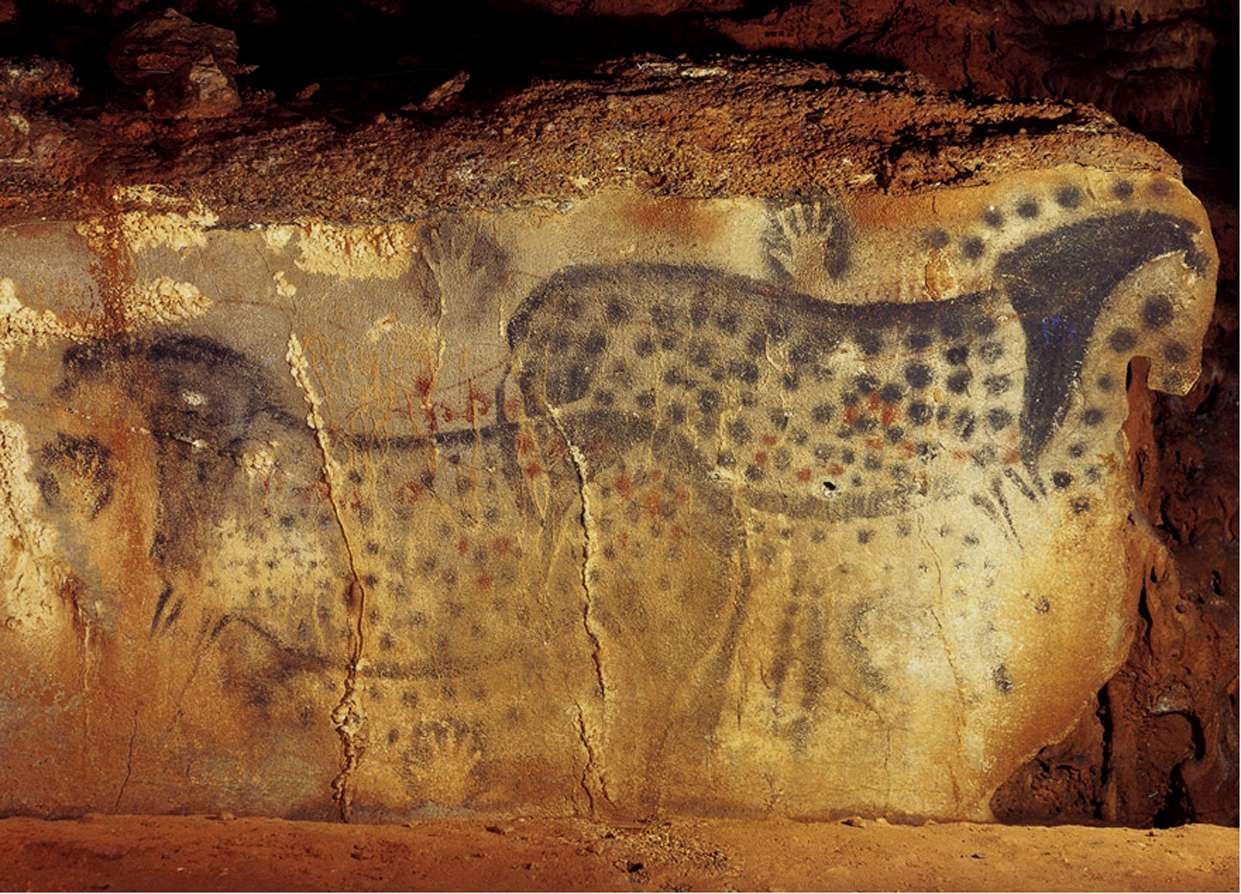
The Pech Merle cave is close to the Cabrerets village in France. Pech comes from the French word puèg that means hill. As for Merle, the origin is unknown. The cave has no signs of prehistoric use in the upper network. The lower network galleries were discovered in 1922 by André David and Henri Dutertre. The cave paintings and engravings were examined by Father Amédée Lemozi. The cave was opened to the public in 1926 as a “historic monument” and is property of Cabrerets. It is over two kilometers in length, and a third is open to visitors. The seven large halls display subterranean sceneries. Within ten kilometers, there another dozen painted caves sealed off from the public.
In 1992, Michel Lorblanchet and Mrs. Hèléne Valladas took samples from the Cougnac cave. Valladas returned with her team and radiocarbon dated the megaloceros panel to 23,000 – 25,000 years old and the dots to 14,000 years old. In 1995, Michel Lorblanchet and his team of specialists took samples from the black contour of the “dotted horses” painting in Pech Merle. The samples were a mixture of manganese and barium oxide. Valladas later radiocarbon dated one of the twenty samples – the other nineteen had too little charcoal – to around 25,000 years old.
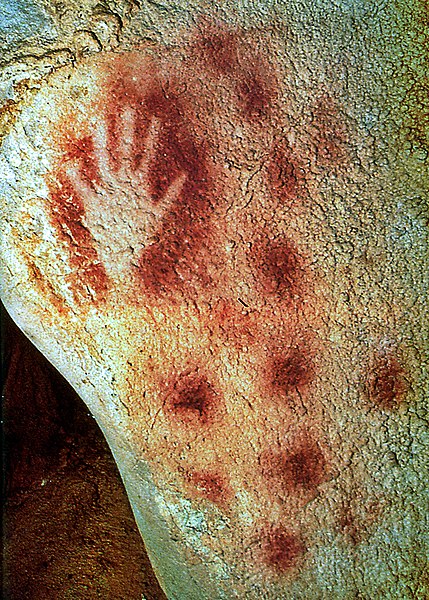
Cave painting of human hands, Wikipedia Commons
In 1998, bones were discovered in the Ossuary hall of Pech Merle. The hall is decorated with paintings and finger drawings. The floor of clay was crammed with animal bones and a path was created for visitors in the low dome room. Later, Jean Claude Faurie took bone samples and so far 118 have been marked, studied and drawn. The bones are from bears, cervidae, reindeers, horses, hyenas, lions, aurochs, and bison. Of these, a bone is engraved by man-made notches and others have been sawed. In 1998, an additional cave was found in the area, Pestillac.
About the Author
I'm Melanie, the founder of BermudaQuest and an archaeology undergraduate at the University of New Mexico. I love writing about ancient and modern cultures. My goal is to make information about our origins available to everyone [in simple English!]
Welcome to BermudaQuest, a free online journal primarily about Archaeology, Ancient History, and stories about different cultures from around the world.
Founded by Melanie E Magdalena, BermudaQuest and Origins (our magazine) have over a million readers! We would love to include your insight, experience, photos, and thoughts about your culture, heritage, and travels. Make sure you check out Origins, with over 4 million readers!
WE'VE MOVED!
Please join our new page! Origins Scientific Research Society now operates BermudaQuest! Please bookmark www.knowyourorigins.org
Explore! by Origins has all of our posts here and all the newest content! We look forward to seeing you on our new and improved site made for our wonderful readers.