Showing posts with label Paleo-Indian. Show all posts

The Paleoindian Period

on 17 February 2012

The Paleoindian period (ca. 13,000 – 7,900 BCE) consists of the occupation areas of the first Indians that crossed the land bridge, that connected Alaska and Siberia, in North America. The land bridge was formed by continent-size glaciers. Glaciers may have prevented the new inhabitants from expanded until after 12,000 BCE. These hunters are characterized by their Clovis points – long, fluted stone projectile points. The Paleoindian period is divided into three subperiods: Early Paleoindian, Middle Paleoindian, and Late Paleoindian.

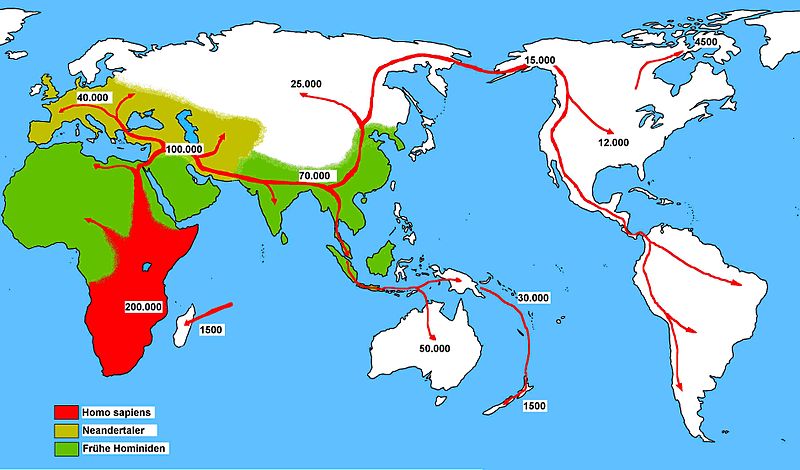
Possible migration routes, Wikipedia Commons
The Early Paleoindian (9,500 – 9,000 BCE) is believed to be a time of exploration and colonization. This has been deduced by examining the wide distribution of Clovis points that were transported large distances from their quarry sources. Large fluted points characterize this subperiod. There are three inhabited environmental zones for this subperiod: cool climate boreal forests, temperate forests, and subtropical sandy scrub. 

The Middle Paleoindian (9,000 – 8,500 BCE) is characterized by fluted and unfluted points that differ in size, larger and smaller, than traditional Clovis points found in the Southeast such as Cumberland, Redstone, Suwannee, Beaver Lake, Quad, Coldwater, and Simpson. The subperiod is viewed as a time for adaptation the optimal resource zones.

The Late Paleoindian (8,500 – 7,900 BCE) is characterized by Dalton and other side-notched points. The points demonstrate a change in adaptive hunting strategy from Late Pleistocene fauna to smaller game, like deer, in southern pine forests instead of boreal. Archaeologists believe that the settlements in the Southeast were permanent or semipermanent camps. Specific locations may have been inhabited around Chert deposits in order to replenish the manufactured stone tools. Settling down in specific areas may also have led to intensive regional specialization that ensured survival and movement into the Archaic period.
Since 1960, the studies of river basin projects, Paleoindian point finds, and site distributions in the Southeast have refined the sequencing of point types and refined the reconstruction of Paleoindian cultural activities.
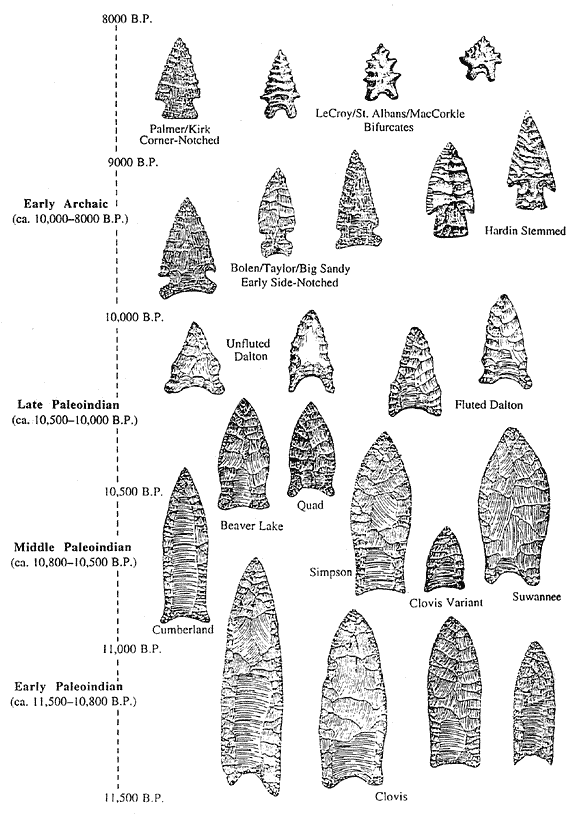
Projectile Point Types, National Parks Service


Profile-photo
About the Author


I'm Melanie, the founder of BermudaQuest and an archaeology undergraduate at the University of New Mexico. I love writing about ancient and modern cultures. My goal is to make information about our origins available to everyone [in simple English!]

Ontario Pleistocene: The Ice Age Horse Debate

on 16 January 2012

Retrieval site, Lake Erie, Southern Ontario
Image courtesy of Jarrod Barker
Some of the most interesting finds in archaeology are discovered by amateurs. Jarrod Barker, publisher of www.thesilo.ca, licensed prospector, artist/musician, and antiquarian, stumbled upon evidence of the Equus scotti- Ice Age horse on the shore of Lake Erie in southern Ontario. Not only were there 9 teeth, teeth from the shoreline and one inland; but also numerous lithic finds of Paleo-Indian inhabitants.

And so, the debate began.

Barker contacted Dr. Gary Warrick, archaeologist, who acknowledged it was possible that several of the stone fragments were tools. He had difficulty identifying them as tools due to signs of wave and surf rolling. There were strong indicators (flaking and conchoidal fractures) that the finds were Paleolithic. Some of the most recent finds include brown chert lithics, much like the brown chert found in Texas, a stone not native to southern Ontario. There were strong indicators (flaking and conchoidal fractures) that the finds were Paleolithic. An interesting find is a possible hand axe, with clear bilateral flaking – a process not achievable by nature. Plus, there are multiple pierced pebbles!


So far, it seems like there were Paleo-Indian inhabitants around Lake Erie – odd since most of the archaeological community is against the possibility of a pre-Bering Strait migration. What about the teeth?
Background Information: Equus scotti is an extinct species of horse that inhabited North America during the Pleistocene epoch. Teeth of the Equus scotti are notably larger than the Equus caballus and Equus complicates. Both of the latter have teeth similar in size to the modern day horse, Equus ferus caballus. For more information on Equus teeth, please read “Aftonian Mammalian Fauna” by S. Calvin in Bulletin of the Geological Society of America, Volume 20, by Geological Society of America.
Barker sent out two sets of samples to Dr. Dan Walker, fossilized animal remains specialist and assistant state archaeologist of Wyoming. Walker identified three teeth that he was almost positive about dating as Pleistocene. Barker then contacted the Royal Ontario Museum. Seeing how he was working under a mentor, a respectable archaeologist, Barker assumed that maybe someone would want to come down and check it out.


Their response was unexpected.

David Seymour, assistant curator in the paleobiology section of the Royal Ontario Museum, claimed that Pleistocene horses did not travel north of Ohio. Adding to that, the teeth discovered were most likely eroded away by water and that Pleistocene horses had teeth that are very similar to those of the modern horse. Seymour told The Intelligencer that he had “only seen photos of the teeth” but did not want to “dismiss Barker’s discovery out of hand.”
According to the individuals Barker consulted, the teeth are Pleistocene. Wave patterns on the caps are easily identifiable – a pattern not seen on modern day horse teeth!
For those of you who need more background, the Ice Age horse originated in North America and traveled to Europe sometime before the Pleistocene epoch, which lasted 1.8 million years. The period ended with the mass extinction of large animals, such as the mastodons, mammoths, sabre-tooth tiger, and horses… or so we think. After the extinction of the Ice Age horse, horses were reintroduced to America during the Spanish Conquest.
Small problem with that – one tooth was found in a dry streambed, another in a stream pool that emptied into Lake Erie, and the rest were found on the high beach shore land on sand mixed with glacial pebbles. One tooth was actually discovered three kilometers inland. Contrary to the Museum’s claim, a bird most likely did not drop it off in the middle of nowhere. A couple teeth even look burnt: an excellent piece of information that could possibly support a pre-Clovis site if the site were excavated more thoroughly.
And so the debate continues…

Radiocarbon dating is expensive. In Texas, it costs at least $350 per sample. For Barker, testing the teeth in Ontario, would cost at least $700 per sample. The Royal Ontario Museum agreed that if Barker tested the teeth, and the dates came back as Pleistocene, they would publish the teeth could have come from the ballast tanks of Lake Erie freighters, freighters that would have come from Europe. Barker understands the need for a scientist to come forward and champion the finds with analysis, study and dating of the teeth and the lithics.

As a closing to our interview, Jarrod Barker said, “I think I’m sitting on an archaeological and anthropological gold mine...”

Read the article published by The Intelligencer.


Profile-photo
About the Author

I'm Melanie, the founder of BermudaQuest and an archaeology undergraduate at the University of New Mexico. I love writing about ancient and modern cultures. My goal is to make information about our origins available to everyone [in simple English!] This article was featured on Archaeology News Network on March 10, 2012.

Share This

Never miss an article, subscribe here!

Credits & Policies

Banner created by Melanie Magdalena.

Images courtesy of: Ricardo Liberato (Pyramids of Giza), Aurbina (Moai), Maria Reiche (Nazca), Zunkir (Gobekli Tepe), Bjorn Christian Torrissen (Chichen Itza), Gareth Wiscombe (Stonehenge).

Images were released to the public and/or licensed under Creative Commons.

Editor's Note

Welcome to BermudaQuest, a free online journal primarily about Archaeology, Ancient History, and stories about different cultures from around the world.

Founded by Melanie E Magdalena, BermudaQuest and Origins (our magazine) have over a million readers! We would love to include your insight, experience, photos, and thoughts about your culture, heritage, and travels. Make sure you check out Origins, with over 4 million readers!