Showing posts with label Prehistory. Show all posts

The Paleoindian Period

on 17 February 2012

The Paleoindian period (ca. 13,000 – 7,900 BCE) consists of the occupation areas of the first Indians that crossed the land bridge, that connected Alaska and Siberia, in North America. The land bridge was formed by continent-size glaciers. Glaciers may have prevented the new inhabitants from expanded until after 12,000 BCE. These hunters are characterized by their Clovis points – long, fluted stone projectile points. The Paleoindian period is divided into three subperiods: Early Paleoindian, Middle Paleoindian, and Late Paleoindian.

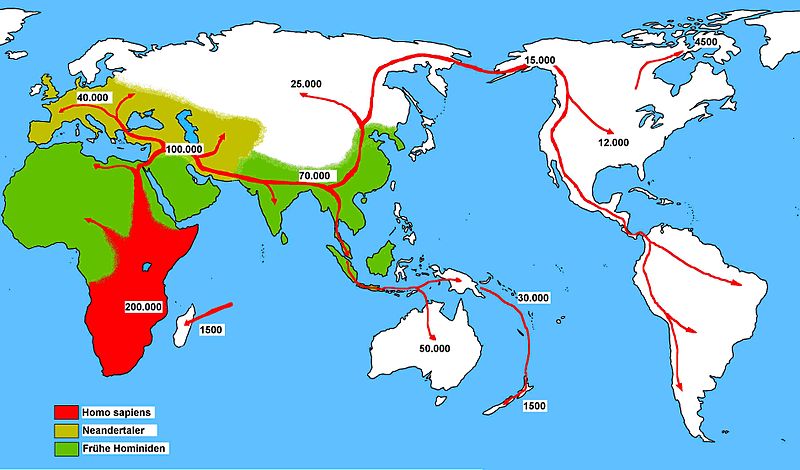
Possible migration routes, Wikipedia Commons
The Early Paleoindian (9,500 – 9,000 BCE) is believed to be a time of exploration and colonization. This has been deduced by examining the wide distribution of Clovis points that were transported large distances from their quarry sources. Large fluted points characterize this subperiod. There are three inhabited environmental zones for this subperiod: cool climate boreal forests, temperate forests, and subtropical sandy scrub. 

The Middle Paleoindian (9,000 – 8,500 BCE) is characterized by fluted and unfluted points that differ in size, larger and smaller, than traditional Clovis points found in the Southeast such as Cumberland, Redstone, Suwannee, Beaver Lake, Quad, Coldwater, and Simpson. The subperiod is viewed as a time for adaptation the optimal resource zones.

The Late Paleoindian (8,500 – 7,900 BCE) is characterized by Dalton and other side-notched points. The points demonstrate a change in adaptive hunting strategy from Late Pleistocene fauna to smaller game, like deer, in southern pine forests instead of boreal. Archaeologists believe that the settlements in the Southeast were permanent or semipermanent camps. Specific locations may have been inhabited around Chert deposits in order to replenish the manufactured stone tools. Settling down in specific areas may also have led to intensive regional specialization that ensured survival and movement into the Archaic period.
Since 1960, the studies of river basin projects, Paleoindian point finds, and site distributions in the Southeast have refined the sequencing of point types and refined the reconstruction of Paleoindian cultural activities.
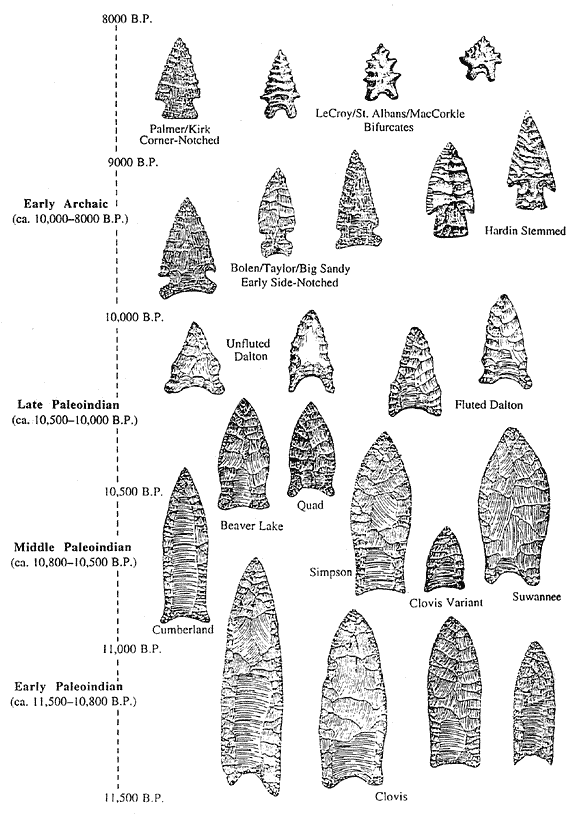
Projectile Point Types, National Parks Service


Profile-photo
About the Author


I'm Melanie, the founder of BermudaQuest and an archaeology undergraduate at the University of New Mexico. I love writing about ancient and modern cultures. My goal is to make information about our origins available to everyone [in simple English!]

Ashoka Maurya - An Example to Follow

on 19 January 2012

Ashoka Maurya
(304 - 232 BCE)
Ashoka Maurya (Aśoka in Sanskrit), also known as Ashoka the Great, reined as a “righteous king” (dhammaraja) during the Maurya Dynasty of India from 269 – 238 BCE. He was known as a righteous king because, after converting to Buddhism, his political expression was dominated by Buddhist values. Ashoka, born in 304 BCE, was the son of the second emperor Bindusara, who in turn had been the son of the first emperor Chandragupta. Ashoka had one younger brother and several older half-brothers. His older brothers feared Ashoka would be given the throne when he began to show success as a military leader. Emperor Bindusara grew ill and it became clear that his death was imminent. War broke out between the brothers fighting for the throne. After a series of battles, Ashoka killed most of his brothers and attained the throne in 274 BCE.

During his early reign, Ashoka set out to conquer the surrounding kingdoms. His military conquests spread across India, Pakistan, Afghanistan, Bangladesh, Nepal, and some parts of Iran.

The first eight years of his empire were brutal – Ashoka “became famous for his brutality and his desire to expand the Mauryan Empire” (Freeman). When he learned that one of his brothers was hiding in Kalinga, he invaded the province. Thousands were killed and the land utterly destroyed.

Ashoka became repulsed by the number of deaths he witnessed at Kalinga. “Standing along the front lines, Ashoka witnessed first hand the massacre of hundreds of thousands […] He knew so many had lost their lives simply because, he, the king, had ordered them to do so. Women became widows, children now orphans, Ashoka asked himself exactly what had his people won in war” (Wold). The kingdoms around them were not a threat of invasion. From that point on, he rejected violence for the rest of his life, converted to Buddhism and embraced vegetarianism. His attention moved from conquest to the welfare of his people. Peace began, his people began to love and respect all living things.

Ashoka the Great is famous for his non-violent propagation of Buddhism across Asia, as well as Europe and Africa. He abolished the slaughter and mutilation of animals. Hunting was limited only for consumption, though many followed his example as a vegetarian. He showed mercy to those in prison and gave them freedom one day every year. He set up universities as well as “water transit and irrigation systems for trade and agriculture” (Wold). The caste system ceased to exist in his eyes. Even though Buddhism was the national religion, he supported religious tolerance and unified the empire. Each and every person was given the rights to freedom, tolerance, and equality.

Now, the first Buddhist emperor became a Buddhist practitioner. He built 84,000 stupas across the Mauryan empire to house the sacred relics of Buddha. Ashoka sent out his children on religious pilgrimages to other kingdoms so they could share the philosophies that had unified their empire of peace and prosperity.


Great Stupa at Sanchi
Ekabhishek, Wikipedia Commons

A surviving Edict of Ashoka, Kolhua, Bihar.
PBS © 2008 MayaVision International.
He began by sending his only daughter, Sanghamitta, and son, Mahindra, to spread Buddhism in Sri Lanka. “Ashoka also sent many prominent Buddhist monks to modern Kashmir, Afganistan, Bhutan, China, Mongolia Cambodia, Laos, Burma, Thailand, Vietnam, Persia, Egypt, and Greece. Ashoka’s efforts helped to spread Buddhism across East Asia, where it has become the dominant faith of that region. Ashoka’s efforts to spread Buddhism in the west were much less successful. Nevertheless, there is evidence that a small Buddhist community began to develop at the Greek city of Alexandria in Egypt at this time. It has even been suggested that certain Ptolemaic Greek philosophers were influenced by Buddhism and that they in turn influenced the early development of Christianity” (Explore the Mediterranean).

Lion Capital of Ashoka
Catawba College
The great Mauryan emperor died in 232 BCE, though his dynasty lasted fifty more years. His name would have disappeared from history becoming only a myth if it hadn’t been for the pillars that recorded the actions and teachings he put in place. His testimonies are located throughout the territories he influenced. These monuments were not written in Sanskrit, instead they were written in what would be the first written language since the ancient city of Harrapa, Prakrita. 

Today “one of his stupas, the Great Sanchi Stupa, has been declared as a World Heritage Site by UNECSO. The Ashoka Pillar at Sarnath has a four-lion capital, which was later adopted as the national emblem of the modern Indian republic” (Cultural India). Pillar Edict VII quotes Ashoka, “I consider the promotion of my people’s welfare my highest duty.” He was able to initiate the global spread of Buddhism and affected around 21.5 billion lives.

Resources:
Cultural India. "Ashoka." CulturalIndia.net
Dhammika, Ven S. "King Ashoka: His Edicts and Timelines." The Wheel Publication Number 386/387. Sri Lanka: Buddhist Publication Society, 1993.
Explore the Mediterranean. "The Top Ten Most Influential People in History." Historical Atlas of the Mediterranean. 
Wold, Kevin. "The Life of Ashoka Mauryan." Kevin Wold's Webpage for Those Who Seek Enlightenment. CHICO.


Profile-photo
About the Author


I'm Melanie, the founder of BermudaQuest and an archaeology undergraduate at the University of New Mexico. I love writing about ancient and modern cultures. My goal is to make information about our origins available to everyone [in simple English!]

Share This

Never miss an article, subscribe here!

Credits & Policies

Banner created by Melanie Magdalena.

Images courtesy of: Ricardo Liberato (Pyramids of Giza), Aurbina (Moai), Maria Reiche (Nazca), Zunkir (Gobekli Tepe), Bjorn Christian Torrissen (Chichen Itza), Gareth Wiscombe (Stonehenge).

Images were released to the public and/or licensed under Creative Commons.

Editor's Note

Welcome to BermudaQuest, a free online journal primarily about Archaeology, Ancient History, and stories about different cultures from around the world.

Founded by Melanie E Magdalena, BermudaQuest and Origins (our magazine) have over a million readers! We would love to include your insight, experience, photos, and thoughts about your culture, heritage, and travels. Make sure you check out Origins, with over 4 million readers!