Showing posts with label Science. Show all posts

CO2: Missing Link to Past Climate Changes

on 17 October 2011

Flaming Iced Earth
A Brown University research team established that over the last 2.7 million years, climate in the tropics have changed and concluded that carbon dioxide is a key role in determining global climate patterns.
.
"We think we have the simplest explanation for the link between the Ice Ages and the tropics over that time and the apparent role of carbon dioxide in the intensification of Ice Ages and corresponding changes in the tropics," said Timothy Herbert, professor of geological sciences at Brown and the lead author of the paper in Science.

"It certainly supports the idea of global sensitivity of climate to carbon dioxide as the first order of control on global temperature patterns," Herbert added, "but we don't know why. The answer lies in the ocean, we're pretty sure."

The research team then began looking at chemical remains of marine organisms that lived in sun-exposed zones in the ocean. They were able to extract surface temperatures of the oceans for the last 3.5 million years and discovered that ocean temperatures drop by 2 to 5 degrees Fahrenheit during each Ice Age.  The tropics also change when Ice Age cycles switched from intervals of 41,000 to 100,000 years.

"The tropics are reproducing this pattern both in the cooling that accompanies the glaciation in the Northern Hemisphere and the timing of those changes," Herbert said. "The biggest surprise to us was how similar the patterns looked all across the tropics since about 2.7 million years ago. We didn't expect such similarity."

Climate scientists have a record of carbon dioxide levels for the last 800,000 years, spanning the last seven Ice Ages. Carbon dioxide levels in the atmosphere fell by about 30 percent during each cycle, and that most of that carbon dioxide was absorbed by high-latitude oceans such as the North Atlantic and the Southern Ocean. New findings say that the pattern began 2.7 million years ago, and the amount of atmospheric carbon dioxide absorbed by the oceans intensifies with each successive Ice Age.

"It seems likely that changes in carbon dioxide were the most important reason why tropical temperatures changed, along with the water vapor feedback," Herbert said.

Questions that are now being asked are, why carbon dioxide began to play a major role when the Ice Ages began 2.7 million years ago?  And why carbon dioxide appears to have magnified the intensity of successive Ice Ages from the beginning of the cycles to the present? Some just argue that CO2 plays little or no role.

References:
http://www.sciencentechnologyupdates.com/2010/06/co2-missing-link-to-past-climate.html#.TpJb195fbQo


Profile-photo
About the Author


I'm Jose Pierre and I like learning about all aspects of culture, both ancient and modern. I enjoy learning how they communicated, expressed themselves, and their technology.
What's the deal with all the dates?!

on 10 October 2011

Dating Techniques by Jose-Estrada and Melanie Magdalena


There are many dating techniques used in the scientific world. Archaeologists, geologists, and paleontologists use dating techniques to determine the age and time frames for civilizations, geologic patterns, and organisms. There are two main types: relative and absolute. Relative dating is abstract while absolute dating requires lab tests... (and money!)

RELATIVE DATING
In simple English, relative dating is using geologic record to find out just how old a rock or artifact is by using the surrounding context. These are not calendar dates, basically what is closer to the surface is younger than what is under the surface. Archaeologists use several techniques to develop a chronological sequence to order styles, types, and assemblages. Geologists also use different relative dating techniques to identify different rock layers; paleontologists date fossils using geologic record.

Relative Dating Techniques:

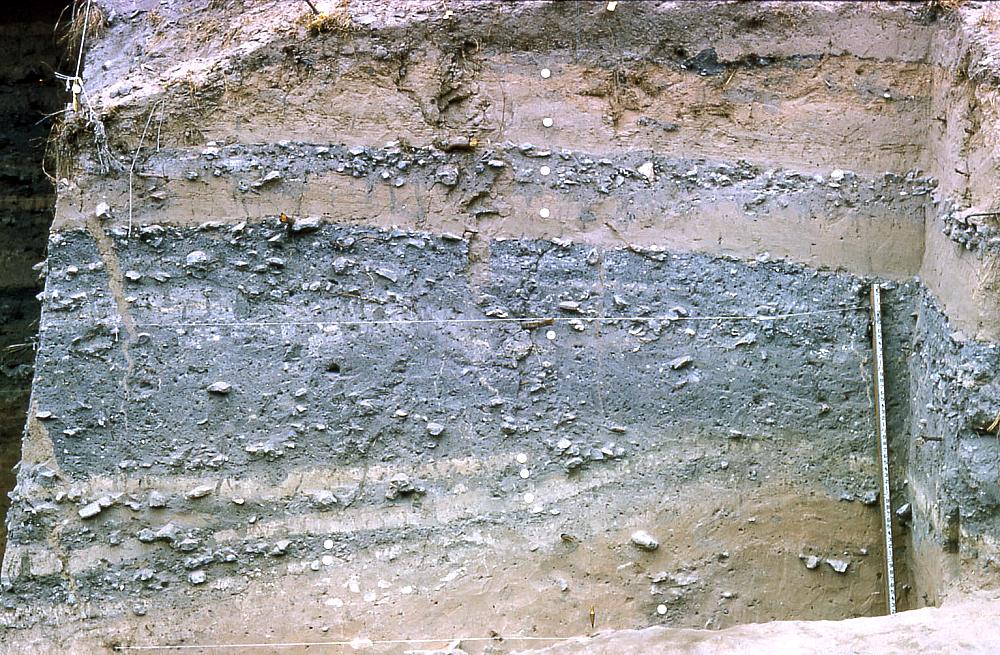
  • The Law of Superposition or Steno’s law is the principle that each bed of sedimentary rock is older than the layers above and younger than the layers below. This concept of rock layers is also known as stratigraphy. An example of stratigraphy is the Arenosa shelter in Texas.
  • Index Fossil Concept is the idea that similar fossils are of similar age or limited to a time span.
  • Time-Markers are artifacts that are proven to be from a particular period of time.
  • Seriation is a change of style, usually in artifacts. as new technologies arise they replace the older over time. Seriation does not tell us the age of a site, it only tells us if a site is older or younger than another based on the style of artifacts.
Arenosa Shelter, Lower Pecos Canyonland
Index fossils and seriation
ABSOLUTE DATING

Absolute dating “provides calendar reference to dates” (Shafer 2007). There are multiple techniques for absolute dating, some can be used for multiple types of samples while others are specialized.

Absolute Dating Techniques:

  • Dendrochronology, or tree ring dating, uses the annual growth rings in trees to assign a calender age to ancient wood. Tree-ring dating was developed by astronomer A. E. Douglass based on the principle that moisture varies from year to year - this moisture ratio is preserved in trees making trees an effective climate change map. One ring is developed each year, the color intensity (light/dark) can distinguish if it was formed in the spring/summer (light ring), or in the summer/fall (dark ring). By combining dendrochronology samples with radiocarbon dates, tree rings have revealed atmospheric changes and the changes in Carbon-14 quantities. A mathematical formula is applies to radiocarbon dates to make up for these fluxes.
  • Radiocarbon Dating is only good for organic remains that are younger than about 45,000 years old. Willard Libby developed this technique based on the fact every living thing absorbs the radioactive Carbon 14 (C-14) isotope. C-14 is produced in the atmosphere by cosmic rays and every living thing breathes in Carbon from the atmosphere. When an organism is alive it maintains equilibrium of ^14C. When it dies its C-14 count begins to decay. The amount of C-14 halves every 5,730 years (half-life) after the death of the organism. Carbon-14 is commonly measured in two ways:

    1. Conventional Radiocarbon Dating uses a Geiger counter and measures the beta particle emission from a sample. The slower the emission rate, the older the sample. This method is destructive and requires a twenty-five gram sample at the very least.
    2. Accelerator Mass Spectrometry (AMS) is a method of Radiocarbon dating that directly counts the proportion of carbon isotopes in samples of one gram or less. Compared to conventional radiocarbon dating, AMS requires less material and is also non-destructive (meaning the sample can be kept after the dating test).

  • Trapped Charge Dating is based on the fact electrons become trapped in mineral crystal lattices due to background radiation. The total amount of radiation the specimen received is divided by the annual dose of radiation. There are three sub-dating techniques for trapped charge dating:
    1. Thermoluminescence (TL) is used to date ceramics and burned stone artifacts. TL measures the total radiation dose of a artifact by heating the specimen to 500 degrees centigrade. the trapped electrons in quarts or feldspar crystals move back to their orbits, releasing energy in the form of light. the amount of light released gives the needed measurement of total radiation dose, which is then divided by the annual dose of radiation.
    2. Optically Simulated Luminescence (OSL) is used to date dirt by determining last time it was exposed to sunlight. It is measured by passing a light of particular wavelength over the sample, the trapped electrons go into orbit again emitting their own light; the intensity of the light reveals the total radiation measurement. soil samples must be collected carefully and cannot be exposed to sunlight.
    3. Electron Spin Resonance (ESR) is used to date tooth enamel. tooth enamel contains hydroxyapatite, which does not trap charges when formed. Once the tooth is deposited in the ground, it starts to a accumulate background radiation. The tooth is exposed to electron magnetic radiation and the amount that it absorbs is proportional to it total radiation dose.  
  • Argon-Argon Dating is used to date volcanic ashes to when they they were erupted that are between 500,000  and several million years old. Argon-Argon dating measures the ratio of argon-39 and argon-40 in volcanic ashes. This dating technique only requires a small sample.
Tree rings
An example of Radiocarbon dating
So now the mystery of dating techniques has been solved. Different types of dating are used for different situations and different types of finds. Every scientist has their own favorite, but now you can go out and make rough estimates for your finds!

References:
Kelly, Robert L. and David Hurst Thomas. (2010) Archaeology (5th ed.). Belmont, CA: Wadsworth/Cengage Learning.
Shafer, Harry J. (2007) Archaeology 101. Texas Archaeological Academy.

Eco Power: Shaklee

on 06 October 2011

Shaklee Corporation has dedicated over 50 years to making us live bettter lives and providing healthier alternatives to our lifestyle.

What is Shaklee?
Shaklee sells natural products that improve our health and the health of the planet.

Always Safe
So how does Shaklee define safe? Simple, their products have:
NO Parabens
NO Triclosan
NO Phthalates
NO Sodium Lauryl Sulfate (SLS)
NO Sodium Lauryl Ether Sulfate (SLES)
NO 1,4-Dioxane
NO Propylene Glycol
NO Volatile Organic Cleaning Compounds (VOCs)
NO Hydrochloric Acid
NO Ammonia
NO Sodium Hydroxide
NO Butyl Cellosolve
NO Formaldehyde
NO Bisphenol-A
NO Petroleum Distillates
NO Toluene
NO Chlorine Bleach
NO MSG
NO Dyes
NO Trans Fats
NO Artificial Sweeteners
NO Toxic Inks
and
NO Banned Substances

Always Works
With over $250 million spent in clinical testing, research, and development and over 100 published scientific papers with 90 published in peer-reviewed journals, Shaklee has become a respectable brand! Olympic gold medalists and athletes in the U.S. Ski and Snowboarding team are examples of the exceptional results of their nutritional products.

I’m sure you’re asking… What do you mean by nutritional products? Well, Shaklee has their own line of multivitamins. They also produce household products that are healthier for the Earth.

I met Mary Lindholm, a Shaklee distributor, in Austin, Texas, during August 2011. She gave me a little vial of "Basic H2." When I asked her about what this little thing of soap could do she told me to add one drop to a bottle of water for a window cleaner and to add the rest to another bottle of water for an all-purpose cleaner. Sure enough I tested it out. The window cleaner works just as well or perhaps even better than Windex and other window cleaners. 

Shaklee won one point with that. Pretty cool.
The all-purpose cleaner works like magic! Not to mention that since the vial was only 2ml, I drastically reduced the amount of chemicals going down the drain in my sink after sponging down the kitchen counters.

Always Green
The most spectacular part about this product is that its NATURAL! No chemicals added - just simple nature. Nature you spray to clean up and nature that ends up back in nature.

Shaklee has "recycled over 1,000,000 pounds of cardboard, eliminated over 10,200,000 pounds of packaging waste, and eliminated over 23,000,000 pounds of greenhouse gases." Talk about environmentally friendly not to mention naturally sustainable.

The BermudaQuest Review

BQ rates Shaklee with 5 Stars!
BQ recommends this product to anyone who wants to make a difference in the world. All it takes is a simple commitment to do one thing that is healthier for the environment.

That one commitment will make you want to make another. Everything you do for the planet gives you a healthier way a of life. So why not accept the challenge? I did, now I challenge YOU.

New to the Genus: Australopithecus Sediba

on 12 September 2011


download


The new kid on the block is Australopithecus Sediba, a recently found member of the hominid species from South Africa’s Malapa cave site. A. Sediba is estimated to be 2 million years old, so in the evolutionary time line, it will fit as an end of the Australopithecus genus or as an early homo.  


What I find most interesting about A. Sediba is that its hand and wrists were more developed and human-like than the famous tool using Homo Habilis. H. Habilis was proven to be a tool wielder because of stone tools found with some of its remains. A. Sediba has not been confirmed as tool user because there is no evidence indicating tool use.

Australopithecus Sediba is still under controversial decision of its location in the evolution time line. The evidence attained so far is not enough to place A. Sediba  in the right location. So far it shows that it was far less primitive than A. Africanus but just as developed as H. Habilis. Stayed tuned for future updates!!

Profile-photo
About the Author


I'm Jose Pierre and I like learning about all aspects of culture, both ancient and modern. I enjoy learning how they communicated, expressed themselves, and their technology.

Eco-Power! What does it mean to "Live Green"?

on 01 September 2011


We see commercials and new products everyday that tell us and show us how to live a green life. Cars are green. Shopping bags are green. Even our shampoo is green. But what does it mean to live green?

To be green simply put is to play your part by participating in actions that help our planet. Biodegradable products do not pollute. Electric cars do not produce emissions like gasoline powered ones do. Recycling saves time and natural resources since we reuse the same material again and again. My personal favorite are the reusable shopping bags, but better yet Puma's Clever Little Shopper is made out of only cornstarch! The dye is biodegradable too!


But still... doesn't it seem like people are just making all these new things that are "environmentally friendly" just to make money? Of course it does, and I'm sure that is probably very true for some producers. In the long run, by switching all of our environmentally damaging goods for friendly ones we will be helping the planet. Helping our planet will ensure that future generations will be able to enjoy the same resources we have enjoyed and maybe even better, more healthier lives.


Why not play your part? Turn off the lights and unplug appliances you're not using. Walk to the corner to pick up milk instead of driving. Recycle your cans and bottles, cardboard and paper. Save that Ziploc bag from your child's lunch and put another sandwich in it tomorrow. Pay the extra fifty cents for biodegradable trash bags and napkins. If you want to buy a new car, go ahead and get that electric one you thought was more expensive: you'll make all the money back if you stop buying gas (not to mention gas is just too expensive and keeps getting higher in cost!). It is not hard to live a life that is kinder to the environment. This is the only home we have... so take care of it!

Visit us every Thursday for more Eco-Power features on BermudaQuest! Thanks for your visit!

The Secret Behind the "Blue" Moon

on 21 November 2010

We've all heard the phrase "Once in a blue moon" but hardly anyone understands what this means. Here's an explanation of the famous blue moon straight to the point:

  • Normally there are 12 full moons in a year, when there are 13 one is called a blue moon.
  • There are 7 blue moons in a lunar cycle of 19 years.
  • Normally there are 3 full moons in a season, when there are 4 one is called a blue moon.
  • The third full moon in a season is referred to as a blue moon.
  • When there are 4 full moons in a season they are referred to as: 
    1. moon
    2. Mid moon
    3. Blue moon
    4. Late moon
  • Unlike the general assumption that the second full moon in a month is a blue moon, it is actually the third full moon in a season.
I'm sure now is when you're saying, "Wait!" This weekend is a blue moon and the next full moon is on December 21; however, the winter solstice occurs fifteen hours after the moon turns full classifying it as a late fall moon.

So there you have it. Blue moon explained and now we can understand the phrase "Once in a blue moon" slightly more than the rest of the non-knowers around us.


Have a great weekend moon gazing!

International Carl Sagan Day ;)

on 28 October 2009


Long live star stuff.

Share This

Never miss an article, subscribe here!

Credits & Policies

Banner created by Melanie Magdalena.

Images courtesy of: Ricardo Liberato (Pyramids of Giza), Aurbina (Moai), Maria Reiche (Nazca), Zunkir (Gobekli Tepe), Bjorn Christian Torrissen (Chichen Itza), Gareth Wiscombe (Stonehenge).

Images were released to the public and/or licensed under Creative Commons.

Editor's Note

Welcome to BermudaQuest, a free online journal primarily about Archaeology, Ancient History, and stories about different cultures from around the world.

Founded by Melanie E Magdalena, BermudaQuest and Origins (our magazine) have over a million readers! We would love to include your insight, experience, photos, and thoughts about your culture, heritage, and travels. Make sure you check out Origins, with over 4 million readers!