Showing posts with label Space. Show all posts

Across the Zooniverse

on 24 April 2013

Telescope View of Sky from Big Hill, NSW. [Ryan Wick, Flickr]

Keeping an eye on citizen astronomy


Amateur astronomers in Russia made a discovery last week any professional would envy – it seems they may have identified the remnants of the ill-fated Soviet Mars 3 lander, 30 years after it lost contact with Earth.

Photos taken by the High Resolution Imaging Science Experiment (HiRISE) camera on NASA’s Mars Reconnaissance Orbiter (MRO) in 2007 show what appears to be the parachute, heat shield, and retrorocket of the Mars 3 lander.

But finding object as small as an 11-metre-wide parachute on the surface of Mars takes a lot of work, especially as the most promising photo – a section of which is below – contains 1.2 billion pixels and requires 2,500 computer screens to view the entire image at full resolution.

The possible Mars 3 lander hardware was found by a group of Russian citizen enthusiasts.
[NASA/JPL-Caltech/University of Arizona]

This is the most recent example of how citizen science is blossoming – and getting results – within the field of astronomy. There is a wealth of amateurs who pursue backyard observations as a hobby and their efforts make headlines worldwide. Some have historically contributed to science by finding comets, tracking asteroids, the Search for Extraterrestrial Intelligence (SETI) program, and monitoring stars.

The Soviet Mars 3 lander before venturing
to Mars in 1971. [Armael, Wikimedia Commons]
One of the most visible citizen-science projects in astronomy and astrophysics is the “Zooniverse” which invites members of the public to analyse data ranging from determining the shape of galaxies to trying to detect if any planets outside our solar system orbit stars.

The Galaxy Zoo


The Zooniverse project grew out of the Galaxy Zoo project which was set up to determine the shape, or morphology, of galaxies.

Galaxy shape is a useful visual indicator to professional astronomers about the state of the galaxy and the physical processes which may be going on inside it.

While there are many types of galaxy shapes, bright galaxies usually fall into one of three categories:
     • spiral
     • elliptical
     • irregular

The Sloan Digital Sky Survey, an internationally funded project to map the sky, photographed and mapped more than 930,000 galaxies over eight years.

Faced with an overwhelming amount of data to sift through, astronomers conceived of the Galaxy Zoo idea to ask the general public for help to look through all the data and classify the shapes of galaxies.

Three main galaxy shapes (from left): spiral galaxy PIA09337, elliptical galaxy NGC 1316, and irregular galaxy NGC 3738.
[NASA]
Since this requires little background knowledge, any member of the public can help so long as they have an internet connection.

Using a simple, clickable interface, users can say whether galaxies are rounded, have spiral arms, have any unusual or distinguishing features, or whether they want to discuss the objects in more detail.

This is especially important in a data-rich field like astronomy: users can sometimes be the first human being to actually look at a galaxy since most of the processing of the images they examine have been done by computers.

Getting the numbers up


For all the excellent work done by the general public, there will still be disagreement about the exact classification of galaxy shapes – and this, fundamentally, raises questions about data integrity.
[Gwydion M. Williams]

This is why the Galaxy Zoo project aims to have at least 20 people attempt to classify each galaxy.

To use the data in professional research, astronomers have to look for disagreements between members of the general public.

Taking a threshold level is one way to solve the problem. If, say, 80% of respondents say a galaxy is a particular shape, that is a reasonable way forward and is perfectly suitable for some analysis purposes.

The cost of this may be that there is a high number of “unclassified” galaxies where there is large disagreement, perhaps caused by very few individuals having looked at a galaxy.

And the results are …


There have been a healthy number of scientific publications arising from the Galaxy Zoo project team, including the relationship between galaxy colour and environment and studies of highly unusual objects such as “Hanny’s Voorwerp” – a possible light echo from quasars (the brightest objects in the known universe).
[NASA]

In my own research, we recently used data from Galaxy Zoo to explore the connection between galaxy morphology, galaxy mass, and the likelihood of hosting an Active Galactic Nucleus (AGN) in a massive cluster of galaxies – a collection of gravitationally bound galaxies and one of the most extreme “environments” in which a galaxy can live.

We used the data to explain an earlier result that red and passive spiral galaxies are, in the majority, also massive and similar in nature to most of the massive elliptically shaped cluster galaxies.

We then inferred that the life cycle of high and low mass cluster galaxies are markedly different.

But we wouldn’t have been able to make these conclusions without the citizen scientists who classified the bulk of the data for us – something for which we are extremely appreciative.

And who knows? As shown by the Russian amateur astronomers sifting through NASA’s high-resolution photos, the next big astronomy discovery could be made by you.

Profile-photo
About the Author

Kevin Pimbblet, from Monash University, is an experienced observational astronomer whose core research interests cover a number of modern topics in extra-galactic astrophysics, large-scale structure of the Universe and cosmology.
Kevin Pimbblet receives funding from the Australian Research Council.
This article was originally published at The Conversation. Read the original article.

Space Archaeology

on 23 April 2013

Space archaeology is a recent research method scientists
FlyingSinger, Flickr.com, CC BY 2.0
have begun using in order to evaluate man-made items found across the galaxy. These artifacts can range from orbital debris, satellites, and other various objects humans have placed on the Moon and Mars. Through these artifacts we keep track of and discover in space we monitor and interpret the adventures of man as we travel into the world beyond. 

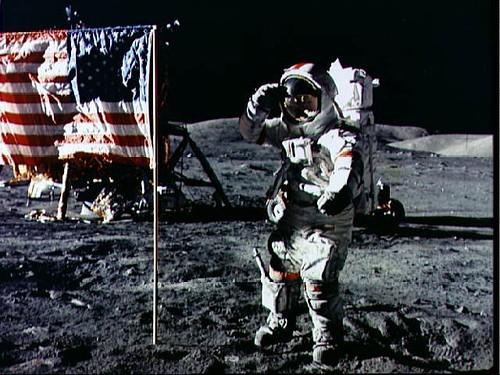
The cultural resource or heritage management is in charge of evaluating the significance of space sites and artifacts according to national and inter-national preservation laws. They examine how and why these outer space artifacts and sites of our recent history should be preserved for our future generations to view. For example, they decide on whether or not the site where Neil Armstrong landed on the Moon should be preserved so that we can see the first steps man made on the moon. 


NASA Goddard Photo and Video, Flickr.com, CC BY 2.0

People like Beth O’Leary, an associate professor of Anthropology at New Mexico State University (NMSU) and co-editor of the handbook of space engineering, archaeology, and heritage, have dedicated themselves to preserve the many artifacts on the moon. One site she had dedicated herself in watching over is the flag and the footprint of Neil Armstrong left to prove he walked on the Moon. With a grant from NASA, O’Leary helped establish the Lunar Legacy Project; which aims to preserve the historical information found at Tranquility Base. She previously stated, “We need to prepare for the future because in fifty years many travelers may go to the moon, if the site is not protected, what will be left?”

Idaho National Library, Flickr.com, CC BY 2.0
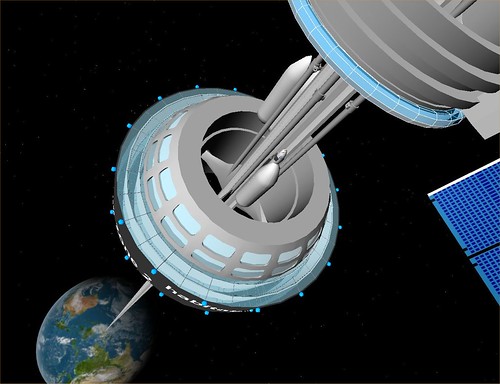
There are artifacts left behind in space other than those found on the Moon and Mars, but some of them threaten the safety of Earth. Since some of these artifacts, like low orbiting satellites and stations, currently run the risk of impacting each other and other space objects; instead of them being labeled as our cultural heritage they are considered space junk. An informed decision on the risk of letting them continue to orbit or destroying them should be made while keeping their international and historical significance in mind.

Because of the global safety dilemma there is the potential of parts of space archaeological record being destroyed and possibly forgotten. The question of which artifacts are culturally important and which are not is being asked, but how exactly are we suppose to answer. As humans living in the world today we have no idea what artifacts will have relevance and which will not in the future. Making us run the risk of leaving a missing link in our record of space exploration. For example, Wall-E from the Disney movie, feeds his curiosity by examining items he comes across in the mountains of trash left by the humans. He finds a woman’s bra and begins examining it and placing it on his head as a hat and over his eyes as a blindfold, confused about what the primary purpose of his finding was. Will we be just as confused when looking at the space artifacts we left behind in the future?

The Secret Behind the "Blue" Moon

on 21 November 2010

We've all heard the phrase "Once in a blue moon" but hardly anyone understands what this means. Here's an explanation of the famous blue moon straight to the point:

  • Normally there are 12 full moons in a year, when there are 13 one is called a blue moon.
  • There are 7 blue moons in a lunar cycle of 19 years.
  • Normally there are 3 full moons in a season, when there are 4 one is called a blue moon.
  • The third full moon in a season is referred to as a blue moon.
  • When there are 4 full moons in a season they are referred to as: 
    1. moon
    2. Mid moon
    3. Blue moon
    4. Late moon
  • Unlike the general assumption that the second full moon in a month is a blue moon, it is actually the third full moon in a season.
I'm sure now is when you're saying, "Wait!" This weekend is a blue moon and the next full moon is on December 21; however, the winter solstice occurs fifteen hours after the moon turns full classifying it as a late fall moon.

So there you have it. Blue moon explained and now we can understand the phrase "Once in a blue moon" slightly more than the rest of the non-knowers around us.


Have a great weekend moon gazing!

International Carl Sagan Day ;)

on 28 October 2009


Long live star stuff.

Share This

Never miss an article, subscribe here!

Credits & Policies

Banner created by Melanie Magdalena.

Images courtesy of: Ricardo Liberato (Pyramids of Giza), Aurbina (Moai), Maria Reiche (Nazca), Zunkir (Gobekli Tepe), Bjorn Christian Torrissen (Chichen Itza), Gareth Wiscombe (Stonehenge).

Images were released to the public and/or licensed under Creative Commons.

Editor's Note

Welcome to BermudaQuest, a free online journal primarily about Archaeology, Ancient History, and stories about different cultures from around the world.

Founded by Melanie E Magdalena, BermudaQuest and Origins (our magazine) have over a million readers! We would love to include your insight, experience, photos, and thoughts about your culture, heritage, and travels. Make sure you check out Origins, with over 4 million readers!