Showing posts with label Teotihuacan. Show all posts

Ancient Art and Pop Culture Revival of Teotihuacan

on 29 September 2011


Mesoamerican Three Part Special on pre-Aztec Teotihuacan

Ancient Art and Pop Culture Revival of Teotihuacan
The Teotihuacan art style can be defined as elegant, refined, highly stylized, and ordered. The most common representations of their art style is found in pottery, sculptures, and paintings.

Pottery
The most recognizable Teotihuacan pottery is cylindrical with three slab-shaped feet, a design that was most likely adopted from the Gulf Coast cultures, such as the Olmec. These pots generally have fitted lids with bird-shaped handles. Thin orange ware, also common in other Mesoamerican pottery styles, was also produced. These, however, take the form of bowls with annular bases, boxes with lids, or effigies of little dogs. Incense burners are abundant amongst the recovered artifacts which suggest that the Teotihuacanos favored cremation upon moving into the afterlife. These containers are largely polychromed and have mold-made details.

Sculpture
The best representations of Teotihuacano sculptures are stone masks made from Greenstone, Basalt, Jade, Andesite, or other materials and adorned with shells or Obsidian.

Paintings
The Teotihuacanos used the technique fresco to create magnificent murals on temples and residency walls. Their technique of "true fresco" consists of diluted pigments applied to a fresh layer of lime and often times a silicate, such as mica, was added to the pigments to increase the vivacious tones.

Pop Culture
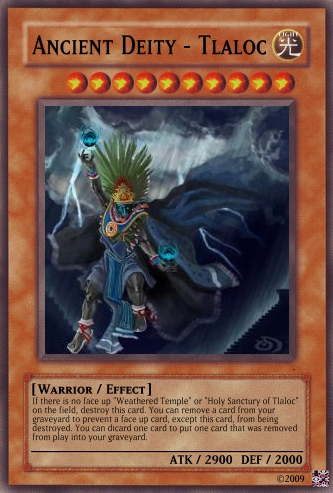
Today, Teotihuacan is still very much alive. Teotihuacan symbols and deities live on in popular culture in many ways, shapes, and forms. A common sight is tattoos of Tlaloc and the Feathered Serpent. Deities are manifested in trading card games, such as Yu-Gi-Oh. Thousands of people visit Teotihuacan every day climbing the pyramids and looking down on the world as if they had a little bit of Teotihuacano hidden deep down inside. Archaeology is rooted in every culture and it is our job to make sure the stories stay very much alive.


 > FINISH: Poll Time, win $50!

Works Cited.
Coe, Michael D. and Rex Koontz. (2008) Mexico: from  the Olmecs to the Aztecs. 6th Ed. New York:  Thames and Hudson.

The Architectural Technology of the Unknown People

on

Mesoamerican Three Part Special on pre-Aztec Teotihuacan

The Architectural Technology of the Unknown People

What type of tools does it take to build a monumental structure? What kind of man power was required to make these projects happen? Who trained the artisans to create stucco masks and paint the structures in vibrant colors?

These are the mysteries that a lot of people face. Not all the answers are known either. Most of the time we are left to speculate the great achievements left behind by the Ancients and marvel their glorious monuments.

The Great Pyramids of Teotihuacan – The Three Great Public Structures

Pyramid of the Sun
The main pyramid, the Pyramid of the Sun, is made up of remains of earlier pyramids equally as large as the final version. The Pyramid of the Sun is one of the largest New World structures. Raised in stages during the Tzacualli phase at the close of the pre-Classic period. Its fill is made up of 41 million cubic feet of sundried brick and rubble. An underneath passageway was discovered in 1971, its 20ft under the center of the pyramid and starts near the beginning of the staircase and continues to the east for 300ft, ending at a multiple-chamber room.

Pyramid of the Moon
The moon pyramid was slightly smaller than the sun pyramid and was built during the next phase, Miccaotli, at the begging of the classic period. The shape of the pyramid echoes the form of the major mountain of the north, Cerro Gordo, believed to be a female deity.

Temple of Quetzalcoatl
The last of the monumental structures built at Teotihuacan and a considerably smaller size than the Pyramids of the Sun and Moon. The structure is a seven-tiered step-pyramid with talud-tablero facades, located directly at the heart of the city.

Pyramid of the Sun

Pyramid of the Moon

Temple of Quetzalcoatl


Teotihuacan influenced many cultures in Mesoamerica. The surrounding areas are heavily influenced by their styles in art and architecture and traces of this extend all the way into Maya territory. It is possible that at least one of the first Maya rulers came from Teotihuacan (Gowing 2007).

Teotihuacan is recorded in ancient Maya hieroglyphs as Tollan. Tollan was the central city in Mesoamerica recorded in the royal histories of the Toltec, the Aztec, the Maya, and other Mesoamerican societies. Teotihuacan held power over many Maya sites during the Early Classic Period. Though the ethnic identity of the inhabitants of Teotihuacan is unknown, it is certain that the rulers of this land existed long before the traditional Aztec images produced in our minds at Teotihuacan. The political structure and power over the land is what allowed these monumental structures come to life.


Works Cited.
Benson, Elizabeth P. (2007). Pre-Columbian Art. In Sir Lawrence Gowing, (Ed.). Facts on File and Encyclopedia Art (2nd ed., Vol. 3, pp. 475). New York, NY: Facts on File, Inc.

Coe, Michael D. and Rex Koontz. (2008) Mexico: from  the Olmecs to the Aztecs. 6th Ed. New York:  Thames and Hudson.

Palka, Joel W. (2010). The A to Z of Ancient Mesoamerica. Plymouth, United Kingdom: The Scarecrow Press, Inc.


Who were the Teotihuacanos?

on

Mesoamerican Three Part Special on pre-Aztec Teotihuacan

Who were the Teotihuacanos?

When someone says pyramid, most people think of Egypt. The New World, in Mesoamerica specifically, there are also pyramids. According to the Aztecs who inhabited Teotihuacan around 1111 CE the city claimed the great city was where the gods created the world we know. The great city of Teotihuacan was not built by the Tula whom inhabited the land prior to the Aztecs, but by a more mysterious, unknown people - lost in history - the Teotihuacanos.

Avenue of the Dead
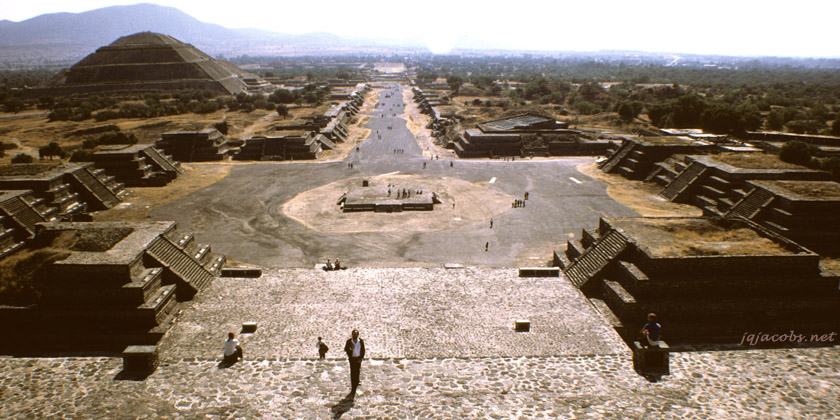
The greatest Mesoamerican Classic planned civilization was Teotihuacan, located in the Teotihuacan valley, “a side pocket of the Valley of Mexico,” during 150 BCE – 200 CE. Abundant natural resources made life possible and farmers moved into this fertile land. The fully urbanized city covered 20 sq. kilometers and was laid out in a grid pattern. Its main axis is the Avenue of the Dead (15° 25’ 00” E). The sacred path is marked by the Pyramid of the Moon to the north and by the Temple of Quetzalcoatl at the center. 
  
Site map of Teotihuacan
The cosmopolitan city is divided into two wards: the western Oaxaca ward and the eastern Veracruz and Maya ward. Each culture that came to visit had its own unique area to “carry on their own customs and worship their own gods.” The palaces in these wards were raised on platforms. Apartment compounds surround the raised central and two flanking temples. This organizational style is referred to as triadic temple arrangements. Most compounds have two or more “rich” burials which suggests that royalty or the “founders” held special honors.

Mesoamerican cultures worshiped deities just like the Ancient Old World civilizations. The most important deity seems to be the “Spider Woman,” a female deity and patroness of our world. The rain god, Tlaloc, is easily recognizable along with the sun god, moon goddess, and Xipe Totec. Xipe Totec was a symbol for the annual renewal of vegetation when the rainy season began. All of the Teotihuacano deities are intimately linked to agriculture, or more specifically maize – the staff of life.

Tlaloc, the rain god
Teotihuacan was economically linked with the Gulf Coast Olmec society. Artifacts have reinforced this point: there is a significant amount of Jade in Teotihuacan (Olmec product) and the Teotihuacan art style is visible in potsherds in Olmec sites.
                     
Home: BACK <

Works Cited.
Coe, Michael D. and Rex Koontz. (2008) Mexico: from  the Olmecs to the Aztecs. 6th Ed. New York:  Thames and Hudson.


Civilizations Around the World: Teotihuacan

on


Mesoamerican Three Part Special on pre-Aztec Teotihuacan


Who were the Teotihuacanos?


The Architectural Technology of the Unknown People


Ancient Art and Pop Culture Revival of Teotihuacan


> START <


My Summer 2011 trip to Teotihuacan:
Traveling down the Avenue of the Dead to the Temple of Quetzalcoatl


Share This

Never miss an article, subscribe here!

Credits & Policies

Banner created by Melanie Magdalena.

Images courtesy of: Ricardo Liberato (Pyramids of Giza), Aurbina (Moai), Maria Reiche (Nazca), Zunkir (Gobekli Tepe), Bjorn Christian Torrissen (Chichen Itza), Gareth Wiscombe (Stonehenge).

Images were released to the public and/or licensed under Creative Commons.

Editor's Note

Welcome to BermudaQuest, a free online journal primarily about Archaeology, Ancient History, and stories about different cultures from around the world.

Founded by Melanie E Magdalena, BermudaQuest and Origins (our magazine) have over a million readers! We would love to include your insight, experience, photos, and thoughts about your culture, heritage, and travels. Make sure you check out Origins, with over 4 million readers!