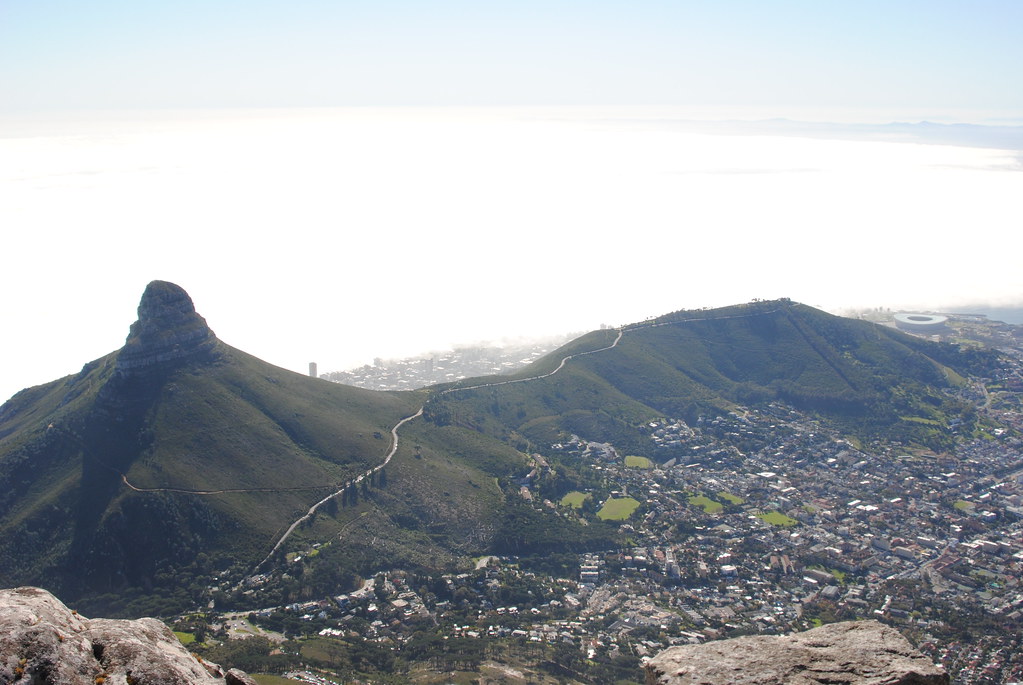
Main attractions within Table Mountain National Park
Table Mountain National Park, which is found in the popular tourist city of Cape Town, South Africa, is a national heritage site and is haven of beautiful natural landscapes and attractions. The Table Mountain National Park offers a number of beautiful hikes and walks for visitors to enjoy and is home to many of Cape Town’s must-visit attractions.
This is where visitors can come and learn about the landscape and environment at the Cape Point visitor centre or take thefunicular or walk to one of the lighthouses overlooking the point where two oceans are said to meet. The reserve surrounding Cape Point is home a variety of birds and lizards as well as some larger wildlife such as zebras, antelope, caracal and ostrich.Spend a couple hours here and picnic at one of the beaches or enjoy a leisurely lunch at the restaurant with spectacular views over False Bay – just remember to keep an eye out for the cheeky baboons!
Boulder’s Beach
Located near Simonstown, Boulder’s Beach is home to a land based breeding colony of cute African penguins. Take a swim on the beach amongst the penguins or simply view these unique birds from one the boardwalks.
Table Mountain
Enjoy a multitude of hikes and walks on the slopes or up to the top of the mountain or if you are not feeling that enthusiastic, enjoy the fabulous views from the cableway. For the more adventurous you can abseil or rock climb the mountain or even stay overnight in one of the little chalets on top of this iconic Cape Town attraction.
Silvermine
Enjoy nature walks on the Constantiaberg Mountain amongst the spectacular fynbos or take a refreshing swim in the beautiful dam or enjoy a picnic on the banks. Silvermine offers something for everyone with waterfalls, dog-walking and mountain bike tracks and even a wheelchair friendly boardwalk.
Signal Hill and Lions Head
The city surrounds these iconic Cape Town landmarks. Thenoon day gun goes off from signal hill and Lions Head is a popular hike for locals particularly when there is a full moon.Take a couple of friends along for a walk and enjoy gorgeous sunset views looking out towards the ocean.
Could we have found the first artist’s studio in human history? We may well have.
We all recognise the material signs of wealth. Fast cars, large yachts and sparkling bling all tell us who has more. Crowns, insignia, mayoral gowns are material signs of rank or status.
Archaeologists have long pondered when these public displays of social difference first occurred. Emerging evidence suggests the antiquity of public symbolism is surprisingly great.
Indeed, the symbolism of social difference seems to have been present from the earliest period of our species existence. The rise of Homo sapiens may even have been linked to the use of public symbols.
Recent work in southern Africa, published today in Science, is helping archaeologists clarify the early history of painting and its use in creating symbols.
Discoveries at Blombos Cave
The latest discovery comes from Blombos Cave, a large cavern located on the southern African coast, south-east of Cape Town.
Here a team, led by Christopher Henshilwood of the University of Bergen and Francesco d’Errico from the Université de Bordeaux, has found a 100,000 year old artist’s workshop.
Excavations of the deep sediments piled up in the cave have regularly yielded surprising finds. Archaeologists have previously recovered standardised bone tools, perhaps awls, and delicately-shaped tools of stone projectile points dated to 70,000 years ago.
Henshilwood and his colleagues suggest these tools show ancient artisans were able to plan and create a sophisticated technology.
Even more revealing is the presence of ochre, natural iron-rich rock that can be ground into powder and used as paint. Archaeologists have long suspected pieces of ochre with abraded facets in those early times might indicate paintings of some kind, on rocks, wooden artefacts or even human bodies.
Since 70,000-year-old ochre slabs have geometric engravings on their surface, it is clear early humans were artistic, but until now archaeologists could not be sure they were painters.
The world’s first studio
Now Blombos has yielded new materials that reveal the earliest artist’s workshop.
In a layer 100,000 years old, Henshilwood excavated two containers, which are probably artist’s palettes or mixing-bowls, and associated tools.
Each palette or bowl is a large abalone shell containing a residue of ochre, burnt bone and other materials that had been ground up and combined with some fluid into a vibrant red paste.
One of these containers also contained a small grinding stone and a number of bone fragments that had been used to stir the paste.
The other container was associated with fragments of ochre, in this case red ferruginous siltstone, that had been abraded to create the red powder and the grinding stones on which they had been rubbed.
Henshilwood speculates that for a short period about 100 millennia ago, the site was used primarily as a workshop for preparing and using the paint mixtures.
Why paint?
Henshilwood and his team think this early painting workshop may be an example of artistic developments associated with the emergence of Homo sapiens.
The genetic evidence, as well as ancient skeletons that have been found demonstrate humans evolved in Africa and migrated across the globe in the last 70-100,000 years.
Did the earliest modern humans develop a knowledge of chemistry that helped them invent painting?
Or does this workshop reflect the emergence of art itself, a behaviour that was carried forth by humans in their global dispersion?
Bifacial points, engraved ochre and bone tools discovered in Blombos Cave, c. 75-80,000 years old.
[Chris Henshilwood, Wikimedia Commons, CC BY-SA 3.0]
It turns out the evolution of art may have a very long history. Ochre has been found in far older African sites, dating back more than 300,000 years, as well as in Europe and the Middle East.
It’s been associated with hominids related, or ancestral, to us, such as Homo heidelbergensis and Homo neanderthalensis. If early hominids used ochre to colour themselves or their possessions then at least a basic form of painting had been present amongst hominids for several hundred millennia.
The artist’s workshop at Blombos 100,000 years ago is not the earliest use of ochre/paint but it represents a new intensity, a new scale, of artistry that may reflect a new role for painted public symbols.
This workshop was created near the start of the last Ice Age at a time when population size and resource availability changed.
In this context, signals of identity and differentiation perhaps assisted people to negotiate territory and trading relationships with neighbouring groups.
The Blombos discovery suggests the expression of social difference through painting was an important element in the development of modern culture.
We may well have found the beginning of a tradition that gave us Leonardo da Vinci, Rembrandt, Pablo Picasso, and, of course, Banksy.
Peter Hiscock is an archaeologist interested in the emergence and global dispersal of modern humans and long-term changes in their technology and social life. His research speciality is Australian prehistory and Palaeolithic technology; his research areas are France, Australia, and Africa.
Peter Hiscock receives funding from ARC. He is affiliated with the Australian National University.
Mountain Walk [South Africa Tourism, used with permission]
A true hiking Mecca, Cape Town offers a variety of hikes that cater to a range of skill and fitness levels and ages. The one thing that all these hikes have in common is that they are all relatively accessible, some even begin from the city centre, and they all have incredible, breathtaking views. A number of accommodation options are available in the picturesque areas near to the mountain. Victoria and Alfred Waterfront offers modern luxury hotels while Camps Bay caters towards classy, seaside living and Constantia hotels offer a colonial, old-world feel. Table Mountain is where it all begins and ends, so strap on your hiking shoes and head on down to one if the new seven wonders of nature.
Lion’s head, which is located just next to the famous mountain, offers an easy hike or run that is best enjoyed with a sunset picnic when you get to the top. Paragliding is also available off Lion’s head with gorgeous views of the charming Camps Bay area.
Then on the actual Table Mountain itself there are too many trails to count. Hikers have the chance to take in views of the Atlantic and the Constantia vineyards while strolling through fynbos, a type of flora that is unique to Cape Town.
Platteklip Gorge takes roughly 2 hours to complete and is an exciting hike complete with stairs cut into rocks and steep ravines that are not for the faint hearted. Skeleton Gorge ascends from the slopes near Kirstenbosch Gardens and is best done with a guide as there are many ladders and waterfalls that need navigating. The route returns to the exquisite gardens where a picnic or light lunch can be enjoyed. To make the most of this beautiful area, consider staying at a hotel nestled on the slopes of the Mountain such as the Cellars Hohenort.
Cellars Hohenort & Spa [South Africa Tourism, used with permission]
Devil’s Peak is a trail that starts of relatively easily with a series of well-constructed zigzags that will take you to the summit from where one gets panoramic views of Cape Town. If you decide to descend on the other side of the peak, you will encounter two gorges, the Dark Gorge has claimed several lives and is not recommended for non-professional hikers while Newlands Ravine provides a challenging trail in the shade of majestic trees.
On top of the actual mountain there are several tracks, the most easy of which start from the Constantia Neck area. These tracks cater towards a wide range of skill levels and can be completed in a couple of hours, a full day or even over a three day period. Towering 1088 meters over the city of Cape Town, Table Mountain provides the perfect playground for adrenaline junkies and nature lovers. Boasting hundreds of plant species, magnificent bird sightings, and the chance to stumble upon a small mammal such as a dassie or mongoose or even a mountain buck or goat and a myriad of waterfalls and rivers this has to be one of the prettiest mountains to explore.
This article was written by South African Tourism. For queries about travel arrangements in South Africa, you are welcome to contact us:
Welcome to BermudaQuest, a free online journal primarily about Archaeology, Ancient History, and stories about different cultures from around the world.
Founded by Melanie E Magdalena, BermudaQuest and Origins (our magazine) have over a million readers! We would love to include your insight, experience, photos, and thoughts about your culture, heritage, and travels. Make sure you check out Origins, with over 4 million readers!
WE'VE MOVED!
Please join our new page! Origins Scientific Research Society now operates BermudaQuest! Please bookmark www.knowyourorigins.org
Explore! by Origins has all of our posts here and all the newest content! We look forward to seeing you on our new and improved site made for our wonderful readers.