Showing posts with label Astronomy. Show all posts

Across the Zooniverse

on 24 April 2013

Telescope View of Sky from Big Hill, NSW. [Ryan Wick, Flickr]

Keeping an eye on citizen astronomy


Amateur astronomers in Russia made a discovery last week any professional would envy – it seems they may have identified the remnants of the ill-fated Soviet Mars 3 lander, 30 years after it lost contact with Earth.

Photos taken by the High Resolution Imaging Science Experiment (HiRISE) camera on NASA’s Mars Reconnaissance Orbiter (MRO) in 2007 show what appears to be the parachute, heat shield, and retrorocket of the Mars 3 lander.

But finding object as small as an 11-metre-wide parachute on the surface of Mars takes a lot of work, especially as the most promising photo – a section of which is below – contains 1.2 billion pixels and requires 2,500 computer screens to view the entire image at full resolution.

The possible Mars 3 lander hardware was found by a group of Russian citizen enthusiasts.
[NASA/JPL-Caltech/University of Arizona]

This is the most recent example of how citizen science is blossoming – and getting results – within the field of astronomy. There is a wealth of amateurs who pursue backyard observations as a hobby and their efforts make headlines worldwide. Some have historically contributed to science by finding comets, tracking asteroids, the Search for Extraterrestrial Intelligence (SETI) program, and monitoring stars.

The Soviet Mars 3 lander before venturing
to Mars in 1971. [Armael, Wikimedia Commons]
One of the most visible citizen-science projects in astronomy and astrophysics is the “Zooniverse” which invites members of the public to analyse data ranging from determining the shape of galaxies to trying to detect if any planets outside our solar system orbit stars.

The Galaxy Zoo


The Zooniverse project grew out of the Galaxy Zoo project which was set up to determine the shape, or morphology, of galaxies.

Galaxy shape is a useful visual indicator to professional astronomers about the state of the galaxy and the physical processes which may be going on inside it.

While there are many types of galaxy shapes, bright galaxies usually fall into one of three categories:
     • spiral
     • elliptical
     • irregular

The Sloan Digital Sky Survey, an internationally funded project to map the sky, photographed and mapped more than 930,000 galaxies over eight years.

Faced with an overwhelming amount of data to sift through, astronomers conceived of the Galaxy Zoo idea to ask the general public for help to look through all the data and classify the shapes of galaxies.

Three main galaxy shapes (from left): spiral galaxy PIA09337, elliptical galaxy NGC 1316, and irregular galaxy NGC 3738.
[NASA]
Since this requires little background knowledge, any member of the public can help so long as they have an internet connection.

Using a simple, clickable interface, users can say whether galaxies are rounded, have spiral arms, have any unusual or distinguishing features, or whether they want to discuss the objects in more detail.

This is especially important in a data-rich field like astronomy: users can sometimes be the first human being to actually look at a galaxy since most of the processing of the images they examine have been done by computers.

Getting the numbers up


For all the excellent work done by the general public, there will still be disagreement about the exact classification of galaxy shapes – and this, fundamentally, raises questions about data integrity.
[Gwydion M. Williams]

This is why the Galaxy Zoo project aims to have at least 20 people attempt to classify each galaxy.

To use the data in professional research, astronomers have to look for disagreements between members of the general public.

Taking a threshold level is one way to solve the problem. If, say, 80% of respondents say a galaxy is a particular shape, that is a reasonable way forward and is perfectly suitable for some analysis purposes.

The cost of this may be that there is a high number of “unclassified” galaxies where there is large disagreement, perhaps caused by very few individuals having looked at a galaxy.

And the results are …


There have been a healthy number of scientific publications arising from the Galaxy Zoo project team, including the relationship between galaxy colour and environment and studies of highly unusual objects such as “Hanny’s Voorwerp” – a possible light echo from quasars (the brightest objects in the known universe).
[NASA]

In my own research, we recently used data from Galaxy Zoo to explore the connection between galaxy morphology, galaxy mass, and the likelihood of hosting an Active Galactic Nucleus (AGN) in a massive cluster of galaxies – a collection of gravitationally bound galaxies and one of the most extreme “environments” in which a galaxy can live.

We used the data to explain an earlier result that red and passive spiral galaxies are, in the majority, also massive and similar in nature to most of the massive elliptically shaped cluster galaxies.

We then inferred that the life cycle of high and low mass cluster galaxies are markedly different.

But we wouldn’t have been able to make these conclusions without the citizen scientists who classified the bulk of the data for us – something for which we are extremely appreciative.

And who knows? As shown by the Russian amateur astronomers sifting through NASA’s high-resolution photos, the next big astronomy discovery could be made by you.

Profile-photo
About the Author

Kevin Pimbblet, from Monash University, is an experienced observational astronomer whose core research interests cover a number of modern topics in extra-galactic astrophysics, large-scale structure of the Universe and cosmology.
Kevin Pimbblet receives funding from the Australian Research Council.
This article was originally published at The Conversation. Read the original article.

Space Archaeology

on 23 April 2013

Space archaeology is a recent research method scientists
FlyingSinger, Flickr.com, CC BY 2.0
have begun using in order to evaluate man-made items found across the galaxy. These artifacts can range from orbital debris, satellites, and other various objects humans have placed on the Moon and Mars. Through these artifacts we keep track of and discover in space we monitor and interpret the adventures of man as we travel into the world beyond. 

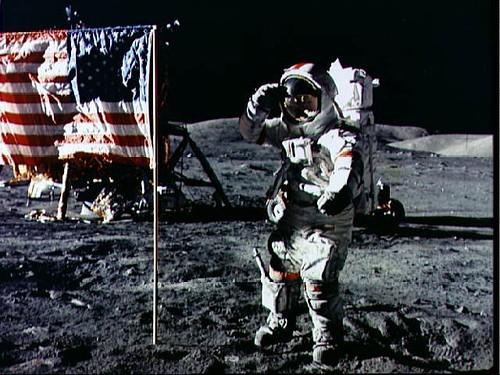
The cultural resource or heritage management is in charge of evaluating the significance of space sites and artifacts according to national and inter-national preservation laws. They examine how and why these outer space artifacts and sites of our recent history should be preserved for our future generations to view. For example, they decide on whether or not the site where Neil Armstrong landed on the Moon should be preserved so that we can see the first steps man made on the moon. 


NASA Goddard Photo and Video, Flickr.com, CC BY 2.0

People like Beth O’Leary, an associate professor of Anthropology at New Mexico State University (NMSU) and co-editor of the handbook of space engineering, archaeology, and heritage, have dedicated themselves to preserve the many artifacts on the moon. One site she had dedicated herself in watching over is the flag and the footprint of Neil Armstrong left to prove he walked on the Moon. With a grant from NASA, O’Leary helped establish the Lunar Legacy Project; which aims to preserve the historical information found at Tranquility Base. She previously stated, “We need to prepare for the future because in fifty years many travelers may go to the moon, if the site is not protected, what will be left?”

Idaho National Library, Flickr.com, CC BY 2.0
There are artifacts left behind in space other than those found on the Moon and Mars, but some of them threaten the safety of Earth. Since some of these artifacts, like low orbiting satellites and stations, currently run the risk of impacting each other and other space objects; instead of them being labeled as our cultural heritage they are considered space junk. An informed decision on the risk of letting them continue to orbit or destroying them should be made while keeping their international and historical significance in mind.

Because of the global safety dilemma there is the potential of parts of space archaeological record being destroyed and possibly forgotten. The question of which artifacts are culturally important and which are not is being asked, but how exactly are we suppose to answer. As humans living in the world today we have no idea what artifacts will have relevance and which will not in the future. Making us run the risk of leaving a missing link in our record of space exploration. For example, Wall-E from the Disney movie, feeds his curiosity by examining items he comes across in the mountains of trash left by the humans. He finds a woman’s bra and begins examining it and placing it on his head as a hat and over his eyes as a blindfold, confused about what the primary purpose of his finding was. Will we be just as confused when looking at the space artifacts we left behind in the future?

My Curiosity is on Mars!

on 07 August 2012

These images [left] may look familiar - they are the FIRST photos received from Mars Rover Curiosity after landing on Mars at 10:31 pm PDT. The photo is a screenshot of the live feed, but you can download the originals.

Since then, NASA has been receiving images and we're going to share our favorites with you.


"Curiosity's Surroundings"

NASA/JPL-Caltech


"Curiosity's Early Views of Mars"

NASA/JPL-Caltech


"Behold Mount Sharp"

NASA/JPL-Caltech


"Looking Back at Crater Rim"

NASA/JPL-Caltech


"Curiosity's Heat Shield in View"

NASA/JPL-Caltech/MSSS


"Curiosity Spotted on Parachute by Orbiter"

NASA/JPL-Caltech/Univ. of Arizona


"Curiosity Sails to Mars as Heat Shield Falls Away"

NASA/JPL-Caltech/Univ. of Arizona


What are your favorite photos? Tell us in the comments below, or share them with us on Google Plus, Twitter, Facebook, or Pinterest.

Curiosity to Land on Mars [UPDATED]

on 05 August 2012

Curiosity [NASA/JPL-Caltech]


UPDATE: 12:47 AM (CDT) 6-AUGUST-2012

AND WE HAVE A SUCCESSFUL LANDING!
The first two images from Curiosity with wheels on the ground, safe and sound.
Thank you everyone involved and CONGRATULATIONS!


As you may have heard, we're about to witness a third astronomical and historical event this year. At 12:32 am (CDT) on August 6, 2012, the NASA rover known as Curiosity will land on Mars. The fate of future exploration on the Red Planet depends on the two thousand pound car size rover's successful landing. A lot of things need to go right - and with a 14-minute delay in transmission, we won't know if the landing went well or not... but, USTREAM will be providing live coverage of the event, just like the Venus Transit. We've added the feed here so you can watch this phenomenal event. We have our fingers crossed!

The live streaming has passed. Please view the video above for the live recording.


If you live in Austin, Texas, there will be a free party at ND for all ages - plus there will be live coverage of the event. Though the landing is after midnight, Austin Planetarium will start off the Mars Landing Party with their mobile dome planetarium. The Texas Space Grant Consortium will have "Mars Bingo" and a replica of the Curiosity rover will be present. 


Transit of Venus: a tale of two expeditions

on 04 June 2012

By David Coward, University of Western Australia

On Wednesday, as you’ll no doubt know by now, a rare celestial event will occur. Venus will pass between the earth and the sun – the transit of Venus. You might also already know that this cosmic spectacle is not without cultural significance…

Venus Transit, 2004
NASA
Some 240 years ago, astronomers from England, France and Austria were sent across the globe to observe the transit. Captain James Cook was part of the English expedition.

Cook also had secret sealed orders from the British Admiralty. After the Venus transit observations were complete the expedition would go in search of the mooted southern continent, Terra Australis Incognita. En route he mapped the east coast of Australia.

But Cook’s success obscures the misfortunes of another man, the French astronomer Guillaume Le Gentil and his cursed obsession to observe the transit.

The goal of the transit voyages


The 18th century transits (1761 and 1769) of Venus inspired international teams of astronomers to travel to the far reaches of the known world, to measure the size of the solar system.

Even today, observing a transit from multiple locations across Earth improves not only the precision of the measurement, but gives better odds against bad weather and bad luck.
Captain James Cook, circa 1775.
Nathaniel Dance-Holland/Wikimedia Commons
But this venture was extremely dangerous in the 18th century, as the transits were only observable from some of the most inaccessible places at the time: South Africa, Siberia, North America, the Indian Ocean, the South Pacific and Central America.

As noted, the two 18th century transits were separated by eight years. Each observation promised to determine the size of the solar system. But the first transit in 1761 occurred during the peak of the “Seven Years' War” between England and France.

A spirit of scientific collaboration was difficult to promote during the conflict.

Cook’s voyage to the South Pacific and Australia was one of the first attempts at a major international scientific collaboration to improve estimates for the Astronomical Unit.

Although Cook and Le Gentil were funded independently by the English Royal Society and the French Academe, the data from all observations was to be combined. In reality the two expeditions were in a friendly competition to show off there scientific prowess.

While Cook’s expedition was heralded a great success, the other, led by Le Gentil, endured great disappointment.


The luck of Le Gentil


Guillaume Joseph Hyacinthe Jean-Baptiste Le Gente de la Galaisiere.
An unheralded hero?
Brocken Inaglory/Wikimedia
Le Gentil was commissioned by the French Academe to observe the 1761 transit of Venus.
After three months at sea, Le Gentil arrived at the French colony of Mauritius to secure a voyage to Pondicherry, only to find the Indian territory under siege from English warships.

Although he had papers granting safe passage, Le Gentil failed to receive permission, and the transit occurred while he was sailing back to Mauritius. This clearly made the task of precision timing impossible and the opportunity was lost.

Rather than give up, Le Gentil decided to stay in Mauritius for another five years, planing the best places to observe the next Venus transit in 1769. He also used the time to map the east coast of Madagascar.

With the war over and letters of support from the Governor of Mauritius and the French Academe, Le Gentil boarded a Spanish ship bound for Manila in May of 1766 … things were looking up.

Or so it seemed.

Fort Venus on the Island of Tahati
Drawings illustrative of Capitain Cook's First Voyage, 1768-1771, located in the British Library
Unfortunately, after all his meticulous planning and a three-month voyage, Le Gentil was accused by the Spanish Governor of being a foreign spy. He fled Manila for Pondicherry, to observe the transit from the Indian Ocean destination.

On the night before the 1769 Venus transit, the weather in Pondicherry was clear and everything was set. But, after nine years waiting for this fateful moment, the wind changed and the transit, clouded out, was unobservable.

Compared to Gentil’s nightmare, Captain Cook’s expedition went smashingly well. Assisted by fellow-astronomer Charles Green, they set up at Fort Venus in Tahiti, the main observation site.

Cook published his transit observations for the Philosophical Transactions of the Royal Society, although he only used data obtained at Fort Venus. By combining observations from four other sites in addition to the Fort Venus data, Oxford astronomer Professor Thomas Hornsby calculated a useful value for the solar-parallax of 8.78" (arcseconds).
Size comparison of terrestrial planets (left to right): Mercury, Venus, Earth, and Mars.
NASA

Le Gentil’s return to Paris


After two failed attempts at observing a Venus transit, spanning a total of 11 years, Le Gentil decided to return to France – a journey that took more than a year.

He had to contend with sickness and a hurricane damaging his ship. Le Gentil finally returned to Paris where he was greatly acclaimed for his memoirs and scientific studies spanning a decade spent at Mauritius, Madagascar, and India.

One can only wonder how deflated Le Gentil felt that a series of remarkable misfortunes prevented him observing a transit of Venus – not to mention the fame and praise heaped on Captain Cook. Le Gentil would have been painfully aware of his friendly competitor’s sucesss.

If you have the opportunity to observe the transit of Venus on Wednesday, don’t be a Le Gentil: make like Captain Cook and watch the skies for something truly remarkable.


Further reading:

Profile-photo
About the Author
My main research area is the study of exotic transient phenomena in the Universe. Of these, gamma ray bursts are my main focus. These events result from the biggest explosions in the Universe, and possibly mark the birth of a black-hole. My recent work is a collaboration with astronomers in France to understand these exotic transients, using the UWA robotic Zadko Telescope and similar instruments in France and Chile. Another research focus is observing transients simultaneously across different spectra, including gravitational waves. This involves networking optical telescopes with other types of observatories to gain new insight into the first seconds of a transient.
David Coward receives funding from the Australian Research Council.
This article was originally published at The Conversation. Read the original article.

The Annular Eclipse

on 20 May 2012

What is an eclipse? 

There are two types of eclipse. First you have the lunar eclipse which occurs when the moon passes behind the Earth and the sun's rays are completely blocked. A solar eclipse, like the one today, happens when the moon passes between the Earth and the sun. Today's eclipse was special - the last annular eclipse in America was nearly 20 years ago! Personally, this is the first one of my lifetime. We created this short video for everyone - a combination of still photos and time-lapsed video - so you can relive the moment (or live it for the first time) as many times as you desire.


Maximum Solar Eclipse - From Round Rock, Texas

Share This

Never miss an article, subscribe here!

Credits & Policies

Banner created by Melanie Magdalena.

Images courtesy of: Ricardo Liberato (Pyramids of Giza), Aurbina (Moai), Maria Reiche (Nazca), Zunkir (Gobekli Tepe), Bjorn Christian Torrissen (Chichen Itza), Gareth Wiscombe (Stonehenge).

Images were released to the public and/or licensed under Creative Commons.

Editor's Note

Welcome to BermudaQuest, a free online journal primarily about Archaeology, Ancient History, and stories about different cultures from around the world.

Founded by Melanie E Magdalena, BermudaQuest and Origins (our magazine) have over a million readers! We would love to include your insight, experience, photos, and thoughts about your culture, heritage, and travels. Make sure you check out Origins, with over 4 million readers!